FGTS for a First Property in Itajaí: 2026 Guide
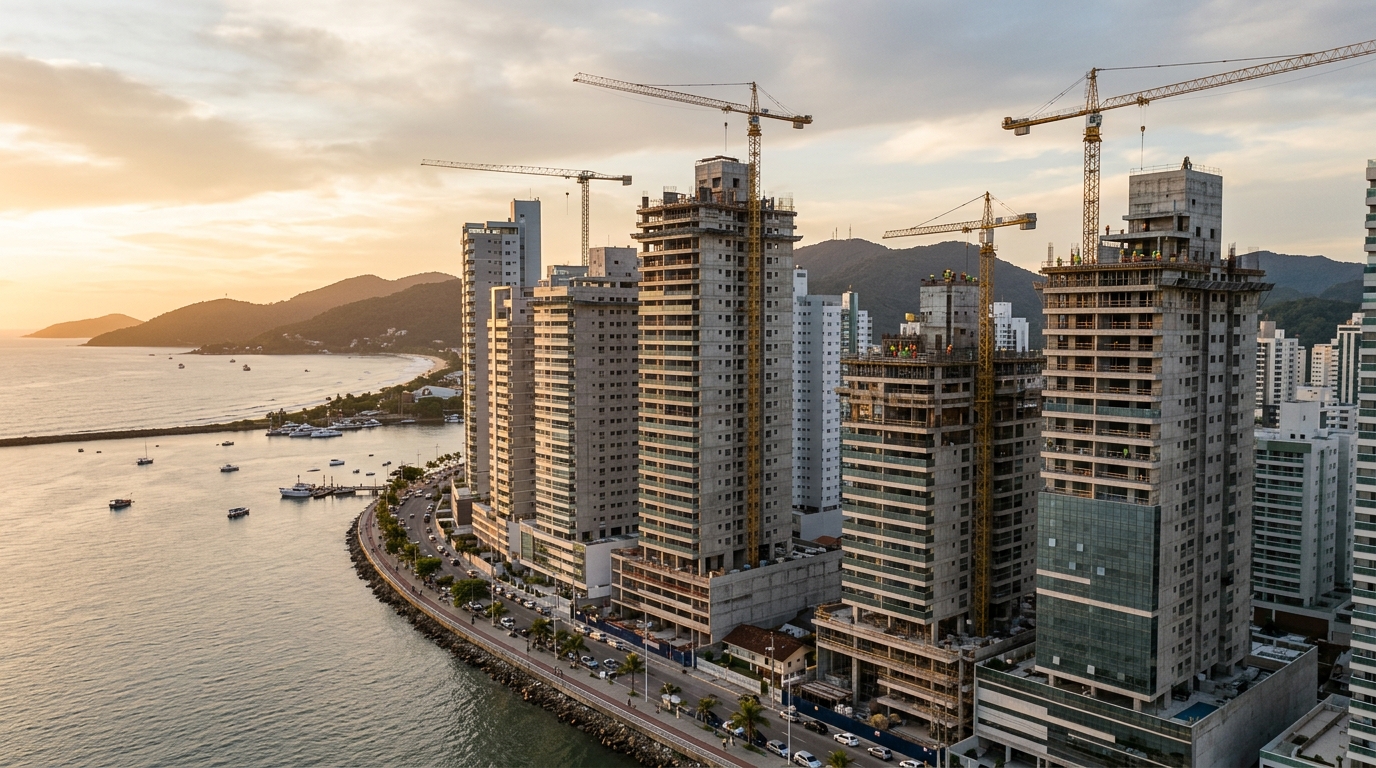
The asking price per square metre for new launches in Itajaí closed the first quarter of 2026 at R$ 12,480, according to the ABRAINC-CBIC dashboard, with a 17.3% gain accumulated over twelve months. Local real-estate inflation is running at more than double the IPCA (Brazil's official consumer price index) — and that single statistic rewrites the maths for any formal-sector worker who sees the FGTS as the only real bridge between paying rent and collecting the keys to a first home.
The FGTS — Brazil's mandatory employment-linked savings fund, funded by an 8% monthly employer contribution on top of every formal salary — remains in 2026 the cheapest and, at the same time, the most underused instrument available to first-time buyers. The average balance of a Santa Catarina worker with more than three years of formal employment sits at R$ 31,700, according to the Fund's Trustee Council. In Itajaí, where the required down payment rarely drops below 20% of the property value, that balance can be the difference between buying today and waiting through three more cycles of INCC adjustment (the INCC is Brazil's construction-cost index, used to mark up off-plan instalments while a unit is under construction).
This guide breaks down, against the current regulation and the real numbers of the market, what a worker needs to understand before signing the contract with Caixa Econômica Federal — the state bank that intermediates almost every FGTS-backed transaction — in one of the hottest stretches of the Brazilian coast.
1. FGTS in 2026: the four use cases that matter
The FGTS Trustee Council kept, for 2026, the four core hypotheses under which the balance may be used to acquire a primary residence — all of them restricted to the SFH (Housing Finance System). In practice that means an urban residential property and, in Santa Catarina, an appraisal value of up to R$ 1.5 million. Anything above that ceiling is pushed into the unrestricted SBPE channel or the Mortgage Portfolio, with no right to use Fund money and, typically, with an interest rate two to three percentage points higher.
The first use case — and the most common one for first-time buyers — is composing the down payment. The worker stacks the FGTS balance on top of personal savings to close the opening tranche and reduce the financed amount. The second is extraordinary amortisation, permitted once every two years, in which the balance is applied to the loan principal, either shortening the term or reducing the monthly instalment. The third is the partial payment of monthly instalments, capped at 80% of the instalment value, for twelve consecutive months, renewable. The fourth, and most aggressive, is full settlement of the outstanding balance, typically used in the final years of the loan.
There is also "Future FGTS", expanded by the Ministry of Cities in 2025 for Minha Casa, Minha Vida (MCMV) contracts — Brazil's flagship public housing programme. Under this format, the 8% monthly employer contribution is channelled directly to instalment payments. It is a useful structure for families in MCMV tiers 1 and 2, but it does not replace the accumulated balance as a down-payment tool.
The structural issue for Itajaí is the SFH ceiling. When it was raised to R$ 1.5 million in Santa Catarina in 2024 — bringing the state into line with São Paulo, Rio de Janeiro, Minas Gerais and the Federal District — most two and three-bedroom launches in the city remained inside the envelope where the FGTS can be used. In the high-end developments of Praia Brava and the outer Brava, with tickets starting at R$ 1.8 million, the Fund loses utility and the equation migrates to the unrestricted SBPE.
2. The eligibility filter: who can actually withdraw
The current regulation requires the holder to have accumulated at least 36 months of FGTS contributions across all formal employment links — a period that does not have to be continuous nor with the same employer. That is the filter that disqualifies the largest share of young buyers in Itajaí, where the average tenure on a formal contract in construction and retail sits at 22 months, according to RAIS 2025 (Brazil's annual social-information register).
A second block sits on top of that rule: the worker cannot hold title to another urban residential property, completed or under construction, in the municipality of Itajaí or in any city of the metropolitan region. The legal concept is the "municipality of residence or principal place of work". Someone living in Itajaí who owns a house with land in Navegantes — the neighbouring city across the river — typically gets caught by this filter, and usually discovers it too late.
The third filter is the most ignored: there cannot be any active SFH financing anywhere in Brazil in the holder's name. A residential mortgage in any city, under SBPE, MCMV or the Caixa portfolio, vetoes the use of FGTS in a new purchase — even if the existing property is in another state.
Documentation required by Caixa in 2026 has been streamlined relative to the previous cycle but still includes: an analytical FGTS statement covering the last five years, evidence of current employment, a negative property record from local registries, and a sworn declaration of no active SFH financing. Access to the analytical statement is now fully handled through the FGTS mobile app, eliminating the need for a branch visit — a meaningful time saving for anyone about to close a deal.
A frequently underestimated procedural detail: balance locked under "birthday withdrawal" (saque-aniversário) cannot be used to buy a property while that modality is active. A worker who opted into birthday withdrawal must revert to the standard severance-withdrawal modality and complete the regulatory waiting period before deploying the balance — a timing mismatch that routinely breaks purchase schedules planned for 2026.
3. The line-by-line maths: a real simulation on a R$ 600k property in Itajaí
To pull the FGTS conversation out of the abstract, consider the following case, calibrated for the reality of a two-bedroom apartment in neighbourhoods like Cordeiros or São Vicente at current market levels. The buyer has R$ 120,000 of personal capital for the down payment, R$ 80,000 of FGTS balance, gross household income of R$ 18,000 a month, and is pursuing Caixa financing under SBPE.
| Variable | Without FGTS | FGTS on down payment | FGTS on biennial amortisation |
|---|---|---|---|
| Property value | R$ 600,000 | R$ 600,000 | R$ 600,000 |
| Total down payment | R$ 120,000 | R$ 120,000 + R$ 80,000 FGTS | R$ 120,000 |
| Amount financed | R$ 480,000 | R$ 400,000 | R$ 480,000 |
| Initial term | 360 months | 360 months | 360 months |
| SFH rate, 2026 | TR + 10.49% p.a. | TR + 10.49% p.a. | TR + 10.49% p.a. |
| Opening instalment (SAC) | R$ 5,530 | R$ 4,610 | R$ 5,530 |
| Interest paid over the loan | R$ 514k | R$ 428k | R$ 392k* |
| Effective final term | 360 months | 360 months | ~282 months |
*Assuming an R$ 80k FGTS injection in month 24 and further injections every 24 months thereafter, with an additional average balance of R$ 18k per biennium accumulated through continued formal employment.
The numbers make explicit a point that buyers routinely get backwards: for a worker whose income is still on a growth curve and who needs comfort in monthly cash flow, channelling the FGTS into the down payment is the right call. Cutting R$ 920 from the first instalment frees cash for an emergency reserve, furniture, or accelerating an inflation-indexed investment portfolio. For a buyer whose cash flow is already stable and whose objective is minimising the total cost of credit, the biennial amortisation strategy delivers R$ 122,000 less in interest across the life of the loan and brings full payoff forward by more than six years.
The most expensive mistake is the middle path: deploying part of the balance on the down payment and trying to scatter the rest into amortisations outside the biennial window. Because the 24-month rule between extraordinary amortisations is strict, the worker ends up leaving balance idle in the Fund, earning TR plus 3% p.a. — in 2026, somewhere near 4.2% p.a., less than half the cost of mortgage credit. Idle balance in the FGTS is, in practice, money quietly losing purchasing power against the INCC.
"The FGTS earns less than any mortgage line in Brazil charges. Keeping balance in the Fund only makes sense if it is being used — on the down payment, on amortisation, on the instalment, or on full settlement. Anything beyond that is a silent income transfer from the worker to the system." — Technical assessment echoed across multiple sector reports on the allocative efficiency of the Fund.
A layer that few buyers fold into the calculation is the TR effect. The TR (Taxa Referencial) is the floating reference rate that the SFH adds on top of the nominal interest. After almost eight years pinned near zero, in 2025 it returned to oscillating between 0.15% and 0.25% per month, depending on the monthly composition published by the Central Bank. Because it is part of the SFH formula, two contracts with the same headline rate can carry materially different total costs. Over a 360-month simulation, an average TR running 0.1 percentage point above projection can add R$ 28,000 in interest to the contract — more than the entire FGTS balance held by many buyers.
4. The Itajaí map: ticket by neighbourhood and the envelope that fits FGTS
Itajaí is a city segmented into clearly differentiated price tiers, and the viability of using FGTS varies sharply across neighbourhoods. The figures below are weighted averages of launch and resale tickets in the first four months of 2026, drawn from regional market dashboards.
Cordeiros. A residential neighbourhood in strong expansion, with an average ticket between R$ 5,800 and R$ 7,500 per square metre. New two-bedroom apartments price between R$ 420,000 and R$ 580,000. This is the natural territory of MCMV tier 4 and SBPE with full FGTS deployment — the R$ 1.5 million ceiling is comfortably above any unit, and the average worker balance covers between 12% and 18% of the down payment. For a first-time buyer, this is the area with the best balance between entry ticket and appreciation potential.
São Vicente. A consolidated neighbourhood, close to the city centre and the BR-101 federal highway, with a ticket between R$ 7,200 and R$ 9,800 per square metre. Two-bedroom units price between R$ 480,000 and R$ 720,000. FGTS remains viable across the entire range, but the required down payment grows and the worker needs a more robust balance to leverage efficiently. Versus Cordeiros: stronger resale liquidity and proximity to commercial hubs.
Fazenda. The commercial and administrative core, with a ticket between R$ 9,500 and R$ 13,000 per square metre. Launches typically arrive as two and three-bedroom units priced between R$ 680,000 and R$ 1.2 million. FGTS still fits within the SFH envelope, but the worker has to assess whether the instalment fits the 30% gross income ceiling — Caixa's structural rule for credit approval. For many families, this is precisely the band where required income drifts apart from real income.
Cabeçudas and the central waterfront. Ticket between R$ 12,000 and R$ 18,000 per square metre. New launches start at R$ 950,000 and, in much of the inventory, cross the SFH ceiling. Here the FGTS loses traction: any property above R$ 1.5 million requires the unrestricted SBPE or the Mortgage Portfolio, with higher rates and no right to use the Fund. This is where alternative structures — a consortium with an FGTS-funded bid, a property swap, or financing split across two registered titles — start to make more economic sense than vanilla SFH.
The split between MCMV and SBPE also changes the game. In 2026, MCMV operates with five income tiers, and tier 4 (household income up to R$ 12,000) absorbs most first-time buyers in Cordeiros and São Vicente. The MCMV tier 4 rate sits at 8.16% p.a. + TR — cheaper than the Caixa SBPE rate, currently 10.49% p.a. + TR for current-account holders with a relationship. FGTS can be deployed in either, but the income-commitment rule is looser in MCMV, which translates into a higher financing ceiling for the same declared salary.
For off-plan units, the sensitive point is the INCC. While a unit has not yet received its occupancy certificate, instalments paid to the developer are adjusted by the INCC — which ran at 6.8% accumulated over the twelve months to April 2026, according to FGV, ahead of the IPCA and the regional CUB-SC construction-cost benchmark. FGTS cannot be used during this pre-keys phase, except under very specific MCMV conditions. The balance only enters the operation at the moment the mortgage with Caixa is signed, which coincides with handover. Unprepared buyers often plan to use FGTS to pay instalments during construction — and discover, late, that the balance stays untouched while the developer debt grows along the INCC curve.
In the resale market, the most decisive filter is Caixa's appraisal. The bank uses its own surveyor and not infrequently appraises the property between 8% and 15% below the seller's asking price. Because FGTS covers only up to the appraised value, not the contracted price, the buyer needs personal capital for the gap — a hole of R$ 30,000 to R$ 50,000 on a R$ 500,000 property that routinely blocks the deal at the finish line. Negotiating a contractual clause that ties closing to the Caixa appraisal, with refund of the deposit in case of mismatch, has become standard practice among experienced brokers in the city.
5. Five mistakes that block FGTS use in Itajaí
Atypical balance movement in the months leading up to the analysis. Caixa cross-checks the FGTS balance against withdrawal and contribution history. Recent severance-related withdrawals with no declared reason, or contributions well above the registered salary, trigger compliance alerts and can suspend the review for 30 to 60 days. In a city with 22% turnover in construction and at the port complex, this happens more often than it looks — and a single suspension is enough to lose the unit to another bidder.
Buying a property over the SFH ceiling without realising. Buyers look at the advertised price and forget to add ITBI (the municipal property-transfer tax), registration fees, the appraisal fee, and — in resale — possible mandatory renovations for Caixa approval. Properties advertised at R$ 1.48 million frequently cross the SFH ceiling once all costs are folded in, and the worker loses FGTS access mid-process. The rule should be read with margin: properties up to R$ 1.38 million sit in the comfortable zone; above that, specific due diligence is required.
Ignoring the INCC curve on off-plan units. Buying off-plan in Itajaí typically makes sense for the long instalment schedule of the down payment, but the INCC has risen faster than the Selic (Brazil's policy interest rate) over the last 18 months. Without reserving cash for the adjustment, the buyer arrives at handover with a larger outstanding balance than projected — and the FGTS, which was supposed to enter as a full down payment, ends up only partially covering the accumulated gap.
Comparing offers by nominal interest alone. Now that the TR carries weight again as of 2025, two contracts with the same advertised rate can carry meaningfully different effective costs. Comparing only the nominal interest without examining the TR composition rule is a structural mistake that compounds badly over the long run. The right spreadsheet compares CET (Custo Efetivo Total — total effective cost) across simulated TR scenarios at three levels: base, moderate rise, aggressive rise.
Treating the FGTS as an emergency reserve. A worker who hoards balance in the Fund "for the right moment" loses purchasing power against the INCC year after year. The return analysis is direct: if the worker has stable income, financing capacity and meets the legal filters, the best date to deploy the FGTS is today. Postponing means transferring income to the system — the Fund pays TR plus 3% p.a., mortgage credit charges TR plus 10%, and the property appreciates, in Itajaí, at INCC plus the location premium.
6. When the FGTS truly is not worth using
Even though it is, in most cases, the most efficient tool for a first home, there are specific scenarios in which deploying the FGTS is suboptimal — and a rational buyer needs to recognise them before filing the request with Caixa.
The first is when the available balance is small relative to the property value — below 5% of the total. In those cases, the worker burns political capital with the Caixa review, adds documentation, slows the process, and the cash-flow impact is negligible. It is more efficient to leave the balance untouched and use it years later as extraordinary amortisation, once the accumulated amount has grown enough to meaningfully bend the debt curve.
The second scenario is the worker about to relocate to another country for professional reasons. Because one of the legal hypotheses for full FGTS withdrawal is professional transfer abroad, withdrawing and investing the proceeds in assets returning above TR plus 3% can be more efficient than locking the balance into a property whose liquidity will be difficult to manage from the destination. The window is narrow, but it exists.
The third is the buyer who sees the property as an investment, not as a primary residence. The FGTS can only be deployed for an urban residential property in the holder's municipality of residence or principal work — it cannot fund the purchase of a rental apartment in another city. For the pure investor, the balance remains unavailable for that purpose, and the alternative is full SBPE financing with personal capital on the down payment.
Finally, the most frequently asked local rule: owning a property in another city — Florianópolis, Curitiba, Porto Alegre — does not block the use of FGTS to buy in Itajaí, provided the worker can prove residence or principal employment in Itajaí itself. Owning any residential property in Navegantes, Balneário Camboriú or in Itajaí itself, by contrast, vetoes the operation. This is the most sensitive filter for anyone who relocated to the region for the port logistics hub and still holds real estate in their state of origin.
Conclusion
The FGTS, in 2026, remains the most underused and at the same time the most efficient instrument for unlocking a first home in Itajaí. It is not a lottery: it is a ruleset with stable parameters, clearly defined modalities, and a financial cost so low that any comparison with market products exposes its superiority. What separates the successful buyer from the frustrated one is not luck — it is documented planning six months before the signature, mastery of the SFH rulebook, and an honest calibration between down payment and amortisation tuned to the buyer's own cash flow.
In a city watching the INCC climb at twice the pace of the IPCA, with new-launch inventory competing for square metres against the growth of the port, waiting is expensive. To follow the weekly read of the Itajaí market — neighbourhoods on the appreciation curve, financing cycles that open real windows, and new developments such as those from SIDE Empreendimentos, still inside the SFH envelope — it pays to subscribe to the portal's curation and assemble the personal purchase dossier before the next price curve closes the door.