São João (Itajaí) Off-Plan Launches: 2026 Investor Guide
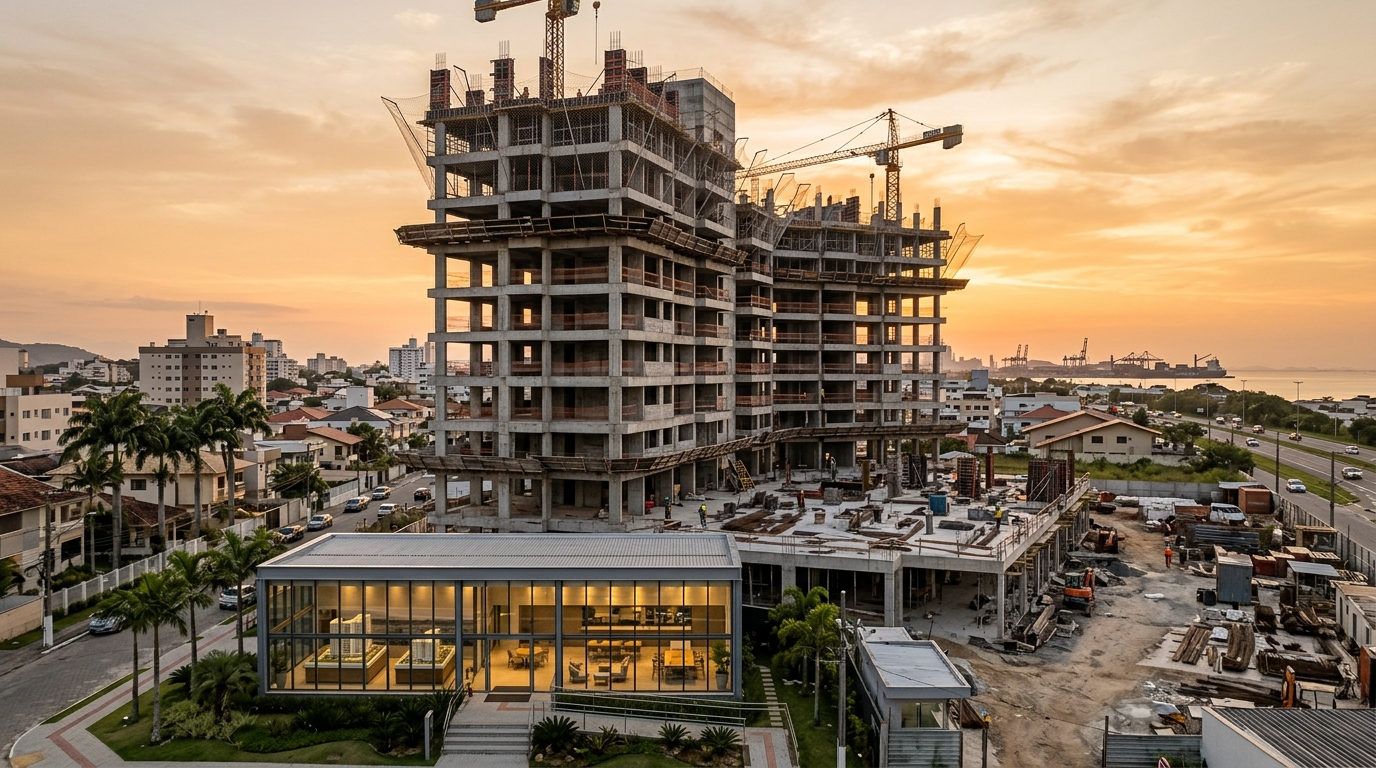
In February 2026, the São João district of Itajaí, on Brazil's Santa Catarina coast, had at least eleven residential projects in the soft-launch, pre-launch or simultaneous-launch phase — a concentration the neighborhood had not seen since the 2018 cycle. Asking prices in the sales material range from R$ 685,000 (roughly USD 115,000 at current rates) for compact two-bedroom units up to over R$ 1.28 million for upper-mid-tier apartments. Over the same window, Brazil's 12-month IPCA consumer inflation was running near 4.8%, the INCC-M construction-cost index near 6.9%, and the Selic — the country's base interest rate, set by the central bank — was holding at a deeply contractionary 14.75% a year. The message Itajaí is sending to investors with tickets between R$ 600,000 and R$ 1.5 million is, therefore, counter-intuitive: buying off-plan in a neighborhood that sits outside the tourist hype, with handover scheduled for 2028–2029, can still be the best risk-adjusted return available on the Santa Catarina coast.
This piece is the first of a dedicated analysis on new residential launches in the São João district of Itajaí. The framing is deliberate: we are not covering Praia Brava, Fazenda or Cordeiros — neighboring areas whose price movement has, to a large extent, already been priced in. We are looking at São João as it actually is in 2026: a transitional neighborhood between Itajaí's urban core and the BR-101 federal highway, with mature infrastructure, a heterogeneous buyer profile, and a pipeline of construction value (VGV — the total sales value of a project, a standard Brazilian metric) inconsistent with the still-conservative reading the wider market has of the area.
Why São João became the launch axis of 2026
São João has historically been a working middle-class neighborhood of Itajaí, with strong residential density and street-level commerce. What changed in the 2024–2026 cycle was the simultaneous arrival of three drivers. The first is logistical: São João sits less than 4 km from the Port of Itajaí and has direct access to the BR-101, just as the port complex broke the 1.5 million annual TEU mark in 2025 across Itajaí and neighboring Navegantes. The second is demographic: the municipality crossed 244,000 residents in IBGE's 2025 estimate (IBGE is Brazil's national statistics agency), growing roughly 2.1% a year on the back of port logistics, naval industry and services workers. The third is relative pricing: while average price per square meter in Praia Brava topped R$ 22,000 in 2025 according to the FipeZap index for high-end coastal properties, São João was still transacting in the R$ 7,500–R$ 10,500 per m² range for new medium-grade units.
That gap is not trivial. It means an investor willing to pay R$ 1.2 million for 55 m² in Praia Brava can buy, in São João, a 70 m² apartment with two en-suite bedrooms, a parking space and full amenities for somewhere between R$ 760,000 and R$ 890,000. The question is whether that gap reflects an exploitable asymmetry or a fair structural discount — and the answer requires looking at fundamentals, not narrative.
From an urban standpoint, São João is anchored by the Koch supermarket on Avenida Marcos Konder Sobrinho, surrounded by public and private schools, three healthcare units, and quick connections both to the historic city center (about 10 minutes off-peak) and to the Marginal Leste arterial. In 2025, Itajaí's partial revision of its master plan, ratified by the city council, kept mid-height building limits intact in the district, which constrains future supply without strangling it — typically a constructive setup for real appreciation. Compared to Cordeiros, São João has more mature retail; compared to Fazenda, it sits closer to the center; compared to Praia Brava, it is radically cheaper. It is this intermediate position that explains the surge in launch VGV announced by local developers over the past twelve months.
The buyer profile has also shifted. Surveys by Secovi-SC, the regional real estate industry association, and consolidated data from ABRAINC indicate that around 38% of buyers of new units in Itajaí in 2025 declared investment intent — rental or resale — versus 27% in 2022. In São João specifically, the share is even higher in the studio and compact two-bedroom segments. The traditional end-user — the local middle-class resident who historically bought off-plan to upgrade neighborhoods — now shares the market with investors from Curitiba, São Paulo and even Buenos Aires, who see São João as a more predictable real-estate allocation vehicle than Praia Brava.
Map of active launches: typologies, prices, timelines
Tracking commercial material as of February 2026, cross-checked with six local developers, makes it possible to draw a reasonably precise map of what is being offered. Three typologies dominate: studios and compact one-bedroom units of 28 to 38 m² of private area; two-bedroom apartments with two en-suites at 60 to 72 m²; and upper-mid-range three-bedroom units with a master suite, between 90 and 120 m². True luxury — four-plus bedrooms and floor plans above 140 m² — remains an exception in the district and is likely to stay so, given height limits and lot characteristics.
It is important to separate commercial labels from legal stage. When a developer advertises "soft launch", the incorporation registration may not yet be entered on the land title, and the disclosed price is indicative only. "Pre-launch" usually coincides with registration under Brazilian Law 4.591/1964 and opens a commercial waiting period, but the technical descriptive memorandum is already available. The full "launch" stage is when the price sheet is frozen for broad sale, mortgage financing kicks in, and the construction schedule becomes auditable contractual document. For an investor, that distinction determines how much of a discount it makes sense to demand.
| Typology | Private area | Price range (Feb 2026) | Implicit price per m² | Expected handover |
|---|---|---|---|---|
| Studio / 1-bedroom | 28 to 38 m² | R$ 320,000 to R$ 445,000 | R$ 11,400 to R$ 11,700 | H2 2028 |
| 2-suite compact | 60 to 65 m² | R$ 685,000 to R$ 790,000 | R$ 11,400 to R$ 12,100 | H1 2029 |
| 2-suite extended | 66 to 72 m² | R$ 790,000 to R$ 905,000 | R$ 11,900 to R$ 12,500 | H2 2028 |
| 3-bedroom upper-mid | 92 to 118 m² | R$ 1.02M to R$ 1.28M | R$ 10,800 to R$ 11,000 | H2 2029 |
Two points jump out of the table. First, the implicit price per m² is surprisingly uniform in the smaller typologies — between R$ 11,000 and R$ 12,500 — and drops a touch in the upper-mid-range, a classic sign that the average absolute ticket is being sized by the SFH financing ceiling rather than by intrinsic quality. When the per-m² price of the upper-mid unit is cheaper than the per-m² of a two-suite compact, there is value to capture for buyers with the capacity to carry larger payments through the build phase. Second, virtually the entire handover schedule clusters between H2 2028 and the end of 2029, which creates a well-defined window for liquidity events three to four years out.
As for developers active in the neighborhood, most are regional groups out of Itajaí, Balneário Camboriú and Joinville, with individual VGV per tower averaging between R$ 60 million and R$ 180 million. That fragmentation is at once an opportunity — competition for buyers tends to compress margins — and a risk, because mid-sized developers have thinner balance sheets to absorb cost shocks. The CUB-SC, the regional construction cost index published by Sinduscon, rose 7.3% in 2025, much of which is being passed through to buyers via INCC-indexed contracts.
Off-plan versus ready: what the numbers say, not the brochure
Choosing between an off-plan launch in São João and a finished unit in nearby districts requires arithmetic many investors avoid doing seriously. Let's do it with a concrete case. Consider a two-suite apartment, 65 m² of private area, listed at R$ 780,000 in February 2026, with handover scheduled for June 2029. A typical payment structure offered by the developer looks like this: 20% down, spread over 24 monthly installments; 15% in semi-annual balloon payments through to the keys; 10% in annual balloon payments through to the keys; and the remaining 55% via mortgage financing at the moment the building receives its occupancy permit.
In nominal terms, that means a down payment of R$ 156,000 split into 24 installments of R$ 6,500. Those R$ 6,500 are not fixed, however: they are adjusted monthly by the INCC-M index until handover. Assuming a conservative INCC-M projection averaging 6% a year through 2029, an installment of R$ 6,500 set in February 2026 will be paid as roughly R$ 7,900 in June 2029. The total amount paid to the developer, summing all adjusted installments, tends to land near R$ 880,000 in handover-date currency — and that's before the financing of the remaining 55%, which still carries SFH-system interest on the order of TR (Brazil's reference rate) plus 9.5% to 11% a year in 2026 market packages.
The IRR calculation requires comparing this flow with the alternative scenario: buying a finished unit today with a 70% SFH mortgage. For an equivalent ready unit, 65 m² in a nearby district of similar grade, market prices in February 2026 are already around R$ 880,000 to R$ 920,000 — precisely what the off-plan unit will cost at handover. This is the point brochures never spell out: the off-plan "discount" relative to the ready unit dissolves into INCC adjustments. For the deal to work as an investment, the gain has to come from somewhere else.
That somewhere else is usually a combination of three effects. First, the resale premium during construction, historically running between 12% and 22% in neighborhoods with São João's fundamentals, per Secovi-SC. Second, implicit leverage: by paying out only 35% before the keys, the investor exposes capital to 100% of the appreciation of the asset — which, on IRR-over-invested-capital basis, can translate to nominal annual returns of 12% to 18% in the base scenario. Third, the option to resell before handover, completely avoiding the mortgage financing and the friction cost of competing with developer inventory in the resale market.
There is, however, an opportunity cost that can never be ignored when the Selic is at 14.75% a year. Capital placed in Tesouro Selic government bonds or top-tier CDB bank certificates yields, net of income tax, somewhere near 12% to 12.5% a year — risk-free, liquid. That means every real locked up in construction installments needs, at the very least, to clear that benchmark to justify the illiquidity. The projected IRR on an off-plan unit only makes sense if it is materially higher — at least 4 to 6 percentage points above — to compensate for construction risk, exit risk and illiquidity.
Risk and how to measure it: what's in the contract, what isn't
The risk of an off-plan investment is not abstract. It has a name, a number and a legal address. In descending order of probability, four material risks matter: construction delays, unfavorable contract termination, illiquidity on off-plan resale, and developer financial fragility.
Delay is the most frequent and most underestimated risk. Brazil's Law 13.786/2018, known as the Distrato Law, allows a contractual tolerance of up to 180 days beyond the planned handover date without the developer being in default. That means a contract with handover set for June 2029 only constitutes a legally relevant delay after December 2029. For an investor, this pushes the liquidity timeline by up to six months with no right to compensation. Delays beyond 180 days do allow the buyer to rescind with 100% of payments returned, indexed for inflation and with contractual penalty. But the refund is never immediate — it typically takes between 60 and 180 days after the decision.
Buyer-initiated termination, in turn, was profoundly reshaped by Law 13.786/2018. In projects covered by patrimônio de afetação — a ring-fencing regime instituted by Law 10.931/2004 that legally separates the project's assets from the rest of the developer's balance sheet — a buyer who walks away can lose up to 50% of payments made. Without that regime, the cap is 25%. This is why the presence of patrimônio de afetação on the title is simultaneously a protection against developer risk and a high exit cost for the buyer. The investor needs to read the deed, not the brochure.
"Patrimônio de afetação is, for the buyer, simultaneously the best seatbelt against developer bankruptcy and the worst exit lock when the buyer themselves needs to walk away. Anyone buying off-plan without grasping that duality is, in effect, selling optionality they do not understand."
Due diligence on the developer therefore starts before the choice of unit. Four indicators are non-negotiable. First, an incorporation registration entered on the land title under Article 32 of Law 4.591/1964, with the technical memorandum and NBR 12.721 area tables (the Brazilian standard governing how built area is measured and reported) accessible to the buyer. Second, the patrimônio de afetação regime registered on the title, ring-fencing the construction project from the rest of the developer's liabilities. Third, a verifiable five-year track record of on-time delivery — systematic delays of more than 12 months on prior projects are a red flag. Fourth, consistent financials, with net debt to equity below 1.5x and positive operating cash flow over the last two fiscal years, when the developer is publicly listed or discloses voluntarily.
Off-plan resale illiquidity is less discussed because the industry prefers not to mention it. Selling an off-plan purchase contract requires the developer's consent, and in projects with strong demand that consent typically comes with a transfer fee of 0.5% to 2% of contract value. In weak-demand projects, consent flows more easily, but the secondary market is flooded with supply and the premium evaporates. Timing matters as much as choosing the right unit.
Strategies by profile: four ways to win
There is no single strategy for off-plan launches. What exists is a correspondence between capital profile, return horizon and investment vehicle. In São João, in 2026, four profiles make economic sense.
The first is the quick-exit investor, who buys at launch and sells the contract for a premium up to 24 months before handover. The premise is that the launch per-m² price embeds an 18%-to-25% discount versus the price target at handover, part of which materializes early as the build progresses and perceived risk drops. This investor operates with own capital for the first 24 months of the project, avoids mortgage financing, and benchmarks success against an annualized IRR above 18%. The biggest risk is competition from other off-plan resellers and the wait time for developer consent.
The second profile is the recurring-income generator via studios for medium-stay rentals. In Itajaí, medium-stay — leases of 3 to 6 months — is fueled by port executives, vessel maintenance technicians and oil-and-gas professionals on rotation. Studios of around 30 m² in São João rented for R$ 2,300 to R$ 2,800 a month in 2025–2026, condominium fee included in the pass-through. For an investor with a R$ 380,000 ticket who finances 40% via the SFH mortgage system, this works out to a net yield close to 5.2% a year on equity, plus appreciation. The advantage is predictable cash flow; the downside is management overhead and exposure to the port cycle.
The third profile is the end-user who locks in launch pricing for future personal use. Here the logic is not speculative: the buyer wants to live in or have the unit available in 2029 and captures the differential between launch price and the projected price of the equivalent finished unit at handover. Risk is low because exit is not in the plan; INCC is absorbed as a necessary cost; and SFH financing is planned with margin. For this profile, the decisive criterion is not IRR — it is developer quality, the specific micro-location within the district and the floor plan, since the asset is first and foremost a home.
The fourth profile is the foreign buyer, whose share has grown over the last two years. Brazil's central bank, through the registered foreign capital regime, allows non-residents to acquire real estate via registration of the capital inflow — a relatively simple process executed through a local bank. More importantly: since 2017, with CMN Resolution 4.676 and its updates, a foreign national with Brazilian tax residency or a documented Brazilian employment contract can access SFH financing — the country's main mortgage system, with favorable rates — on the same terms as a Brazilian resident. For Argentines, Uruguayans and Portuguese nationals eyeing Itajaí as a gateway into the Brazilian market, a São João launch offers a ticket compatible with the current SFH financing ceiling of R$ 1.5 million.
The six mistakes that destroy the investment thesis
Behavioral research on Brazil's real estate market converges around recurring mistakes that show up worryingly often even among experienced investors. Six of them are particularly costly in São João launches.
The first is comparing per-m² prices without normalizing for real usable area. Some commercial materials quote price over private area, others over equivalent area, others still over total area. The NBR 12.721 standard codifies these definitions, but the area schedule attached to the incorporation memorandum is rarely read by the buyer. The result: false comparisons between projects that look similar but distort per-m² by up to 15%.
The second is ignoring INCC in the IRR calculation. An IRR computed on the nominal launch price, without indexing installments, systematically overstates returns by 1.5 to 2.5 percentage points a year in environments of elevated sectoral inflation like the current one.
The third is dismissing the absence of patrimônio de afetação as a non-material risk. Projects without the regime are cheaper because a premium is embedded. That premium is only worth it if the developer is of unquestionable quality — a rare case. For most projects, the 2% to 4% saving in price does not compensate for the legal fragility.
The fourth is underestimating the off-plan exit cost. Developer transfer fees, proportional transfer tax (ITBI) on the premium, income tax on capital gains and time on market can consume 7% to 12% of sale value. Real net IRR is systematically lower than the gross IRR shown in marketing material.
The fifth mistake is sizing the position without a liquidity reserve. Semi-annual balloon payments, annual balloons and the handover balloon are concentrated cash events, in amounts that grow with INCC. An investor who allocates all available capital into the early installments without a reserve discovers, mid-project, that they have to sell in worse conditions than planned.
The sixth, and most subtle, is buying with neighborhood confirmation bias. Legitimate enthusiasm for São João can lead an investor to overweight the base scenario and mentally discount stressed scenarios. The discipline of modeling three scenarios — base, optimistic, pessimistic — with plausible IRR in each is what separates investors from fans.
Conclusion: the right neighborhood at the right time requires the right reading
São João, in Itajaí, offers in 2026 a relatively rare combination: solid urban fundamentals, an entry ticket compatible with the R$ 600,000 to R$ 1.5 million investor, and a pipeline of construction VGV that opens concrete exit windows three to four years out. There is, however, no free lunch. The trade only makes sense if the investor is able to model an INCC-indexed cash flow, compare it against the opportunity cost of a 14.75% Selic, read the incorporation memorandum in light of NBR 12.721, demand patrimônio de afetação, and calibrate strategy to their own profile — quick exit, recurring income, end use, or foreign buyer via SFH.
The launch cycle now opening in São João is likely to close by the end of 2029, and what comes after will be the reading of a different neighborhood — more mature, more expensive, with less room for arbitrage. The moment for rigorous analysis is now. For readers who want to track this window closely, with weekly readings of numbers, contracts and real construction schedules, the editorial coverage at SIDE Empreendimentos will keep monitoring, project by project, what changes in the math — and what continues to hold.