Is Penha (SC) Worth Investing In for 2026?
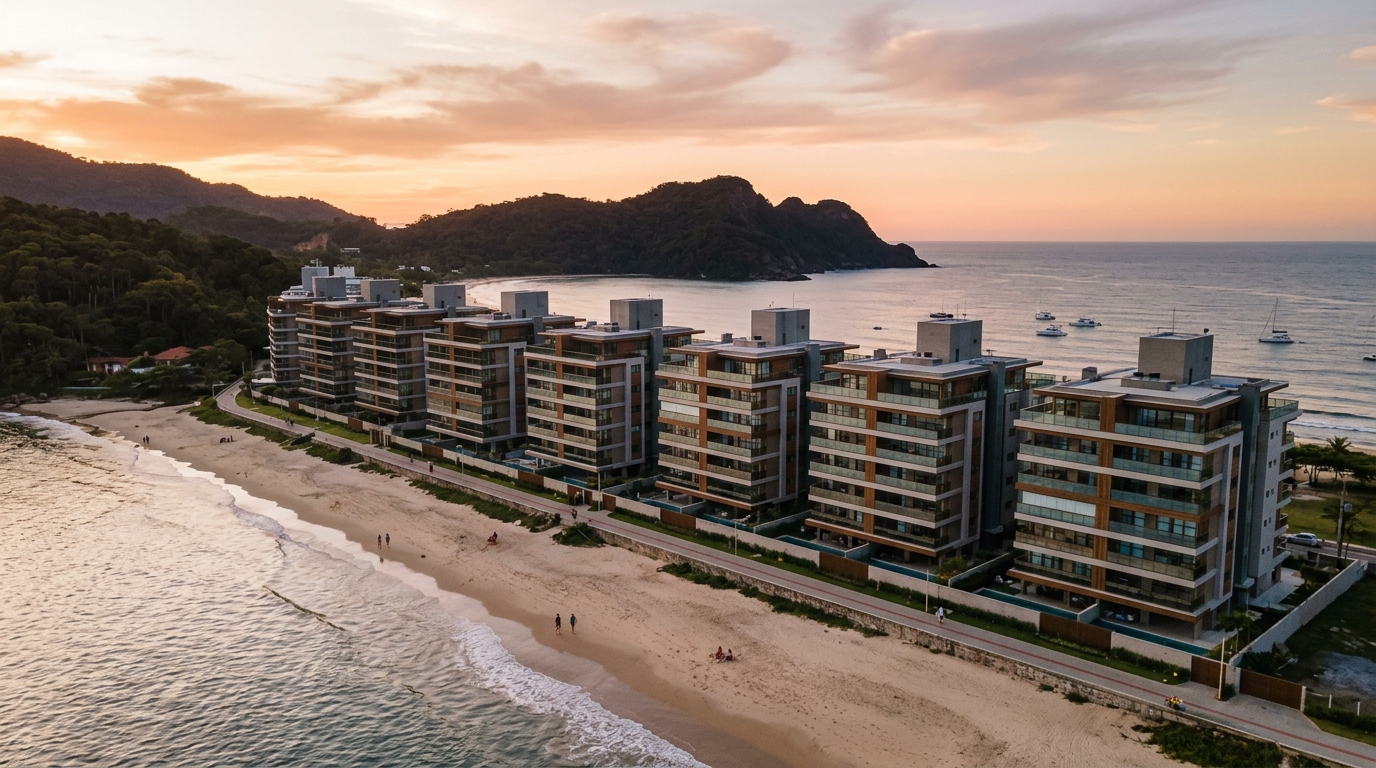
The Penha-Piçarras-Barra Velha real-estate corridor on Brazil's Santa Catarina coast posted BRL 1.96 billion (roughly USD 350 million) in gross sales value during 2025, a 38.3% jump over 2024, according to figures compiled by Secovi-SC and cross-checked with project launches registered by ABRAINC, the national developers' association. The headline matters because 2025 was the year Brazil's Selic — the central bank's policy rate, broadly equivalent to the Fed funds rate — ended at 14.75%, and the CDI, the interbank benchmark that anchors local fixed income, was paying conservative investors more than 1% per month gross. That coastal property still drew capital while competing against the most generous local risk-free rate of the decade is, in itself, an analytical signal worth unpacking. The question a patrimonial investor needs to answer before signing any purchase contract in 2026 is whether this flow is a late-cycle wave of buyers who missed Balneário Camboriú looking for "the next BC," or whether Penha has its own fundamentals that justify the price.
This piece is not developer marketing. It is an analysis for the reader who already watches Balneário Camboriú, Itapema and Itajaí — the three established towers-and-beach markets on the same coast — and wants to understand, with numbers, whether allocating capital to Penha makes sense right now, or whether the cycle has already extracted its premium.
Penha by the 2026 numbers: why this corridor became a capital target
Penha has 33,000 permanent residents and absorbs a floating peak-season population estimated between 250,000 and 300,000, according to data consolidated by Santur, the Santa Catarina state tourism agency, and the municipal government. Beto Carrero World — Latin America's largest theme park — operates 320 days a year and pulled in 1.9 million visitors in 2025 at an average ticket above BRL 380 (about USD 68). That visitor flow creates lodging demand that is structurally less seasonal than purely summer-driven coastal markets: average occupancy of guesthouses and serviced flats in the Armação neighborhood, the central waterfront, ran at 64% across the full year, against the 41% typical of equivalent beaches further south in Rio Grande do Sul.
Layer onto that the expansion of the Port of Itapoá, 80 km up the coast, which moved 1.7 million TEUs in 2025 and directly hired roughly 1,200 new qualified positions in logistics, customs and operations. The spillover effect on dormitory cities and executive second homes has been measured by Sinduscon Norte-SC, the regional construction industry union: demand for residential units between 80 and 130 m² across the Itajaí-Penha-Itapoá axis rose 22% in two years.
In parallel, the gradual Selic cut path expected through the second half of 2026 — the Focus survey, which aggregates economists' forecasts for the central bank, projected the year ending at 12.25% — is beginning to thaw the SBPE mortgage system, which had been credit-constrained through 2024 and 2025. Savings deposits, the main funding source for that mortgage pool, returned to positive net inflows in four of the first five months of the year, according to Abecip, the mortgage lenders' association. For the investor, this carries a concrete reading: the tightening cycle is near its end, but price has already moved. Anyone who bought off-plan in Penha in 2023 at BRL 9,800 per square meter in front of Armação beach now sees equivalent units listed at BRL 13,500.
The 2026 local picture combines three variables that rarely appear together: tourism demand that is robust and weather-antifragile (because Beto Carrero is not sun-dependent), a real logistics vector (Itapoá and the duplicated BR-101 federal highway), and an installed supply that is still fragmented — Penha does not yet have the tower concentration of Itapema or Praia Brava. That fragmentation creates both the window and, as we will detail below, the risk.
Nominal vs. real appreciation: stripping out INCC, IPCA and the sticker-price illusion
The most expensive mistake for a first-time coastal investor is to confuse nominal price movement with real return. When a developer advertises that "the square meter in Penha appreciated 41% in 24 months," the statement is technically true and economically nearly irrelevant without three deductions: general inflation measured by the IPCA (Brazil's official consumer price index), construction-cost inflation measured by the INCC (the index that actually adjusts off-plan installment balances), and the opportunity cost of the CDI over the same window.
The INCC accumulated over the 24 months ending May 2026 closed at 18.7%, per FGV, the foundation that calculates it. The IPCA, over the same interval, summed 9.4%. The CDI delivered roughly 27.6% gross. Translated: a nominal 41% appreciation on the square meter becomes around 19% in real gains over INCC, or only 13.4% above CDI — before deducting capital gains tax (15% up to BRL 5 million on the current Brazilian schedule), broker commissions on sale (averaging 6%), the ITBI municipal transfer tax on purchase (3% in Penha), and carry costs (condo fees, property tax, maintenance and platform fees).
Once those costs flow through, the net real return over CDI for the two-year window is roughly zero for anyone who bought ready-built, and only mildly positive (5% to 8% over the biennium) for anyone who bought off-plan and held through completion. The honest reading is that property does not consistently beat CDI during a high-Selic cycle — it beats Selic when the cycle turns. And that turn is precisely what we are pricing in now.
The FipeZap commercialized index for the Santa Catarina northern coast closed May 2026 at 1.1% monthly and 11.8% over 12 months — above IPCA, below gross CDI. The CUB-SC index for high-standard residential construction costs closed the same month at BRL 4,180 per square meter, signaling that full replacement cost of a new unit in Penha requires a sale price above BRL 12,500 to preserve a minimum developer margin. That floor is currently being respected across nearly every launch on the corridor — which lowers the risk of artificially low "teaser" pricing and simultaneously narrows the space for negotiation.
"The investor entering the Santa Catarina coast in 2026 is no longer buying the start of the cycle, they are buying the middle. Real returns will require fine selection of product, neighborhood and payment structure — geography alone is no longer enough." — synthesis of the reading shared by managers of brick-and-mortar real estate funds focused on Santa Catarina.
Off-plan, completed, or transfer of contract: three cash flows, three different theses
Each acquisition route in Penha embeds a radically different risk-return profile, and treating the three as equivalent is the second most common error. Let us decompose.
Off-plan. The investor commits 20% to 30% as down payment, pays monthly installments indexed to INCC for 36 to 48 months, spreads the ITBI over time, and gains implicit leverage: roughly one fifth of the unit's value is deposited while 100% of any appreciation is captured. This vehicle has historically delivered the highest return per dollar invested during hot-market cycles. The flip side is that the investor is simultaneously betting on three variables — on-time delivery, controlled INCC, and a willing buyer pool at handover. With INCC running above 7% per year through 2025-2026, the off-plan "INCC trap" is biting: installments that looked comfortable at signing are now 22% larger in nominal terms, and that is already squeezing upper-middle-class buyers who signed in 2023.
Ready-built. Buying a completed unit eliminates construction risk but pays a premium. The typical discount of a key-ready unit in Penha against the current relaunched table price ran only 4% to 7% in 2025, historically tight — in normal cycles, that discount sits between 10% and 15%. The ready-built segment is therefore expensive in relative terms, and only makes sense for buyers who want immediate rental income or are buying for personal use.
Contract transfer (resale before handover). Buying from a third party who acquired off-plan and wants out before delivery. This is the most technical niche and potentially the most profitable. The original buyer often needs liquidity (job loss, divorce, the discovery that financing 60% post-handover is hard with Selic still high) and accepts a discount against the current table. Cases documented by Secovi-SC in Penha show discounts of 8% to 14% against the updated table for transfers in projects with delivery scheduled 12 to 18 months out. This is where the best risk-return sits for the sophisticated patrimonial investor in 2026 — and it is also the hardest to source, because it depends on direct relationships with specialized brokerages and on the ability to read the original purchase contract carefully.
| Route | Initial capital | Time to liquidity | Expected cap rate | Dominant risk |
|---|---|---|---|---|
| Off-plan at launch | 20-30% | 36-48 months | n/a until handover | INCC, delay, distrato |
| Contract transfer | 50-70% | 12-18 months | n/a until handover | Seller liquidity, due diligence |
| Ready for short-stay | 100% or 40% + finance | immediate | 5.5-7.5% gross | Real occupancy, hidden costs |
| Ready for annual lease | 100% or 40% + finance | immediate | 4.8-5.8% gross | Default, wear and tear |
An important note: the cap rates shown are gross, before personal income tax (up to 27.5% on rental income for Brazilian individuals via the monthly carnê-leão schedule), management fees (8% to 15% for short-stay), condo dues and reserve fund. On a net basis, a well-operated short-stay unit in Penha delivers 4% to 5.5% per year net — below net CDI in 2026, but above it in any reasonable scenario of Selic cuts through 2027-2028.
The risks no flyer prints: contract termination, delays, exit liquidity
Brazilian Law 13.786/2018 — commonly called the Distrato Law, governing off-plan contract termination — reorganized the arithmetic of exiting an off-plan purchase. For projects under the patrimônio de afetação regime (the segregated-asset structure that ring-fences each development from the developer's other liabilities, and which is standard practice in Penha), the maximum amount the developer can retain on a buyer-initiated termination is 50% of what has been paid. For projects outside that regime, the cap drops to 25%. This looks investor-protective, but the honest reading is the opposite: termination is expensive, and the off-plan investor must enter with the conviction to carry through to handover. Anyone using off-plan as a short-term punt expecting to flip the contract in 12 months may discover that, in a lateral market, the exit path is exactly the discount we discussed in the previous section — but from the wrong side of the table.
Construction delay is the next underestimated variable. The same Law 13.786/2018 allows the developer a tolerance window of up to 180 days with no indemnification owed — that extra half-year must be embedded in the investor's cash flow. From day 181 of delay, the buyer is entitled to 1% of the amount paid (inflation-adjusted) per month of delay, but exercising that right is frequently long and litigated. In Penha, the rate of projects delivered more than 90 days late ran at 23% in 2024-2025, according to informal tracking by local brokers — a number consistent with the wider Santa Catarina coastal average, but worse than the capital-city average.
Exit liquidity at handover is the third risk. Penha is not Balneário Camboriú: the resale market absorbs fewer units per month, and the average time-on-market for a ready 2-bedroom oceanfront unit runs between 90 and 160 days when priced in line with the table. Pricing 10% above the table to "test the market" can easily leave the asset sitting for 12 months — and during that period the investor is paying condo fees, property tax and full-rate income tax on any rental, if a single unit is held. The prudent rule is to budget up to 6 months of carry in cash before buying ready-built for resale.
There is also a structural risk that is rarely discussed: supply concentration. The Penha-Piçarras corridor has roughly 9,700 units under construction or recently delivered, of which 64% are concentrated in just three neighborhoods (Armação, Praia Grande and Gravatá). When overlapping projects deliver in the same quarter — which is exactly what is set to happen between Q4 2026 and Q2 2027 — the new-sale market and the resale market compete for the same buyer, and prices give. This dynamic was already observed in Itapema between 2022 and 2023, and in Itajaí in 2024.
Short-stay income: the calculation few tables show
The big commercial pitch around Penha property is short-stay rental income. The right question is not "how much does it yield," but "what is left after everything." Let us build the calculation for a 65 m² 2-bedroom oceanfront unit in Armação, bought ready-built for BRL 1.15 million in 2026.
Realistic operating scenario, marketed through the owner's own channels with a local management company: 14 full nights in January at BRL 1,150, 12 full nights in February at BRL 980, 8 full nights in December at BRL 820, 6 full nights in July at BRL 540, and distributed occupancy of 38% across the rest of the year at an average nightly rate of BRL 410. Annual gross lands close to BRL 71,000. From that, deduct: 15% for the specialist management company (BRL 10.6k), 12% average platform commission for non-direct bookings (on roughly 60% of revenue, around BRL 5.1k), BRL 8.4k annual condo fees, BRL 4.2k property tax, BRL 5.8k for utilities, internet, gas and linens, BRL 3.6k for ongoing maintenance and item replacement, and approximately BRL 7.8k in income tax (assuming the carnê-leão schedule on net rental income). What remains is BRL 25,500 net per year, equivalent to a 2.22% net yield on deployed capital.
That is less than half of what net CDI delivered in 2025 (5.76% for individuals at 15% tax). The Penha income thesis only closes through concurrent capital appreciation — and that appreciation needs to run above 7% per year for the total return to match fixed income. With Selic projected to fall from 14.75% to 9% over the next 30 months, this is plausible. If Selic stays flat or climbs, the thesis is tight.
One tax detail that most sales pitches omit: short-stay rental in Penha is subject to a 5% municipal ISS service tax on the nightly rate when conducted as a business activity, and the federal Receita has been increasingly aggressive in classifying high-volume short-stay rental as a business activity, particularly when run through platforms. The standard workaround for investors holding more than three units is to set up a Simples Nacional corporate vehicle (a simplified tax regime for small companies) to hold the properties — but it carries fixed costs and requires a minimum scale to pay off.
The most expensive mistakes for the first-time Penha investor
The first mistake is confusing promised yield with realized yield. Sales tables routinely show peak-season nightly rates applied across 30 days and extrapolated for the year. The right calculation starts from measured real occupancy — and, for Penha, outside January, February and long weekends, that figure rarely exceeds 45%.
The second mistake is buying into a hotel-pool development without reading the convention carefully. Pools with uniform distribution clauses spread real occupancy across the set — good for avoiding bad-unit luck — but frequently embed internal commissions of 18% to 22% and common costs allocated generously toward the operator. Cap rates advertised as "8% per year guaranteed for 24 months" are almost always commercial subsidy diluted into the unit's price; once the guarantee expires, the yield reverts to the real market level, which is 4-5%.
The third mistake is ignoring the surrounding delivery schedule. Buying off-plan on a street with three more towers under construction means direct competition at handover. The Penha municipal licensing map is free to consult and essential.
The fourth mistake is the false equivalence with Balneário Camboriú. Penha has a different customer base (more family-oriented, longer average stays), different product (fewer ultra-tall towers, more mid-tier), and different price dynamics. The historical price-per-square-meter ratio of Penha to BC ran between 0.38 and 0.46 over the last five years — today it sits at 0.52. Anyone buying Penha expecting "convergence to BC" is betting against the historical mean.
The fifth mistake is financing heavily post-handover without stress-testing the installment against the unit's actual rental income. Financing 60% of a BRL 1.15 million unit at 11.5% per year over 30 years produces an opening monthly payment of BRL 6,840. The average net monthly short-stay income (BRL 2,125 from the math above) does not cover even half. The unit only self-finances if the equity portion covers at least 70% — and that completely changes the return-on-equity calculation.
Verdict by profile: not every investor should enter Penha in 2026
Long-horizon patrimonial investor (10+ years). Makes sense, with criteria. Seek mid-to-high standard product in a consolidated neighborhood (Armação or Centro), avoid zones saturated with simultaneous launches, prioritize a developer with a verified track record of on-time delivery in Santa Catarina. Accept low net yield in the first 3-4 years as the cost of subsequent capital appreciation. Valid thesis.
Income-focused investor. Penha in 2026 is a suboptimal product for pure income. Net CDI beats net short-stay yield comfortably, with no operational risk, and Santa Catarina-focused brick-and-mortar REITs in logistics and shopping have been paying dividend yields of 9-10% per year with daily liquidity. An income investor should only enter if they already have meaningful allocation to CDI and REITs and want patrimonial diversification — not as a primary vehicle.
Off-plan speculator. The window is tighter than it looks. New 2026 launches already start above CUB plus standard margin, INCC erodes the thesis during construction, termination is expensive, and resale of transfers depends on a liquid buyer pool — which is not guaranteed for the 2027-2028 delivery windows given the concentrated pipeline. Anyone going this route needs to select a project with real differentiation (oceanfront, efficient floor plan, premium developer brand) and accept holding to the end.
Dollar-based foreign investor. With the real near BRL 5.60 to the dollar and purchasing power parity still favorable, Penha looks cheap to European or North American buyers. The point of attention is less price and more structure: direct mortgage lending to non-residents is restricted (Caixa Econômica Federal, the dominant lender, requires a CPF — Brazilian tax ID — and proofs that foreign individuals often cannot produce), purchase via Central Bank inbound remittance requires specific documentation, and any future sale must repatriate capital through the same channel. The thesis works if it is patrimonial diversification into emerging-market real estate, not pure currency arbitrage — because the latter exposes the investor to FX risk that can wipe out the property gain in any cycle of real appreciation.
Conclusion: the right entry into Penha in 2026 starts with diagnostic honesty
The Penha-Piçarras-Barra Velha corridor has real fundamentals: weather-antifragile tourism thanks to Beto Carrero, a logistics vector via Itapoá, growing executive-housing demand, and supply still fragmented enough that premium product can stand out. At the same time, the cycle has already extracted part of the premium: the square meter has doubled in four years, the contract-transfer discount is tight, INCC is biting, and the 2027 delivery pipeline will test absorption.
In 2026, buying in Penha is an analytical decision, not an emotional one. It works for the patient patrimonial investor who selects product, neighborhood and payment structure carefully. It works for the foreign buyer diversifying into emerging real estate. It is debatable for the off-plan speculator — and it is, honestly, an inadequate product for anyone seeking only current income comparable to CDI. There is no shame in acknowledging that: the best decision in some cycles is not to enter, or to enter small.
SIDE Empreendimentos publishes patrimonial analysis and weekly readings of the Santa Catarina property market for international investors. To receive upcoming analyses of the northern Santa Catarina corridor — including the 2027 delivery pipeline review and the evolution of the regional FipeZap index — subscribe to the market newsletter in the footer of this page.