Praia Brava Luxury Beachfront Buildings: 2026 Guide
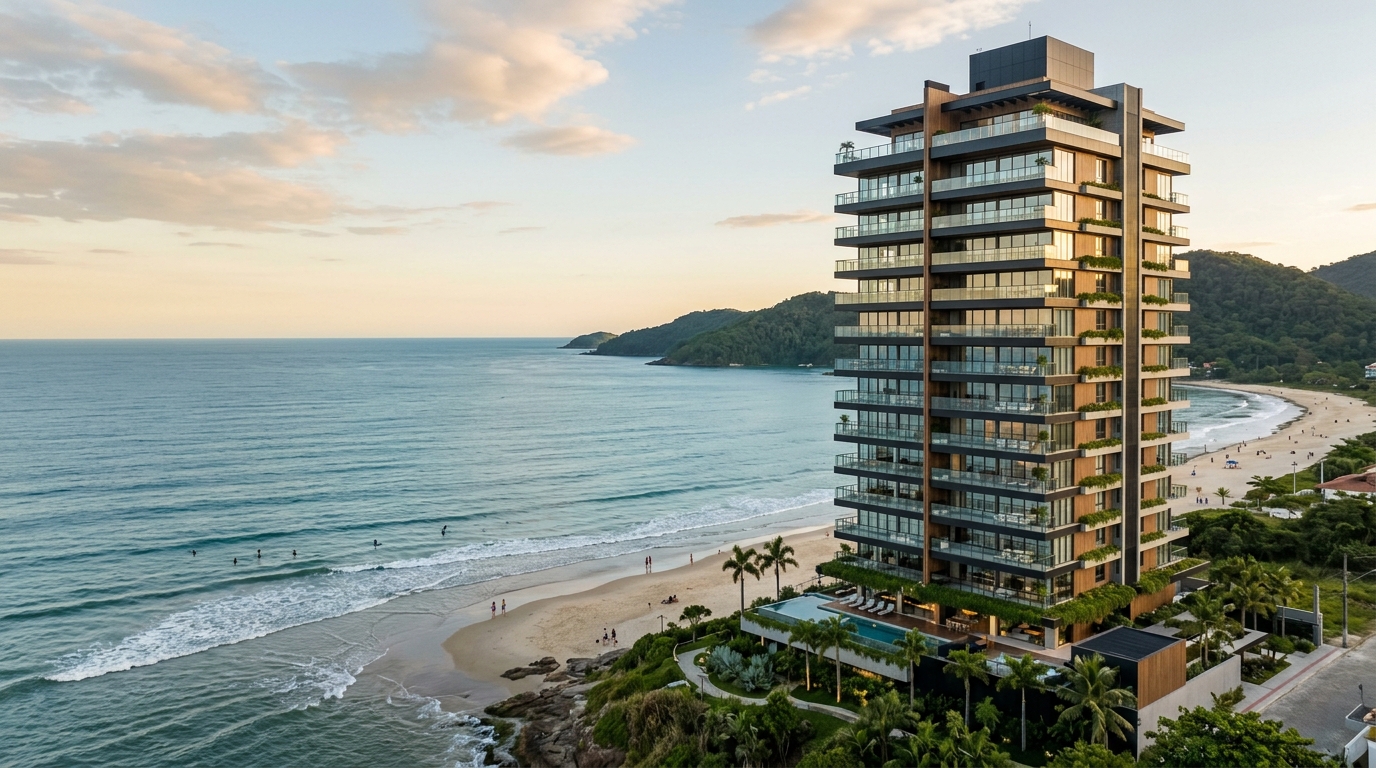
Between January 2020 and December 2025, the advertised square-meter price at Praia Brava jumped from an average band of roughly R$ 11,000 to somewhere between R$ 24,000 and R$ 32,000, according to combined FipeZap and Sinduscon/SC series for Itajaí (the local construction-industry union). In parallel, the average ticket of beachfront launches in the neighborhood stopped orbiting R$ 2.5 million and migrated into the R$ 5 million to R$ 14 million range — with a handful of penthouses crossing R$ 25 million. For the high-net-worth investor looking at Brazil's southern coast, the question is no longer "is it worth getting in?" Within the same postal code, which building, at which stage of the cycle, with which developer, delivers the best combination of capital appreciation, secondary-market liquidity, and short-term rental income?
This comparative piece looks at seven projects currently associated with the top tier of Praia Brava — Bravíssima Private Residence, Sense Praia Brava, Brava Prime, Bay House, Atmosphere Spa Home Club, Tirreno Residenziale, and Reserva Figueira — through the lens of someone allocating capital, not someone choosing a primary home. Nothing here is a recommendation. What follows is criteria, public numbers, and the macro frame that distinguishes price from value in a market that has already cycled twice through both INCC (Brazil's construction cost index) and Selic (the country's base interest rate) over the past decade. The buildings are treated as market examples, not acquisition suggestions.
Why Praia Brava became the most expensive address on Santa Catarina's coast
Praia Brava combines three elements that, taken together, are rare anywhere on Brazil's coastline: a beach strip hemmed in by hills (non-renewable physical scarcity), an Itajaí zoning code that has historically capped the height of front-row buildings, and a buyer base dominated by agribusiness entrepreneurs from southern and central-western Brazil, executives from the Itajaí River basin, and São Paulo capital looking for a second home with rental upside. The interaction of these three forces is what sets Brava apart from other Brazilian shorelines currently in vogue.
On the supply side, the 2023-2026 cycle delivered an atypical clustering of launches in the R$ 5 million to R$ 15 million bracket. Consolidated data from Secovi/SC (the regional real-estate syndicate) for the AMFRI metropolitan area show that projects with an average ticket above R$ 4 million accounted for more than 35% of total VGV (potential sales value) launched in Itajaí during 2024 — an unprecedented proportion in the city's historical series. ABRAINC, in its National Real Estate Indicator for the second half of 2025, classified Itajaí among the three Brazilian cities with the strongest VGV growth in the high and ultra-high segment, alongside Balneário Camboriú and the city of São Paulo.
On the demand side, the buyer profile has changed materially. In 2018, Praia Brava was still a second-home destination for inland families from Santa Catarina and Rio Grande do Sul. By 2025, the average buyer of units above R$ 6 million — based on data gathered from local brokerages and cross-checked with property registry offices — broke down as follows: Santa Catarina (38%), São Paulo (24%), Rio Grande do Sul (15%), the central-western states (12%), and foreign buyers (11%, with notable Argentine and Portuguese participation). This capital is hunting two things simultaneously: a partial currency hedge (a slice arrives via the non-resident investor channel) and a defensive asset against Brazil's long-run inflation, a role historically played by established beachfront real estate.
The aggregate result is a market that, over five years, stopped being comparable to the northern coast of Rio Grande do Sul and now competes for benchmark status with Balneário Camboriú and Jurerê Internacional in Florianópolis. The difference is structural: Balneário absorbed an aggressive cycle of tall-tower development — with structures above 200 meters — while Brava, constrained by zoning, kept significantly lower density. That scarcity contrast is, today, the neighborhood's main bullish thesis.
Objective comparison criteria — what separates price from value
Before going building by building, it is worth fixing the ruler. Seven variables explain almost the entire price dispersion within the same neighborhood and the same ultra-high segment. Anyone who ignores one of them tends to pay dearly for marketing.
True oceanfront versus side view. There is a material difference between a unit with its main facade facing the ocean and one whose ocean view comes from a secondary balcony at an angle. The first position typically trades 18% to 35% above the second inside the same building, and secondary-market liquidity is incomparably greater. In blind comparisons, facade orientation is the single item that escapes the hurried buyer most often.
Ceiling height and units per floor. In genuinely premium product, useful ceiling height tends to start at 2.90 meters in social areas and reach 3.20 meters on terraces. More decisive: the number of units per floor. Projects with a single unit per level — the private-residence model — operate at a different tier of perceived exclusivity and, therefore, pricing. Buildings with two or four units per floor compete on a different shelf even when finishes look similar on paper.
Developer track record. In a market where a meaningful slice of VGV is sold off-plan, with delivery horizons of 36 to 60 months, the counterparty matters as much as the product. On-time delivery history, post-handover service quality, and the ability to hold price tables through high-INCC cycles separate the developers who historically command a premium on the secondary market from those that suffer a discount at resale. In 2024, three developers concentrated more than 60% of premium-segment VGV at Praia Brava, according to crossed registry and Secovi/SC data.
Useful amenities versus catalog amenities. Spa, heated indoor pool, massage room, climate-controlled beach lounge, and professional short-stay rental management (where applicable) are variables that convert effectively into nightly rates. Oversized multi-sport courts, children's playrooms, and party halls for 300 people — in product aimed at the childless couple or the investor — are condo fees without marginal return.
Total VGV and number of units. Boutique buildings with VGV between R$ 80 million and R$ 150 million tend to operate with tighter price-table control and lower pressure from contract cancellations at the end of the cycle. Projects with VGV above R$ 400 million and hundreds of units depend more on macro mood and the Selic rate at handover.
Monthly condo fee. In the Brava band, premium condo fees currently run between R$ 2,500 and R$ 6,500 per unit per month, depending on amenities and units per floor. That number must enter the net-yield calculation — investors routinely project gross revenue and forget fixed expenses.
Urban-planning compliance. In a city actively debating a revision of its zoning code, buildings with construction permits and habite-se (occupancy certificate) consolidated under the prior rules carry an implicit scarcity premium, particularly on the front row, with height profiles that are unlikely to be reissued.
Comparison of the main beachfront buildings in 2026
The table below consolidates seven projects currently associated with the top of Praia Brava's market. The figures reflect entry-level tickets and the average area of the most-offered floor plan — not penthouses or ground-floor garden units, which trade above the upper band shown. Values are rounded to the nearest R$ 250,000 increment and based on a cross-reference of developer price tables, public FipeZap listings, and notarized transactions in the twelve months ending May 2026. Delivered buildings show secondary-market tickets; buildings under construction show price-table tickets.
| Project | Avg. m² | Ticket (R$) | Delivery | Status | Developer |
|---|---|---|---|---|---|
| Bravíssima Private Residence | 340 m² | 9.5M – 14M | 2026 | Advanced construction | FG Empreendimentos |
| Sense Praia Brava | 240 m² | 5.8M – 8.2M | 2025 | Delivered | Procave |
| Brava Prime | 210 m² | 4.5M – 6.5M | 2024 | Delivered | Embraed |
| Bay House | 275 m² | 6.2M – 9.0M | 2027 | Off-plan | FG Empreendimentos |
| Atmosphere Spa Home Club | 185 m² | 3.8M – 5.2M | 2023 | Delivered | Procave |
| Tirreno Residenziale | 260 m² | 5.5M – 7.8M | 2026 | Near completion | FG Empreendimentos |
| Reserva Figueira | 320 m² | 8.0M – 11.5M | 2027 | Off-plan | Embraed |
Bravíssima Private Residence is the archetypal example of the one-unit-per-floor model pushed to its limit on Brava, with private areas exceeding 300 m² and a real oceanfront facade. The 2026 projected ticket already reflects three annual price-table adjustments tracking INCC and, at the same time, the absence of comparable product in the surroundings.
Sense Praia Brava, by Procave, operates in a different cut: delivered in 2025, with units averaging 240 m² in three- and four-suite layouts and a full spa structure, it sits at a ticket level that tends to price in the "ready unit" advantage — it escapes residual INCC exposure and eliminates delivery-delay risk. Historically, in the Brazilian ultra-premium market, this premium settles between 8% and 15% over the off-plan equivalent.
Brava Prime and Atmosphere Spa Home Club represent the most accessible floor of the premium bracket: both already delivered, with tickets that still allow entry into Brava below R$ 5 million in certain internal floor plans. For investors focused on gross short-stay yield, these are traditionally the products with the best revenue-to-investment ratio — precisely because the entry ticket is smaller.
Bay House and Reserva Figueira, at the off-plan end, carry the classic thesis of buying off-plan from a strong-brand developer: an initial discount versus comparable finished product, but full exposure to INCC adjustments and execution risk. In moderate-INCC cycles — below 6% per year — the historical gain from buying off-plan from a premium Brava developer ranged between 25% and 45% by handover. In cycles with INCC above 10%, that gain compressed sharply.
Tirreno Residenziale, near completion and scheduled for delivery in 2026, captures the best of both worlds when the construction schedule is honored: the off-plan entry discount, with most of the INCC exposure already paid down, and a short horizon to possession — historically the exact stage of the cycle when the asset appreciates fastest, as the secondary market starts pricing in delivery.
The investor's calculation — yield, appreciation, and the invisible cost
The return on a Praia Brava beachfront asset comes from three separate sources that must be analyzed independently: nominal capital appreciation, short-stay rental income, and inflation protection. Mixing all three into a single "annual return" figure is the most common mistake made by marginal buyers.
On appreciation, the five-year window from 2020 to 2025 delivered nominal gains between 95% and 160% on consolidated oceanfront positions, with a wide advantage for buildings with one unit per floor and front-row placement. That performance, however, is measured against an accumulated IPCA inflation index of roughly 38% over the same period. Real gains, then, came in between 41% and 88% — robust, but a long way from the "doubled in dollars" narratives that circulated in 2022 and 2023. In dollar terms, accounting for currency depreciation and the Selic cycle, the real gain for foreign buyers was more modest: between 18% and 45%, based on annual parity calculations. Foreign investors should keep in mind that the Brazilian real has historically traded with high volatility against major currencies, and that currency exposure can amplify or erase nominal local gains over any given five-year window.
On short-stay rental income, Brava operates with heavy seasonality. Market studies point to occupancy rates above 85% in December, January, and February (Brazilian summer), with nightly rates between R$ 2,200 and R$ 6,500 depending on the floor plan. Outside high season, occupancy drops to between 22% and 38%, and rates adjust to the R$ 900 to R$ 2,200 band. Projecting the calendar year, typical gross yield lands between 5.5% and 8% over property value — before management commission (15% to 25%), IPTU (the municipal property tax, variable by area), condo fees (R$ 2,500 to R$ 6,500 per month), and furniture depreciation. Realistic net yield converges into the 3.2% to 4.8% per year range on well-managed premium assets.
"When you compare a premium beachfront property to an inflation-linked Treasury bond or a brick-and-mortar real-estate fund, you are not just comparing yield to yield. You are comparing an asset with a geographic scarcity premium, embedded personal use, and partial currency coverage against a liquid financial asset. These are different functions inside a portfolio — and they must be sized as such."
Secondary-market liquidity above R$ 5 million is the least discussed and most decisive topic. In Itajaí, the average time on market for properties in that bracket during 2025 settled between 9 and 18 months for buildings with prime facade orientation and a recognized developer — well below the 24 to 36 months observed in comparable products on other Brazilian shorelines. Above R$ 10 million, time on market doubles. Above R$ 20 million, the asset migrates into a restricted off-market channel, with deals negotiated bilaterally and typical discounts of 8% to 15% off the initial asking price.
INCC exposure for off-plan buyers deserves special attention in 2026. The index accumulated 11.9% in 2021, 8.9% in 2022, 3.2% in 2023, 4.8% in 2024, and has been running close to 5.5% to 6.5% on an annualized basis in the first half of 2026, according to Fundação Getulio Vargas. In typical four-year contracts, that translates to a cumulative add-on of 18% to 28% over the initial sticker price — a number that must be embedded in the return projection of anyone buying today an off-plan unit with keys scheduled for 2029 or 2030.
Specific risks — what could break the thesis
Four risks are particular to the Brava premium cut and deserve explicit sizing before signing.
Contract cancellation (distrato). Brazil's distrato law (Federal Law 13.786/2018) capped developer retention at 25% or 50% of the amount paid, depending on the regime. In high-Selic cycles with riskier VGV, some projects recorded cancellation rates above 18% — well above the historical average of 6% to 9% for the high-end segment. Mass cancellations pressure developer cash flow, delay construction, and may force downward price-table revisions, hurting investors who entered early.
Delays. The average habite-se in Itajaí, according to Sinduscon/SC's 2024 survey, was issued with an average delay of 4.8 months over the contractual schedule. For buildings above 30 floors, the average rises to 7.2 months. Standard contracts allow a 180-day tolerance window — delays beyond that generate a right to compensation, but enforcing that right requires court action, which weakens its practical effect for the investor.
Oversupply above R$ 8 million. The R$ 8 million to R$ 15 million band on Brava absorbed, between 2023 and 2025, launches totaling more than R$ 2.1 billion in VGV, according to public Secovi/SC compilations. Absorbing that inventory depends on the continued migration of capital from São Paulo and from the agribusiness regions — a flow sensitive to domestic real interest rates and the exchange rate. A scenario with Selic above 14% per year for more than twelve consecutive months pressures this segment disproportionately compared with the rest of the market.
Zoning revision. Itajaí's city hall has been debating a revision of the master plan since 2023, with discussions covering building heights, setbacks, and floor-area ratios for the front row. Any move that expands the permitted height profile on the front row reduces, at the margin, the relative scarcity of buildings already constructed under stricter rules. Any move that further restricts construction consolidates the premium of existing assets. The risk is symmetric, but the market tends to price only the benign scenario — it is worth following the legislative process on the city hall's official portal and through the Municipal Development Council reports.
There is also a regulatory IPTU risk. Itajaí's property valuation table was reset in 2024, and a new revision cycle is expected for 2027. In premium buildings, annual IPTU currently ranges from R$ 18,000 to R$ 65,000 — a meaningful line item for the investor holding a unit vacant during the off-season.
Comparison with Balneário Camboriú and Jurerê: how Brava differs
To size Brava as an asset class, it must be benchmarked laterally. Balneário Camboriú operates, on its main beach, at an average m² between R$ 22,000 and R$ 38,000 in 2025, according to FipeZap, with average launch tickets above R$ 4.5 million. The structural difference is scale: Balneário absorbed more than R$ 12 billion in launched VGV between 2020 and 2025 and allows building heights above 200 meters on some stretches. Scarcity is lower; liquidity is higher; the exclusivity premium is smaller.
Jurerê Internacional, in Florianópolis, operates in yet another bracket: a predominance of houses and low-rise developments, higher average tickets (frequently above R$ 12 million for beachfront houses), lower liquidity, and a more mature buyer profile. For an investor with a ticket between R$ 5 million and R$ 10 million in beachfront apartment, Brava offers a middle ground: scarcity close to Jurerê's, with still significantly higher liquidity and an appreciation horizon still on the upslope — Jurerê has already consolidated much of the historical gain that Brava is absorbing now.
On the broader northern coast of Santa Catarina, outside the Brava-Balneário-Jurerê triangle, premium launches in Bombinhas, Porto Belo, and Itapema are climbing, but they trade in 2026 with an average m² between 35% and 55% below Brava, and with a buyer profile more sensitive to interest rates. These are markets at an earlier stage of the cycle — attractive for those looking for cheaper entry, with the trade-off of higher execution risk and a less consolidated surrounding district.
Notes for the international buyer
Foreign buyers can acquire real estate in Brazil under a regime that is, in most circumstances, identical to that of resident buyers. The two practical requirements worth flagging early are the CPF (the Brazilian taxpayer identification number, which any foreign individual can obtain through a Brazilian consulate abroad or via the Receita Federal once in Brazil) and a Brazilian bank account or a registered investor structure for the inflow of funds. The Central Bank of Brazil regulates inbound capital and records each transfer — a step that becomes important later when the investor wants to repatriate sale proceeds or rental income with the original currency basis preserved.
On financing, foreign buyers without Brazilian residency rarely access local mortgage credit on competitive terms; most cross-border transactions on the Praia Brava premium cut are closed in cash, sometimes with an installment plan negotiated directly with the developer during the construction phase. That structure is common, but it is not a substitute for a mortgage: installments during construction are indexed to INCC and, after delivery, to the IPCA index plus a real spread, with conditions defined building by building.
Final decision checklist
Synthesizing the criteria and the macro reading, seven questions should be answered before signing any reservation in a Brava premium building. Anyone answering "no" or "I don't know" to three or more is probably paying for marketing — not for the asset.
1. Is the main facade of the intended unit true oceanfront or side-facing? On which floor and at what exact viewing angle?
2. How many units per floor? Is there a private elevator landing directly inside the unit? Does useful ceiling height exceed 2.90 meters?
3. Does the developer have at least three deliveries in Santa Catarina's premium segment in the past seven years, with habite-se issued and a functional post-sale service channel?
4. Is the project's total VGV consistent with the segment's absorption capacity — between R$ 80 million and R$ 250 million in boutique premium product? Above that range, what is the current sales pace?
5. What is the projected condo fee per unit per month? Has that number entered the net-yield calculation?
6. Off-plan: what balance is still exposed to INCC, and what is the physical-financial construction schedule? Delivered: what is the historical average time-on-market in the secondary inventory of the same building?
7. Is there an explicit clause addressing zoning revision during construction? Under which urban-planning regime was the building permit issued?
Conclusion
Praia Brava in 2026 is no longer a speculative bet. It is a consolidated address, with an explicit geographic scarcity premium, a structurally diversified buyer base, and a product range covering tickets from R$ 3.8 million to R$ 14 million within the same neighborhood, at distinct stages of the cycle. For the high-net-worth investor, the decision has stopped being between Brava and another shoreline — it has shifted to off-plan versus delivered, boutique versus scale, front facade versus side, consolidated versus newcomer developer. Buildings such as Bravíssima, Sense, Brava Prime, Bay House, Atmosphere, Tirreno, and Reserva Figueira are legitimate market examples of each of these cuts — not recommendations.
The angle that most often escapes counter-side conversations is also the heaviest: realistic net yield, after condo fees, IPTU, management, and wear-and-tear, rarely exceeds 4.8% per year on premium assets. True return comes from the combination of real capital appreciation (historically robust on 5 to 10 year horizons), protection against Brazil's long-run inflation, and personal use — variables that must be sized as complementary functions, not substitutes, of the rest of the portfolio. To follow weekly analyses of Santa Catarina's coastal real-estate market and Itajaí's high-end segment, consider subscribing to the editorial curation of the SIDE Empreendimentos portal. The numbers, the cycles, and the master plan continue to move — and the informed decision remains the only kind that stays in short supply.