Itajaí Property Appreciation in 2026: Is It Worth It?
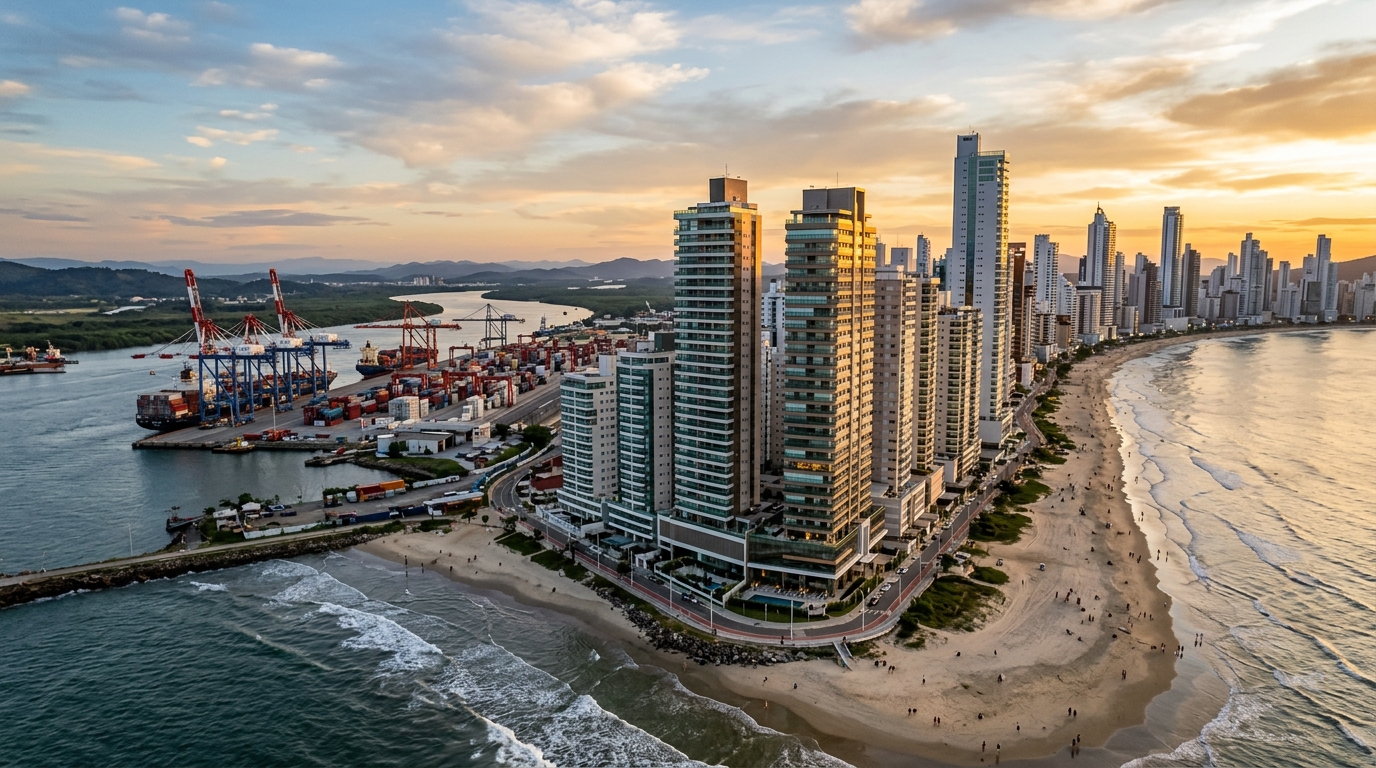
The square-meter price in Itajaí closed the opening months of 2026 with cumulative variation outpacing even Balneário Camboriú in the FipeZap (Brazil's leading residential price index) — unthinkable five years ago, when this port town was still seen as the working-class cousin of Santa Catarina's northern coast. For investors looking in the rear-view mirror, the temptation is obvious: buy off-plan in Praia Brava, wait 36 months, pocket the spread. For those running the numbers with pencil, paper and Brazil's Selic (the country's base interest rate, akin to the Fed funds rate) in hand, the question reframes itself — and the answer is not the "buy now" echoing across local broker channels.
This article dissects the appreciation thesis for Itajaí property in 2026 through the lens of financial journalism rather than the sales deck: structural drivers, cash-flow mathematics, index-linked clauses, legal risks and a neighborhood-by-neighborhood read. Anyone hunting for confirmation bias will leave frustrated. Anyone hunting for an informed decision, with horizon and ticket size that actually fit together, finds here the material the search results don't deliver.
Itajaí in 2026: the numbers that matter (and the ones usually left out)
Start with the raw picture. The FipeZap twelve-month cumulative figure for Itajaí now sits in the high-single to low-double-digit band, led by Praia Brava, whose average price per square meter already flirts with the state's premium tier — territory that historically belonged, by a wide margin, to Balneário Camboriú's central beachfront. Secovi-SC, the regional housing-developers' association, reports quarterly Sales Velocity (VSO) on new developments persistently above 15% in the beachfront zones, a number that signals healthy inventory absorption but has to be cross-read against the pace of new launches to avoid a distorted picture.
On the supply side, the consolidated VGV (Valor Geral de Vendas — the total contractual launch value, an industry-standard supply gauge in Brazil) for the Itajaí/Itapema/Balneário Camboriú axis hit a nominal record in 2025, with a 2026 launch pipeline that remains robust. Here sits the first analytical trap: rising nominal VGV, in an environment where the INCC (Brazil's National Construction Cost Index, the benchmark used to escalate off-plan installments) runs at 6%–8% per year, does not automatically equate to real sector expansion — it partly reflects the re-pricing of construction costs themselves. Mistaking sector inflation for structural heat is buying the wrong story.
The macroeconomic backdrop completes the picture. With Selic in double-digit territory and the IPCA (Brazil's official consumer price index, the inflation target metric) easing slowly toward the upper band of the central bank's target, the opportunity cost of capital allocated to fixed income remains high. A good-quality post-fixed CDB (Certificado de Depósito Bancário — a bank-issued certificate of deposit, the workhorse instrument of Brazilian fixed income) delivers, net of taxes, somewhere between 0.75% and 0.90% per month. That is the benchmark any off-plan Itajaí thesis has to fight against — not the 30% nominal cumulative figure flashed across sales presentations.
A note for the international reader before we go further: BRL/USD has traded in a wide band through 2025 and into 2026, and all Brazilian rates and prices in this analysis are in local currency. A foreign buyer funding in dollars or euros into a BRL asset carries an FX overlay the Brazilian investor simply does not see, and that overlay can flip the entire return profile in either direction. We treat the rest of this article in BRL terms; the currency hedge math is yours to model.
Why it appreciates: the structural drivers behind the price
Itajaí's recent appreciation is not, despite common perception, the fruit of a single tourism cycle. There are structural drivers, and each carries its own horizon.
The first is the port. The Port of Itajaí combined with Portonave (its private peer across the river in Navegantes) handles one of the country's largest container volumes, and the associated logistics chain — operators, customs brokers, shipowners, dockside industry — sustains a high, stable income base that does not depend on summer. This driver explains the resilience of the year-round rental market in Centro, Beira-Rio, Fazenda and parts of São Vicente. It is not the Santa Catarina investor pushing prices: it is the logistics executive settling in for the long term.
The second is demand spillover from Balneário Camboriú into Praia Brava. With the central beachfront square meter in BC at levels that scare off part of the "new premium" buyer, Praia Brava — administratively in Itajaí, but integrated into BC's urban fabric — captured over the past three years a flow of demand that used to be trapped on the other side of the hill. The effect is rapid re-pricing of the local inventory, with launches at BRL 25,000 to BRL 35,000 per square meter trading on par with the neighboring central beachfront.
The third is infrastructure. The duplication and continuous upgrades to stretches of BR-101 (the federal highway spine of Brazil's south-southeast coast), combined with slow but visible progress on urban road works and the densification of private healthcare and education facilities, compress commute times to Florianópolis and Curitiba and widen the radius of qualified bedroom-city demand. The fourth driver, demographic, is the net inflow of migrants from São Paulo, Paraná and Rio Grande do Sul — a flow that, according to recent IBGE (Brazil's national statistics bureau) data cuts and FGV (Fundação Getulio Vargas, a leading economics think-tank) studies, places the Santa Catarina vector among the country's strongest in relative attractiveness.
Finally, the regulatory driver. Itajaí's Plano Diretor (the municipal master plan that sets zoning and building rights) has some areas with high height-limit allowances and others under tightening restrictions; understanding zoning before buying land or a development is a return factor as decisive as reading the developer's balance sheet. A structural driver is not destiny: each one has its window, and each one can cool.
Off-plan versus ready: the real investor math
The operational question is not "Does Itajaí appreciate?" It is "off-plan or ready, indexed how, over what horizon, against which opportunity cost?" Here enters the accounting that sales pieces leave out.
In an off-plan property (na planta, in local parlance — bought directly from the developer during construction), the standard cash flow involves a 10%–20% down payment, monthly installments adjusted by INCC throughout the build, annual top-up payments, and the keys at delivery — the moment when, typically, the remaining balance is transferred to a bank via SBPE (Brazil's Savings & Loan System, the dominant mortgage channel for completed properties). The risk is not in the contract; the risk is in the INCC. In cost-acceleration cycles — like 2021–2022 and partially repeated in 2024–2025 — INCC-DI breaches 8% per year and adjusts the entire outstanding balance monthly. An installment of BRL 8,000 today can become BRL 9,500 in 18 months without the buyer having signed up for anything beyond what was already on paper.
For the ready property, the math is different. The investor pays the full ITBI (Imposto de Transmissão de Bens Imóveis — the municipal property transfer tax, typically 2%–3% of the deal value), registry, notary, and either finances or pays the full ticket in cash. Return depends on rent plus capital appreciation, in a rental market whose annual net yield in Itajaí oscillates between 4% and 6% for well-located residential units — below, therefore, the current CDI (the interbank reference rate, Brazil's de facto fixed-income benchmark). Without nominal appreciation above IPCA, the ready property loses to fixed income over short horizons.
| Scenario | Off-plan — 36 months | Ready — 36 months | Net CDI — 36 months |
|---|---|---|---|
| Initial capital outlay | BRL 200k (down payment + year-1 installments) | BRL 1.2m (cash) | BRL 1.2m |
| Index / return | INCC ~7% p.a. + capital appreciation | Rental yield 5% p.a. + appreciation | ~10% p.a. net |
| Estimated terminal value | BRL 1.8m (after handover transfer) | BRL 1.55m (rent reinvested) | BRL 1.60m |
| Approximate IRR | 22%–28% p.a. | 10%–13% p.a. | ~10% p.a. |
| Main risk | Delay, INCC, cancellation, liquidity | Vacancy, maintenance, thin net yield | Issuer credit risk |
The read is harsh but honest: off-plan only beats CDI by a meaningful margin in a scenario of substantial capital appreciation by the time of handover. If the Itajaí cycle decelerates — and property cycles do decelerate — the projected IRR collapses, and the investor discovers they were being remunerated, in truth, by INCC plus a market delta that is not guaranteed. For tickets between BRL 800,000 and BRL 3 million (roughly USD 150k–580k at recent exchange rates), the correct allocation is rarely 100% in a single asset. Putting everything into one off-plan unit trades diversification for adrenaline.
There is also the secondary-market assignment, known locally as repasse. The discount between the developer's sticker price for a delivered building and what the secondary market pays in an immediate sale typically runs 5%–12%, depending on the developer's remaining stock in the same project. Anyone needing to sell before delivery discovers liquidity is far thinner than imagined.
The risks the scale model never shows
Construction delay is the most underestimated risk for the first-time investor. Brazil's Lei 13.786/2018 — known as the distrato law because it governs contract cancellation between buyer and developer — reshaped the equation significantly. On one side, it made the 180-day grace period beyond the contracted delivery date a no-indemnity standard. On the other, it tightly regulated penalties for voluntary cancellation by the buyer, with retentions reaching 25% of the amount paid in projects without patrimônio de afetação and up to 50% in those with that protection registered.
Patrimônio de afetação, created by Lei 10.931/2004, is the accounting ring-fence that separates a specific project from the developer's general balance sheet — it protects the buyer in the event of corporate insolvency. Buying off-plan without checking whether the project has affectation registered means giving up one of the few structural defenses Brazilian law actually offers. The great majority of premium launches in Itajaí adopt affectation, but "great majority" is not "all"; verifying the project memorandum is a five-minute job that prevents six-figure losses.
"In an off-plan market, three variables explain 80% of the investor's final outcome: developer solvency, installment index, and exit window. Anyone walking in looking only at the sticker price is paying for the learning curve." — recurring read among independent analysts of the Santa Catarina market.
Secondary-market liquidity is the other quiet unknown. Itajaí has an active resale market up to about BRL 2 million, but the average time between listing and closing, even in hot neighborhoods, usually runs four to eight months. Tickets above BRL 3 million face a narrower buyer universe, and the discount required to accelerate a sale can eat a meaningful share of the accounting gain. Anyone needing liquidity in 90 days is in the wrong market.
Regulatory risk closes the list. Updates to the Plano Diretor, changes to floor-area ratios, environmental restrictions on the coastal strip, and revisions to municipal land-use legislation can dramatically alter the relative value of a plot or development. This is not an academic hypothesis: recent history in Itajaí and neighboring municipalities shows meaningful moves that flipped, overnight, the thesis of those who bought land on assumed height allowances.
Neighborhood by neighborhood: where price asymmetry still exists
Praia Brava is the mainstream of the current cycle. Premium launches, price per square meter in the elevated band, buyer profile from out-of-state, strong seasonal demand. For the long-horizon investor (5+ years) with cycle tolerance, the thesis is still there; for those entering today seeking quick arbitrage, the window has partially closed. Developments by SIDE Empreendimentos along the Praia Brava axis illustrate the current segment standard: high-end product, robust technical specifications, ticket aligned with the upper band of the Santa Catarina market.
Fazenda and Cabeçudas are going through their own repositioning. Traditional neighborhoods, long-resident profile, stock of older buildings, they attract waves of retrofit and new mid-to-high-standard developments that still trade at a meaningful discount versus Praia Brava — a 15% to 30% differential on comparable products. For the investor willing to accept a high ticket without the shine of the new beachfront, there is value.
Centro and Beira-Rio are two cities inside one. The traditional Centro suffers from old commercial structure, with small units and heterogeneous residential composition. Beira-Rio, adjacent to the port corridor, has absorbed launches with views over the canal and firm year-round rental demand linked to logistics. A less showy market, but with more palatable rental cap rates.
São Vicente, Cordeiros and São Judas form the densification ring for middle and upper-middle class residential. Significantly lower price per square meter, predominantly local buyer profile, an appreciation cycle linked more to municipal infrastructure than to tourism. For the investor seeking year-round rental income with a stable tenant, this is the most solid slice.
| Neighborhood | Average ticket (BRL/m²) | 12-month change | Dominant profile |
|---|---|---|---|
| Praia Brava | BRL 22,000 to 35,000 | Double-digit | Premium leisure / second home |
| Fazenda / Cabeçudas | BRL 14,000 to 22,000 | Low double-digit | Long-time resident / retrofit |
| Centro / Beira-Rio | BRL 9,000 to 15,000 | 8%–12% | Mixed residential / logistics-corporate |
| São Vicente / Cordeiros | BRL 7,000 to 11,000 | ~7%–10% | Local middle class / year-round rental |
| São Judas | BRL 8,000 to 12,000 | ~8%–11% | Emerging mid-to-high standard |
The comparison with Balneário Camboriú and Itapema completes the picture. BC's central beachfront remains more expensive, but with compressed 12-month variation — it is closer to the cycle top. Itapema, especially Meia Praia, maintains an aggressive appreciation pace and still shows asymmetry versus Itajaí on comparable products, but it concentrates oversupply risk over a 24–36 month horizon. The Santa Catarina coast is not homogeneous, and treating it as a single block is the mistake that costs out-of-state and out-of-country investors the most.
Recurring mistakes investors make in Itajaí
The first mistake is confusing nominal variation with real return. A property that appreciated 30% in three years, in a scenario of cumulative INCC at 22% and cumulative IPCA at 15%, delivered a compressed real return — and still showed up on social media as "30% appreciation." The investor needs to apply the deflator before celebrating.
The second is ignoring carry cost. Every month of installment paid is capital tied up that could have been earning CDI. Over a 36-month build, that accumulated carry equals 25%–35% of the total amount paid. IRR projections that omit this component are, systematically, too optimistic.
The third is judging the developer by the showroom. A polished sales stand, an illuminated scale model, and dozens of units sold over a single weekend tell you nothing about the company's financial soundness. Anyone investing between BRL 800,000 and BRL 3 million off-plan should demand the balance sheet, the delivery history, proof of affectation registration and, ideally, a conversation with owners of the same developer's prior projects.
The fourth is concentrated allocation. Investors without prior sector experience frequently park 40%, 50%, sometimes 100% of their net worth in a single off-plan unit. That is concentrated active, geographic and sector exposure in a single illiquid asset indexed to construction costs. Diversification is not a pension-fund taboo; it is a mathematical principle.
The fifth is assuming foreigners can finance like Brazilians. They cannot. A foreigner without a CPF (Cadastro de Pessoa Física — Brazil's tax ID for individuals), without local fiscal residence, and without verifiable local income runs into severe restrictions in SBPE — in practice, they operate mostly with cash or with home-country financing. Selling to that profile without aligning expectations creates needless friction at closing. This is the section that matters most for the international reader: build home-country financing or cash into the model from day one, and remember that Brazilian banks do not extend residential SBPE-style mortgages to non-residents on the same terms locals receive.
Conclusion: the checklist before the yes
Itajaí's property appreciation in 2026 is real, sustained by identifiable and measurable structural drivers. It is not, however, a mathematical guarantee of return for any investor, in any ticket, over any horizon. The cycle is more advanced than it was in 2022; INCC adjusts faster than Selic eases; the secondary market has asymmetric liquidity across price bands; and the investor entering today has to run different math than someone who entered four years ago.
The objective checklist: (i) minimum five-year horizon, ideally seven; (ii) ticket sized to allow diversification — never more than 30% of net worth in a single asset; (iii) tolerance for at least 12 months of illiquidity; (iv) a requirement for registered patrimônio de afetação and a verified developer delivery history; (v) critical reading of the installment index and INCC scenario simulation; (vi) honest comparison of projected IRR against CDI over the same horizon; (vii) a clear understanding of zoning and the Plano Diretor for the neighborhood of interest.
It makes sense for those with a long horizon, diversified capital, a clear thesis on which structural driver they are buying into, and a critical read of the technical sheet. It does not make sense for those who need short-term liquidity, allocate a single block of capital, and treat "Itajaí is booming" as an investment diagnosis. For weekly analyses of the Santa Catarina real estate market with this level of rigor — numbers, indices and critical reading instead of marketing copy — the editorial curation on the SIDE Empreendimentos portal remains one of the few addresses in the sector that consistently separates signal from noise.