Investing in Navegantes (SC) real estate in 2026
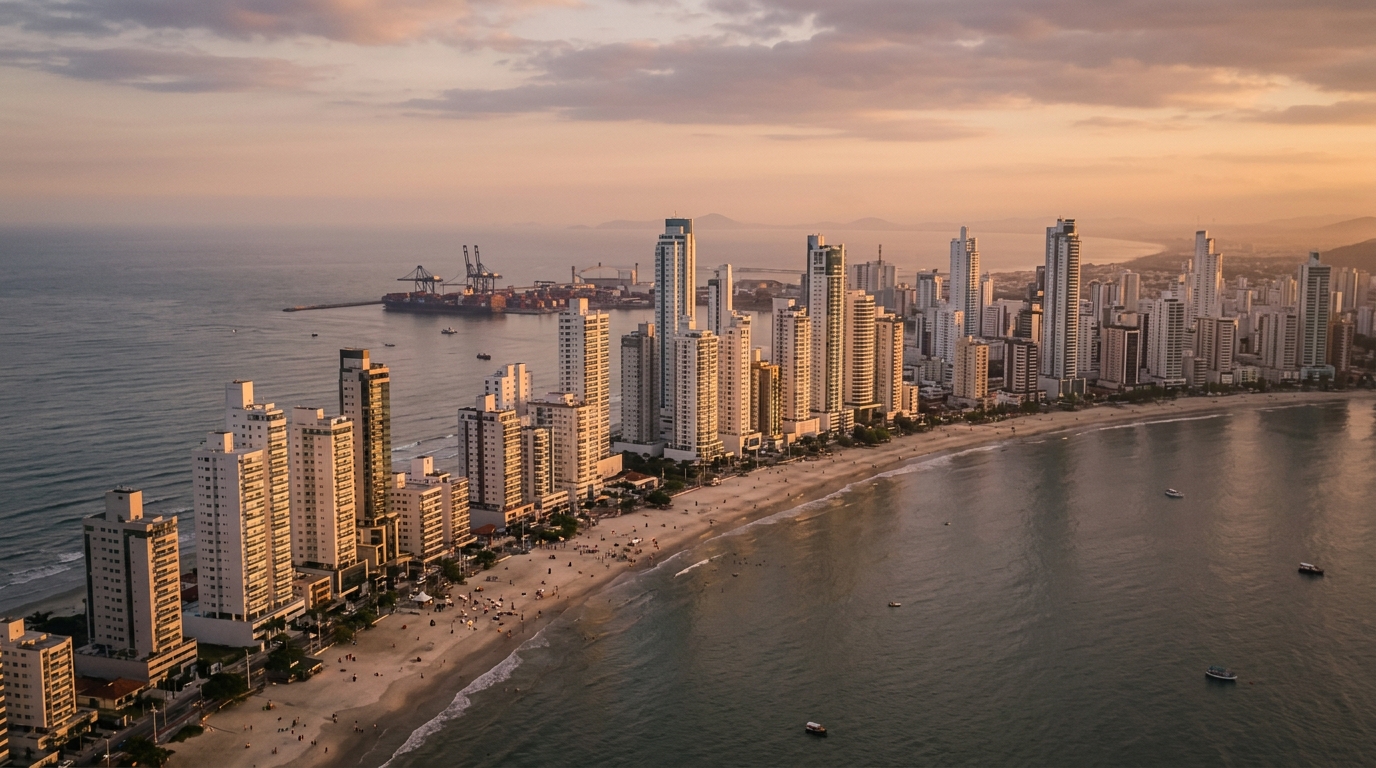
Between January 2024 and the first quarter of 2026, the average launch price per square meter in Navegantes, on the northern coast of Santa Catarina, rose from roughly R$ 9,800 to the R$ 13,500 range — a nominal gain of about 38% over a stretch in which Selic (Brazil's base interest rate, set by the central bank) ranged between 10.5% and 13.75% and INCC-M (the National Construction Cost Index, the standard yardstick for building inflation in Brazil) accumulated close to 14%. Translation: a significant slice of that appreciation was eaten by construction costs and by the opportunity cost of money. It is in that context — not in the binary post-pandemic euphoria — that the investor placing somewhere between R$ 800,000 and R$ 3 million on the table needs to decide whether Navegantes still is, in 2026, the best use of capital along Santa Catarina's northern coast.
The question matters because the reader of this analysis has very likely already looked at — or already bought in — Balneário Camboriú, Itapema or Itajaí. Comparing Navegantes only with its own past is myopia. The right question is: in the competition for the marginal capital flowing into the Itajaí–Navegantes–BC axis, what justifies, today, choosing Navegantes over its immediate neighbors?
Navegantes in 2026 by the numbers: GDP, Portonave, the airport and R$/m²
Navegantes stopped being a bedroom community on the wrong side of the Itajaí-Açu river at least a decade ago. The municipality closed 2024 with estimated GDP above R$ 5.5 billion (roughly USD 1.0 billion at current FX) and one of the highest per-capita incomes in Santa Catarina among cities under 100,000 inhabitants, driven by port logistics, industrial fishing, an aeronautical cluster, and — more recently — second-home tourism. Demographics remain robust: population grew above 2% a year over the last decade, against a state-level average below 1%.
Two physical assets sustain that expansion. The first is Portonave, the private container terminal that operates above 1.4 million TEUs per year and which, with its berth expansion and channel dredging program, entered 2026 with enlarged capacity — qualified direct jobs, a permanent flow of executives in transit, and locked-in demand for corporate rentals. The second is Navegantes International Airport, currently the third busiest in southern Brazil by paying passengers, with terminal and runway expansion works that should unlock additional direct flights from 2026–2027. For a real-estate investor, that combination means demand that does not depend solely on the summer season — a structural asymmetry against purely seasonal markets elsewhere on the coast.
Price-per-square-meter figures tell the story of regional convergence. According to FipeZap series (the leading residential price index in Brazil, published by Fundação Getulio Vargas) and surveys from Secovi-SC (the Santa Catarina developers' and brokers' association) for the 2025 cycle, average launches in the Navegantes oceanfront (Meia Praia/Gravatá neighborhoods) currently trade in the range of R$ 13,000 to R$ 15,000 per square meter of private area, with premium oceanfront units reaching R$ 18,000. Itajaí, on Praia Brava, operates in the R$ 22,000 to R$ 30,000 band. Itapema, R$ 18,000 to R$ 26,000. Balneário Camboriú, R$ 25,000 to R$ 45,000 — with iconic towers crossing R$ 60,000 per square meter on high floors. In other words: Navegantes still carries a 30% to 50% discount versus its direct neighbors, and that gap, in a maturing market, is precisely where the investor's thesis lives.
The indicator that separates promise from reality is the VSO (Velocidade Sobre Oferta — Sales Velocity Over Inventory), measured by Secovi-SC, which captures how fast new supply is absorbed. In the rolling 12-month cycle ending in Q1 2026, Navegantes' VSO oscillated between 12% and 16% per month on well-priced launches — healthy, comparable to Itapema's, and above the northern-coast average. It is the kind of reading that signals inventory continues to be absorbed, though with less slack than in 2022–2023.
Selic, INCC and the real cost of money in 2026
No real-estate decision survives without understanding the cost of money. In June 2026, Selic still operates at an elevated level by post-2017 historical standards, with the market pricing in the beginning of a cutting cycle through the second half of the year. The ex-ante real rate — Selic discounted by 12-month IPCA expectations (IPCA being Brazil's official consumer inflation index, equivalent to CPI elsewhere) — remains above 6% per year. That is the opportunity-cost floor against which any annual rent and any expected appreciation must compete.
On bank financing through the SBPE channel (the Brazilian Savings and Loan System, the standard mortgage funding source for middle and upper-middle income housing), investors today face nominal rates at private banks in the range of TR + 10.5% to 12% per year, depending on relationship and loan-to-value. TR (Taxa Referencial) is a small floating benchmark close to zero in recent years, so the headline rate is effectively the spread. The FGTS pró-cotista line — funded by Brazil's mandatory employment-savings system — pushes that cost down to roughly TR + 8.5% to 9.5% when available, but requires eligibility (property below the SFH ceiling, active FGTS balance, residential purpose) that often does not apply to someone buying a second or third unit for investment. Out of those caps, the buyer falls into pure SFI financing, with higher rates and shorter terms. For tickets between R$ 800,000 and R$ 3 million in Santa Catarina, financing typically comes from either SFI or the developer's in-house funding scheme.
There is a second point that few examine carefully: the indexation clause on residential rentals. Since 2022–2023, the market migrated massively from IGP-M — historically the "rental index" — to IPCA, precisely because IGP-M, exposed to FX and wholesale prices, produced near-30% spikes that froze pass-throughs and triggered widespread litigation. In 2026, with IPCA running between 4.5% and 5.5% and IGP-M already calmer, the debate has come closer to neutral. But the investor signing a new contract in Navegantes in 2026 still tends to prefer IPCA, because it tracks the tenant's wage budget and reduces default risk on renewal.
INCC — the National Construction Cost Index — closed 2025 above 7% and is running near 6.5% on a 12-month rolling basis in 2026. That is the index that adjusts the outstanding balance of installments during construction, and it is where the first off-plan trap sits for the buyer. If a unit sells today at R$ 14,000/m² and INCC runs at 6.5% per year for 36 months, the outstanding balance grows around 21% just from indexation — before any interest, before any real gain. International buyers used to fixed-rate U.S. or European mortgages find this counter-intuitive on first contact, but it is structural to how off-plan financing works in Brazil.
Off-plan, ready or resale: the cash-flow math that actually matters
Experienced investors know the right product depends on horizon and cash patience. Off-plan, the appeal is fractional disbursement and the possibility of reselling at a premium before delivery. In Navegantes, in 2026, the standard cash-flow pattern for a R$ 1.2 million unit looks roughly like this: 15% to 20% down payment in 24 to 36 installments, monthly payments indexed to INCC adding up to 30% to 40%, semiannual or annual reinforcement payments totaling 10% to 15%, and the balance-at-keys (35% to 45%) that is typically either financed or paid in cash on delivery.
A realistic IRR on this operation — discounting INCC, the opportunity cost of own capital locked up in installments, and the resale expectation — rarely exceeds 12% to 16% per year in normal conditions, and only when the asset is well chosen. Those who model a "basement" resale scenario, flipping before the certificate of occupancy, need to count on a short window and a hot buying market — neither of which is guaranteed.
Ready stock, by contrast, trades volatility for predictability. You buy in cash or finance, generate immediate income, and nominal appreciation tends to track IPCA and local inventory more closely. In Navegantes, the cap rate (net annual rent divided by property value) on standard units in long-term lease oscillates between 4.5% and 6.5% per year. For short-stay tourism, the math changes: a well-positioned unit in Meia Praia can generate 18 to 25 booked nights in high season (December through February and part of Easter), at nightly rates of R$ 600 to R$ 1,200, with off-season occupancy in the 30% to 45% range. Net of platform fees, IPTU (the Brazilian municipal property tax), condo fees, maintenance and management, the mature investor rarely tops 7% to 9% per year — good, not miraculous, and exposed to sharp seasonality.
The resale market is the most inefficient segment in the region, precisely because it is fragmented. In Navegantes there are still blocks of units with 10 to 15 years since delivery, in good addresses, selling below replacement cost (the cost of building the equivalent today). It is where disciplined investors find entry points in addresses that will not be launched again — but it demands serious due diligence on title (matrícula), regularization, the condo convention, and the reserve fund for major repairs.
| Mode | Disbursement | Realistic IRR per year | Main risk |
|---|---|---|---|
| Off-plan (launch) | Fractional 36–48m, indexed to INCC | 12% to 16% | Delay, distrato, high INCC |
| Ready new (annual lease) | Cash or financed via SFI/SBPE | 4.5% to 6.5% (cap rate) + appreciation | Vacancy, rental index |
| Ready new (short-stay) | Cash or financed | 7% to 9% net | Seasonality, management cost |
| Resale (5–15 years) | Cash or financed | 5% to 8% (cap rate) + appreciation | Maintenance, replacement, paperwork |
Where the risk lives: distrato, delays, VGV concentration and the Master Plan
The most underestimated risk for off-plan buyers is not disappointing appreciation — it is the distrato, the contract rescission. Brazil's Law 13,786/2018, known as the Distrato Law, organized what had been a gray zone: retention of up to 25% of the amount paid on developments under patrimônio de afetação (an asset-segregation regime that legally walls off a specific project's assets from the developer's broader balance sheet), up to 50% in exceptional cases, and repayment in a single installment after the certificate of occupancy or within 180 days of rescission, depending on the regime. For the investor, that means changing your mind mid-construction is expensive. And buying from a fragile developer — where the inverse risk, a delivery delay or bankruptcy, materializes — does not have a cheap solution either, even with the affectation regime in place.
Construction delays remain a reality on the northern coast of Santa Catarina. The labor, steel and supplies cycle navigated 2023–2025 with sporadic pressures that pushed deliveries 90 to 180 days past contractual dates on projects that looked impeccable at launch. In 2026, with the state's launch pipeline still heavy from the post-2021 boom, investors should assume in their financial model a delay of at least 6 months beyond contractual delivery. Those who cannot absorb that delay in their personal cash flow should not be buying off-plan — buying construction-stage product is the equivalent of buying volatility the investor cannot measure.
"On the northern coast of Santa Catarina, the professional investor does not buy from a small developer outside the asset-segregation regime, and does not buy product whose VGV represents more than 30% of the developer's active portfolio. It is the silent rule that separates those who sleep well from those who lose sleep."
VGV concentration (VGV — Valor Geral de Vendas — is the developer's total sales pipeline value across active projects) is the other variable that separates amateur from professional. If your developer has three towers launching simultaneously and the combined VGV exceeds R$ 800 million with little dilution into delivered projects, the financial fragility is structural — one sharp market turn is enough to break the cash cycle. Always ask: how many projects delivered in the last five years, what is the portfolio default rate, what is the average LTV of the asset segregation, what is the contracted construction-financing balance.
Liquidity is another matter. Selling a R$ 1.5 million property in Balneário Camboriú in a neutral cycle takes on average 90 to 150 days for a fair price. In Navegantes, the same ticket takes 150 to 240 days — the local buyer pool is shallower, and the outside investor still needs to be convinced that the address justifies the price. Whoever needs liquidity pays the discount. That is one of the reasons why Navegantes is not yet a game for those with horizons under 4 to 5 years.
On the Master Plan (Plano Diretor): the ongoing municipal revision, with debates on height limits, oceanfront coverage and zoning for port expansion, is a medium-term variable that can both unlock value (authorizing taller towers in currently underused blocks) and lock it (limiting verticalization near the airport for flight-path safety). Investors who ignore the Master Plan read are buying blind.
The neighborhoods where capital concentrates: Gravatá, Centro, Meia Praia and Volta Grande
Navegantes is not homogeneous. Four neighborhoods account for practically all the VGV of premium and upper-mid launches.
Gravatá is today the darling of new money. It is the neighborhood that borders Itajaí, with privileged views over the channel and across to Praia Brava, recent infrastructure, and the highest average price in the municipality — R$ 14,000 to R$ 18,000/m² on premium launches. Lower cap rate, higher expected appreciation, more qualified end-buyer profile. It is also where well-located land inventory is scarcest, which underpins the medium-term scarcity thesis.
Meia Praia is the classic urban beach of Navegantes, with the highest density of short-stay rentals in the municipality. Launch ticket of R$ 12,000 to R$ 15,000/m², with feet-in-the-sand units breaking that band. It is where the short-stay yield thesis works best, but also where competition with Itapema is most direct for the tourist's wallet. Developments such as those by SIDE Empreendimentos along the oceanfront axis, with contemporary architectural identity and branded amenities, have been capturing a buyer segment that previously went straight to Itapema.
Centro offers the best price per square meter among the four zones — R$ 9,500 to R$ 12,000/m² — and is the bet for those prioritizing annual rental income from the local renter base: Portonave professionals, airport and aeronautical cluster staff, retail workers. Higher cap rate, lower expected appreciation, low operational risk, historically short vacancy.
Volta Grande and its surroundings form the expansion frontier. It is where high-end lot developments and horizontal projects are appearing. Lower per-unit ticket than the oceanfront, but with land-appreciation logic — buying a well-located lot in an expansion zone with a mature Master Plan is one of the classic vectors of returns above 15% per year in Santa Catarina. Risk: regulatory uncertainty and incomplete infrastructure in some stretches.
Beginner mistakes in Navegantes (and how to avoid them)
Those entering the Itajaí–Navegantes–BC axis for the first time tend to repeat five recurring mistakes. The first is anchoring the decision on the most hyped launch of the moment rather than on the developer's fundamentals. The second is confusing the nominal rise in price per m² with real return — ignoring INCC, IPCA and the opportunity cost of own capital locked into installments. The third is failing to model construction delays: the investor who builds the cash flow on contractual delivery dates in the best-case scenario discovers, when reality hits, that personal cash cannot absorb the slippage.
The fourth mistake is giving up due diligence on smaller developers in exchange for a discount. In a high-Selic cycle, the developer offering the most aggressive payment table is usually the one with the hardest time raising capital — an asymmetry the investor pays dearly for if things turn. The fifth mistake is confusing Navegantes with Balneário Camboriú: market depth, secondary liquidity and exit ticket are different. The higher cap rate compensates for part of it, but only if the investor's horizon matches the local market's average time-to-sell.
There is a sixth mistake worth highlighting: ignoring the tax dimension. Property bought as an individual and sold after 30 days, outside the exceptions in article 39 of Law 11,196/2005, is taxed on capital gains at progressive rates of 15% to 22.5%. A patrimonial holding structure makes sense above a certain threshold — but it requires planning, not a last-minute solution. Foreign buyers, in turn, can indeed finance property in Brazil, but with limitations: they need a CPF (Brazil's individual taxpayer ID, easily obtained at any Brazilian consulate abroad), an account with a Brazilian bank, foreign capital registration with the Central Bank (Bacen), and either developer or bank approval — feasible, but only with prepared legal counsel familiar with non-resident structures.
Conclusion: Navegantes in 2026 is a thesis, not a promise
Investing in real estate in Navegantes in 2026 is worthwhile for a specific investor profile: the one who sees the Itajaí–Navegantes–BC axis as a single maturing real-estate macro-province and is willing to pay for Navegantes' remaining discount in exchange for a longer horizon, more careful due diligence, and tolerance for thinner liquidity. It is not worthwhile for the investor who needs to turn capital in 24 months, who does not model INCC and construction delays into the cash flow, or who buys product without reading the developer's balance sheet.
The number that matters is not the price per m² at launch — it is how much real return, net of INCC, IPCA, cost of capital and taxation, remains for the investor after 5 to 7 years. When that calculation is done honestly, Navegantes still appears in 2026 as one of the few markets in southern Brazil where the fundamentals-price-liquidity ratio works. But the cycle of "buy anything to make money" ended in 2022. From here on, it is selection.
For weekly analyses from the SIDE Empreendimentos portal on the northern-coast Santa Catarina real-estate market — with FipeZap, Secovi-SC, ABRAINC (the Brazilian association of large developers) and CBIC (the national construction chamber) data filtered through the lens of the high-ticket investor — subscribe to the newsletter on the portal homepage. It is free, curated, and arrives on Tuesdays.