Office Space Near Itajaí Port: The Real 2026 Math
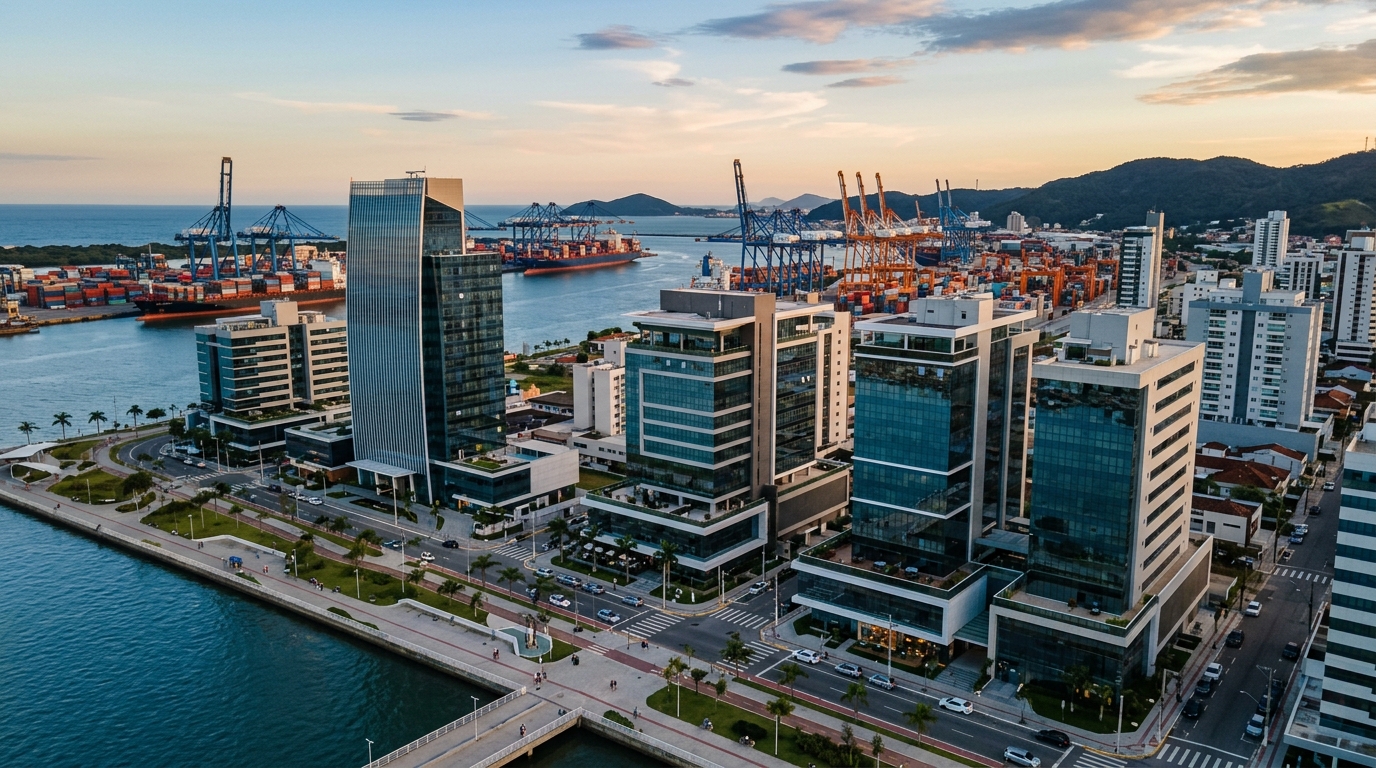
The Port of Itajaí and its neighbouring terminal Portonave together handled more than 1.5 million TEUs in 2024, and projections published by the port authority and Brazil's port operators' association (ABTP) point to over 1.6 million in 2026. This logistical engine — which has turned the Centro/Fazenda/Cordeiros triangle of Itajaí into one of the densest commercial hubs in Santa Catarina — sustains a quiet but constant demand for small office spaces of 30 to 80 square metres, occupied by customs brokers, maritime law firms, freight forwarders, customs clearance houses and trading companies. It is precisely this asset class, and the real return it delivers to the investor in 2026, that this analysis examines.
The starting point is not the marketing brochure — it is the spreadsheet. With Brazil's Selic rate (the central bank's base interest rate) sitting in double digits through most of 2025 and 2026, the investor weighing a commercial office in Itajaí needs a blunt answer: what is the minimum net yield that justifies giving up the comfort of Tesouro IPCA+ (Brazilian inflation-linked sovereign bonds) for the risks of vacancy, default and obsolescence? The numbers show there is room — but the gap between a good buy and a bad one is narrow, and the port environment carries peculiarities that set this market apart from any other mid-sized Brazilian city.
The Port as a demand engine: why downtown Itajaí sustains commercial leasing
The first thing that separates Itajaí from other mid-sized Brazilian cities is the sectoral concentration around port activity. The Itajaí Port Complex — the public port, Portonave in neighbouring Navegantes, Poly Terminais and Teporti combined — accounts for a meaningful share of southern Brazil's animal-protein and pulp exports, and handles a heavy flow of refrigerated containers. That flow creates an administrative chain that must sit minutes from the berths: clearing cargo, filing import declarations, dealing with the Receita Federal (Brazilian federal tax authority) and MAPA (the agriculture ministry), dispatching trucks on tight windows.
The result, on the map, is the specialisation of the Centro/Fazenda/Cordeiros triangle. Centro concentrates maritime and tax law firms, customs consultancies and traditional clearance houses — a tenant profile that takes 35 to 70 square-metre offices with on-site staff and walk-in service. Fazenda, the more residential neighbourhood, has been receiving new corporate floors that attract expanding customs brokers and small-to-mid trading companies. Cordeiros, neighbouring the BR-101 highway and the access route to Portonave, draws logistics operators and foreign-trade back-office teams, with larger floor plates and on-site parking as a deal-breaker.
The tenant profile matters because it defines ticket, contract length and stability. Mature brokers and law firms tend to sign 60-month leases, post bank guarantees or rental insurance, and rarely change address — the switching cost in foreign-trade operations goes well beyond the rent itself. Smaller trading companies and early-stage operators churn more, which translates into vacancy and re-leasing costs that the investor must price in before closing the purchase. In 2025, the average re-leasing window for commercial offices in downtown Itajaí ranged between 60 and 110 days, according to data consolidated by local brokerages and cross-checked against the FipeZap Comercial index (Brazil's leading commercial real-estate price tracker).
The real math: from gross yield to net cap rate
The most expensive mistake an inexperienced commercial-office investor makes is reasoning in gross yield. The correct calculation starts with annual rent, but deducts costs that, taken together, erode the return by 25% to 35% in the first year of operation and by 18% to 25% in steady-state years. Before any comparison with Selic or inflation-linked bonds, the net cap rate — the ratio of Net Operating Income (NOI) to acquisition cost including all entry expenses — has to be built from the ground up.
Consider a real, replicable case: a 45 square-metre office in downtown Itajaí, monthly rent of R$ 4,200 (roughly USD 770 at mid-2026 exchange rates), monthly condominium fee of R$ 522 and pro-rata monthly property tax (IPTU) of R$ 61. At first glance, R$ 50,400 of annual rent on an acquisition value of R$ 650,000 (around USD 119,000) would deliver a gross yield of 7.75% per year — above the coastal residential average, and seemingly competitive. The catch is that this number ignores how the asset actually operates.
Subtract from the annual rent: two months of vacancy (R$ 8,400, assuming the long-term average of 2.0 months per year), 8% property-management fee (R$ 4,032), property tax and condominium fees paid by the owner during vacant months (R$ 1,166), reserve for refurbishment and tenant fit-out amortised yearly (R$ 2,500), property insurance (R$ 900) and one-off expenses for painting, inspections and assorted fees (R$ 1,000). NOI drops to roughly R$ 32,400, which over R$ 650,000 delivers a net cap rate of 4.98% per year — about 0.41% per month, below the bar of any investor looking at the Tesouro IPCA+ 2035 bond offering, in 2026, a real yield close to 6.5% per year.
For the same office to deliver 0.55% to 0.70% net per month — the band that justifies the risk of the asset class in 2026 — the acquisition price has to fall. Holding the cost structure constant, the break-even at 0.60% net per month sits near R$ 540,000, and at 0.70% near R$ 462,000. That reverse-engineering, not the listing price, should drive the negotiation. In markets like downtown Itajaí, where the average advertised ticket for offices of that size ranged between R$ 11,000 and R$ 15,000 per square metre in 2025, there is real room to negotiate 12% to 18% off the asking price on assets with pending refurbishments or in estate-sale transfers.
The minimum spread over fixed income
Comparing a commercial office to Tesouro IPCA+ without adding a risk premium is the second structural mistake. Public fixed income has no vacancy, no defaults, no relevant exit cost and daily liquidity. The investor willing to take all those risks should demand, as a rule of thumb built by Brazilian REIT managers, a minimum spread of 2.5 to 3.5 percentage points over a duration-matched NTN-B (the Treasury's inflation-linked benchmark). With long IPCA+ trading at 6.5% real per year in 2026, that means demanding a net real cap rate between 9.0% and 10.0% — hard to find in stabilised assets in Centro, but feasible in offices that combine acquisition discount, controlled refurbishment and a long-term lease already in place.
Indexation, contract and guarantees: where investors lose money in the details
Brazil's tenancy law (Lei 8.245/91), read in its commercial chapter, gives the landlord more latitude than in residential leases — but also more responsibility. The standard commercial lease in Itajaí runs for 60 months, a term that guarantees compulsory renewal through a renewal action if the tenant meets the requirements of Article 51. That is a point in favour of landlords seeking stability, but it is also what turns the choice of inflation index into a decision worth years of cash flow.
Through 2025 and 2026, the practical debate has centred on three indices. The IGP-M, historically the market default, has been viewed with suspicion since its 2020–2022 rollercoaster and has lost ground in new contracts. The IPCA (Brazil's consumer price index) is the natural replacement, accepted by professional tenants and regarded as neutral by landlords in an environment of anchored inflation. The INCC (the construction-cost index), more typical of pre-construction sales, has been appearing in atypical build-to-suit leases that involve refurbishment by the landlord.
For a finished office with a professional tenant, IPCA is the balanced choice: it adjusts rent to consumer inflation, does not spike with currency shocks the way IGP-M does, and is accepted without friction by the tenant's accountants. In long contracts, the technical clause that most protects the investor is the negotiated review provision — not the annual adjustment, but the right to seek judicial revaluation every three years at market value, provided for in Article 19 of the law, which shields the landlord from real losses during local cycles of strong appreciation.
On guarantees, the Itajaí market alternates between bank guarantees (rare, expensive, but liquid in case of default), rental insurance (more common, costing the tenant 8% to 14% of annual rent), and a security deposit equal to three months' rent held in a linked savings account. The choice is not neutral: rental insurance simplifies enforcement but does not cover material damages; the deposit is too thin to absorb long defaults; the personal guarantor, still encountered, has become close to unenforceable in court.
The port-side risks that don't show up in the listing
The Port of Itajaí is a demand engine — but it is also a concentration of risk. Four specific risks set this market apart and have to be priced into the required cap rate.
The first is the seasonality of foreign trade. Port activity contracts in short cycles when the exchange rate squeezes exporters' margins, or when sanitary and regulatory issues hold up shipments. The 2020–2022 dredging episode, when silting of the channel redirected cargo to Navegantes and Imbituba further south, showed how quickly volumes can migrate. Tenants in the sector feel it before any other segment, and late rent is the first warning signal.
The second is sectoral concentration. On entire blocks of Centro, more than 70% of offices are leased to companies tied, directly or indirectly, to the port. A prolonged strike, a regulatory shift at the federal tax authority, or a wave of mergers in the customs-brokerage industry can release a synchronised flood of empty offices — and the market absorbs that supply over months, not weeks.
The third is the obsolescence of older buildings. Commercial buildings erected in the 1980s and 1990s, without structured cabling, without central air conditioning, with elevators of limited capacity, lost appeal as newer developments — projects like Mirante do Porto, contemporary buildings along Genésio Miranda Lins avenue and new towers in Fazenda — delivered modern corporate floors. The rent gap between a new office and an old one of the same size reaches 35% in 2026, and the trend is widening.
"A commercial office in Itajaí delivers a premium over fixed income only if the investor understands they are buying a piece of the port logistics chain — not a piece of real estate. The day that chain reorganises, rents react before prices."
The fourth risk is the re-leasing window. A well-priced residential unit on Beira-Rio leases in 30 to 45 days; a commercial office in downtown Itajaí, under normal conditions, takes 60 to 110 days between move-out and new occupancy — and in bad windows, more than six months. That gap is not folklore: it is negative cash flow over months, with property tax and condominium fees coming out of the owner's pocket.
Commercial office vs. Beira-Rio residential vs. Cordeiros warehouse vs. REITs
The rational decision for an investor with R$ 400,000 to R$ 1.2 million (roughly USD 73,000 to USD 220,000) to deploy in Itajaí in 2026 is not to buy the first office that comes along, but to compare the risk-return ratio of this asset class against the real alternatives available in the same market and on capital markets. The table below consolidates the typical ranges observed in 2025 and the projections for 2026.
| Asset class | Typical net monthly yield | Average annual vacancy | Exit liquidity | Main risk |
|---|---|---|---|---|
| Commercial office — downtown Itajaí | 0.55% – 0.75% | 1.5 – 2.5 months | Low: 4–9 months | Vacancy and obsolescence |
| Commercial office — Fazenda/Cordeiros (new floors) | 0.50% – 0.65% | 1.0 – 2.0 months | Medium | Neighbourhood maturation |
| Residential — Beira-Rio Itajaí | 0.35% – 0.45% | 0.5 – 1.5 month | Medium-high | Yield compression |
| Logistics warehouse — Cordeiros/Itaipava | 0.65% – 0.85% | 2.0 – 4.0 months | Low | Single-tenant exposure |
| Listed REITs (XPLG, BRCO, KNRI) | 0.65% – 0.80% (dividend yield) | Diversified | High: daily | Share-price volatility |
| Tesouro IPCA+ 2035 | ~0.55% real per month | Zero | High | Mark-to-market |
The reading is uncomfortable for anyone expecting the commercial office to dominate the table. On pure yield, diversified corporate REITs and logistics warehouses compete head-on — and offer, respectively, daily liquidity and lower exposure to one specific port cycle. The commercial office in Itajaí wins in three specific situations: when the investor secures a meaningful acquisition discount, when the tenant is a professional with a long lease already in place at the time of purchase, and when the asset sits in a new building with the features that protect against obsolescence.
It is in this context that new commercial developments have played a meaningful role in renewing the stock. Local-pedigree builders, among them SIDE Empreendimentos, have been delivering corporate floors designed for the port-side tenant profile — generous ceiling heights, adequate technology infrastructure and realistic parking ratios — features that translate directly into lower vacancy and lower obsolescence risk across the 10-to-15-year cycle typical of this kind of investment.
Investor checklist: due diligence, ownership structure and exit strategy
The decision to buy a commercial office in Itajaí in 2026 should be preceded by a sequence of verifications that separates the amateur from the professional investor. Before submitting an offer, it is mandatory to pull the up-to-date title certificate, review the condominium bylaws (some prohibit specific activities), check tax compliance with the municipality, verify the actual floor area against the title and the floor plan, and — a step frequently skipped — read the minutes of the latest condominium meeting to find structural works that will trigger extraordinary assessments over the next 24 months.
On the tenant side, the cross-check matters: how long the company has been in foreign-trade operations, dependence on a small client base, quality of the guarantee, average age of the team, and stated expansion plan. A tenant relocating because of growth sends a different signal than one downsizing. Experienced investors talk to the current landlord before closing on an occupied property and request the past 24 months of rent payment statements.
The ownership structure deserves a tax review. As an individual, a Brazilian taxpayer pays rental income tax on a progressive table — marginal rate of 27.5% on meaningful brackets. A patrimonial holding company under the "lucro presumido" regime (Brazil's presumed-profit corporate tax regime) is taxed on rent at roughly 11.33% (PIS, Cofins, IRPJ and CSLL combined over a presumed-profit base of 32%), and capital gains on resale can be planned more efficiently. The inflection point usually sits around annual rental income above R$ 150,000 — below that, the cost of running the holding eats the tax saving. Foreign buyers face a separate set of rules: rental income from Brazilian real estate is taxed at 15% withheld at source if the owner is non-resident, and a Brazilian CPF (taxpayer ID) and authorised legal representative are required at registration.
The exit strategy is the part of the plan nobody writes down — and the part that defines the real return. The investor must define, at the moment of purchase, the scenario for selling: target exit cap rate, maximum holding period, sell trigger in case of building obsolescence, and whether to sell occupied (preserves value) or vacant (accelerates the sale but loses 8% to 15% of price). Without that discipline, the investor who enters with a 10-year horizon ends up carrying a 20-year asset by inertia, and along the way obsolescence consumes the real return.
What to watch from here
Three variables will define the trajectory of commercial-office cap rates in Itajaí over the 2026–2027 cycle. The first is the path of the Selic rate — any sustained cut opens room for the yield compression demanded by the market, which would re-rate assets bought in 2026 at fatter cap rates. The second is the delivery of new corporate floors along the Fazenda/Genésio Miranda Lins axis, which may put pressure on rents in older downtown offices. The third is the progress of the dredging and modernisation works at the Itajaí port channel, whose full completion would recover the scale lost to Navegantes and bring administrative flow back to Centro.
In parallel, the attentive investor should monitor three aggregate indicators: the regional FipeZap Comercial index, the quarterly reports from Secovi-SC (Santa Catarina's real-estate union) on vacancy and average ticket, and the sectoral indicators from ABRAINC and CBIC that flag the pipeline of new deliveries. Together, these data points anticipate movements in rent and sale prices in the local market by six to twelve months.
Bottom line
A commercial office near the Port of Itajaí in 2026 is not the simplest real-estate thesis available to the Brazilian — or foreign — investor. Under narrow conditions, however, it can be one of the most defensible. The math only works when the net cap rate delivers a clear premium over Tesouro IPCA+, when the tenant is a professional with a long contract, when the building can withstand the next decade of obsolescence, and when the exit strategy was defined before the deed was signed. Outside those pillars, the investor is buying a story, not cash flow.
Readers who want to follow the next moves of the Itajaí, Praia Brava and north-coast Santa Catarina property and capital markets in depth can subscribe to the weekly analysis on the SIDE Empreendimentos portal, which cross-references cap rates, official indices and the new-development pipeline for investors who decide with numbers before adjectives.