Signature Architecture in Itajaí: Worth the 22% Premium?
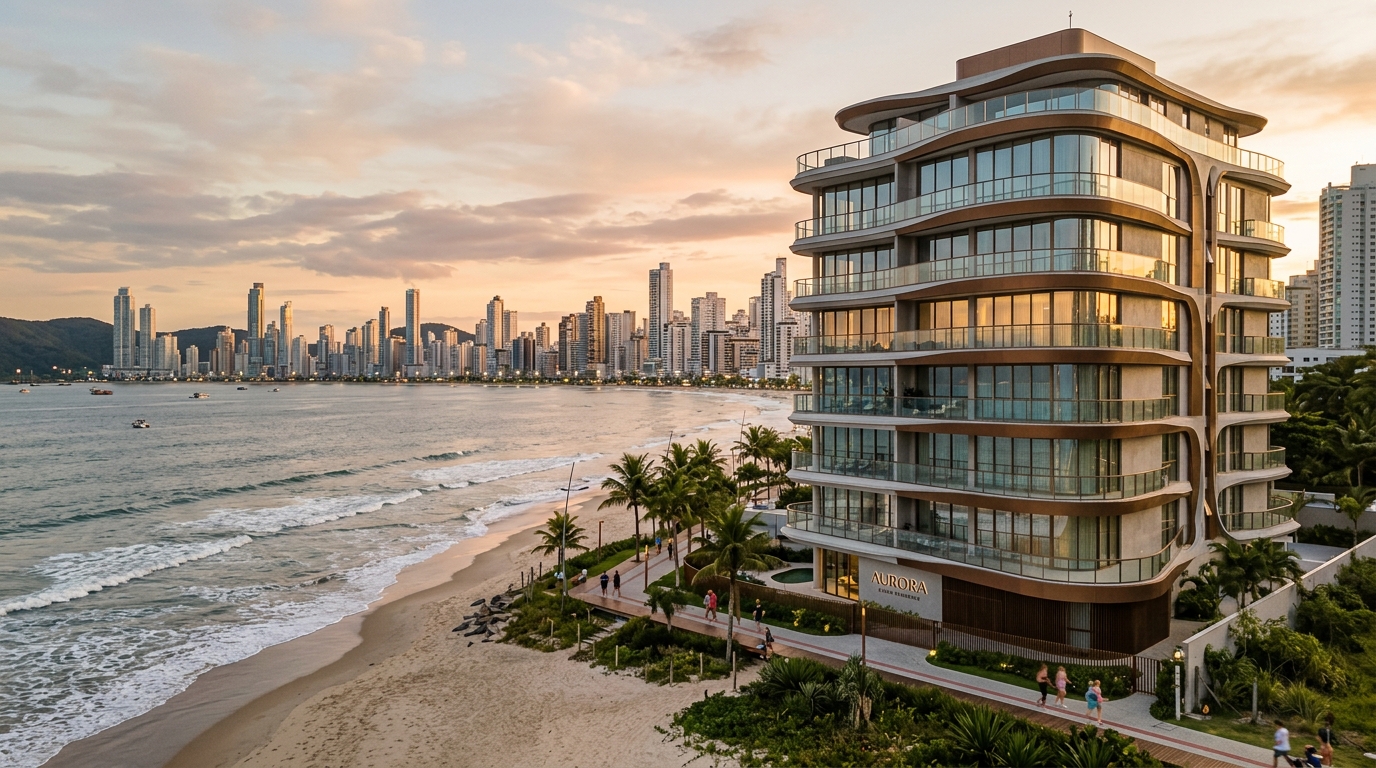
In May 2026, a 180 m² unit in an Italian-signature tower on Praia Brava traded for R$ 4.1 million — roughly 19% above the average per-square-metre price of conventional towers two blocks inland, according to a survey circulating among brokers affiliated with Secovi-SC, the Santa Catarina real-estate trade association. The question that defines the investor's thesis is not whether the building is beautiful. It is whether the 12% to 22% spread the "designer label" charges over the surrounding per-square-metre price translates into measurable return by the exit — or evaporates in the first downturn of the FipeZap index, Brazil's most-followed residential price benchmark.
Over the past three years, the northern coast of Santa Catarina has become Brazil's showcase for co-branding between developers and global design and hospitality marques. Itajaí, Balneário Camboriú and Itapema now host the highest density of branded residences per kilometre of shoreline in the country, ahead even of São Paulo's Faria Lima corridor and Rio's Leblon. The trend has genuine demand behind it — but it also has zones where the premium charged no longer matches the value delivered. This piece dissects both sides for the foreign buyer weighing an entry.
What "signature architecture" actually means — and why the SC coast became a laboratory
"Signature architecture" is an umbrella term. Underneath it sit three models with very different economics. The first is the starchitect approach: a prestigious international practice is hired for the architectural design and, in some cases, the interiors of common areas. The second is the pure branded residence, where a luxury label licenses its name, finish standard and, in some deals, the operation and services as well. The third is co-branding with luxury hospitality, where a hotel flag operates the common areas and offers hotel-grade services to residents.
Names that have appeared in the recent Santa Catarina pipeline illustrate each tier. Pininfarina has signed projects in Brazil for over a decade, exporting Italian industrial aesthetics to residential towers. Yoo, founded by John Hitchcox, distributes global interior design with curated furniture packages. Fasano, the Brazilian luxury hospitality brand, exemplifies co-branding with active service operation. Each charges a different premium and delivers a different operational counterpart. Treating the three as interchangeable is the first mistake the buyer makes.
Why the SC coast became the laboratory comes down to three converging factors. Demand from São Paulo and Rio Grande do Sul buyers for premium second homes rose faster than inflation through the 2021–2024 cycle. Annual launched VGV — the sector shorthand for total general sales value of new launches — crossed R$ 12 billion in 2024 for the Balneário Camboriú–Itajaí–Itapema axis alone, according to monitoring by Brain Inteligência Estratégica, the Brazilian real-estate research firm. And the saturation of the prime oceanfront strip pushed developers to compete not on floor count or built area — both already brushing regulatory ceilings in several stretches — but on intangible differentiation. Brand is the natural vector for that fight.
What the premium costs — broken down per square metre
Numbers observed in 2025–2026 along the BC–Itajaí axis show premium ranges of 12% to 22% over the comparable per-square-metre price of the surrounding stock, depending on the signature + operation combination. In stretches like Praia Brava and the central strip of Balneário Camboriú, the launch price for conventional premium towers sits between R$ 18,000 and R$ 24,000 per m². Towers with strong signature plus hotel operation crossed the R$ 28,000/m² mark and, in a handful of cases with continuous ocean frontage, surpassed R$ 32,000/m². The gap between the two worlds widened, not narrowed, through 2025.
| Product tier (Itajaí/BC shoreline, 2025–2026) | Launch price per m² | Premium vs. conventional tower | Source of the premium |
|---|---|---|---|
| Premium conventional tower | R$ 18,000–24,000 | Baseline (0%) | Location, build quality |
| Starchitect (design only) | R$ 21,000–27,000 | +10% to +14% | Fees, specified materials |
| Branded residence (design + curation) | R$ 24,000–30,000 | +16% to +20% | Licence, finish standard |
| Hotel co-branding (active operation) | R$ 27,000–33,000 | +18% to +22% | Operation, recurring services |
Decomposing the premium is the exercise that separates the investor from the emotional buyer. Four components form the spread. The architectural design itself weighs relatively little — between 1% and 3% of total construction cost, even with a foreign practice. The materials and finishes specified by the brand weigh more, often 4% to 8%, because specifications force imports or pre-selected domestic suppliers. Common areas and the amenity programme account for another 3% to 6%, especially when there are multiple pools, spa, beach club or hotel services. And the brand licence, plus the operator's management fee where it exists, rounds out 2% to 5%.
INCC — the National Construction Cost Index, the Brazilian benchmark for sector inflation — enters as a risk variable, not a stated cost. The INCC-M variant ran at roughly 6.8% over the twelve months to April 2026, according to the Getulio Vargas Foundation (FGV) series. In products with heavy imported specification — Italian signature work and curated international furniture, for example — exchange-rate sensitivity amplifies the effect. An off-plan purchase contract with INCC indexation during construction and uncapped FX exposure on the finishing tranche is a combination that deserves an explicit ceiling clause. Without one, the launch-day premium can grow another 4 to 6 real percentage points by handover.
What the brand actually delivers financially — four metrics that matter
The developer's pitch is usually that the brand accelerates absorption at launch, holds price on resale, compresses vacancy and pushes seasonal rental cap rates higher. Each of those claims has partial evidence and needs to be tested with neighbourhood-specific numbers, not national averages.
Resale spread over three to five years. In recent comparables on the central Balneário Camboriú strip, units in strongly signed towers that entered the secondary market between 2023 and 2025 showed nominal appreciation of 28% to 41% over launch table prices, versus 18% to 26% for conventional towers in the same period and radius. The net spread, after INCC indexation and transaction costs, settled around 6 to 9 percentage points in favour of the signed tower. That is a meaningful differential — but far from the "double your money" narrative circulating in sales decks.
Seasonal rental cap rate. Here the gap is clearer, but the universe is smaller. Apartments in towers with active hotel operation show gross seasonal cap rates between 7.5% and 10.5% per year over an extended high season (December to March plus winter holidays), versus 5.5% to 7.5% for premium towers without operation. On a net basis — after the operator's fee, broker commission, condo dues, IPTU (the annual municipal property tax) and furniture depreciation — the spread narrows to 1.2 to 2.0 percentage points. Still positive, still relevant, but a long way from the doubling some brochures imply.
Vacancy and absorption speed. This is the most consistent data point. Launches with strong hotel co-branding along the BC–Itajaí axis absorbed on average 70% of stock within 90 days of launch through 2024 and the first half of 2025, according to monitoring by ABRAINC, the Brazilian association of developers. Conventional premium launches landed between 35% and 55% over the same window. For the developer this lowers construction financing cost and frees working capital faster — an effect partially passed through to the initial unit price. For the quick-exit investor it is the strongest argument on the positive side.
"The brand premium is collected in full at signing. Delivery only materialises over eight to twelve years of operation. Buying a signed apartment is buying a long-term promise at a spot price — and that asymmetry is the blind spot of the less experienced investor." — development analyst interviewed for this article
Five traps where the premium fails to hold
The first is the facade-only signature. The famous practice designs the envelope and the lobby. The rest of the building — apartments, technical areas, garage, service zones — follows the local builder's standard with no distinction. The buyer pays a premium across the entire square-metre count, but the "signed" portion covers less than 10% of built area. Test question: does the architecture office sign the technical specification of the apartments, or only of the common areas? If the answer is "common areas only," the fair premium drops to the 4% to 8% range, not 18%.
The second is the absence of local operation. Co-branding with hospitality that actually operates requires a permanent local team, a long-term hotel management contract and a periodically audited international standard. There are cases along the Santa Catarina axis where "operation" amounts to a booking app and a brand on the gate. No team, no standard, no audit — no hotel-grade cap rate. The 18% to 22% premium those products charge has no real counterpart and tends to correct downward from the third resale onward.
The third is excess of identical units. A single tower with 240 nearly identical apartments — same area, same view — guarantees programmed saturation of the secondary market. The moment three owners decide to sell at the same time, the floor price of the whole neighbourhood drops because the listings compete with each other. Branded residences work better with vertical product in a small number of well-differentiated typologies — penthouses, full-floor units, family layouts — and a compressed total unit count.
The fourth is the inflated condominium. Extensive common areas, a full hotel programme and recurring services produce monthly condo dues that, in some BC–Itajaí products, exceed R$ 25 per m² per month. On a 180 m² unit that is R$ 4,500 a month — before IPTU, before private maintenance. That recurring cost eats into the rental cap rate and shrinks the resale buyer pool. Demand, before signing, a realistic condo simulation under full operational regime, not the optimistic launch estimate.
The fifth is the brand licence with a fixed term. Brand licensing contracts, especially with international hotel flags, typically run 10 to 20 years with non-automatic renewal clauses. The buyer needs to understand what happens to the asset's value when the brand exits — and who decides on renewal. The condominium bylaws should require a qualified quorum to change brand and a defined transition rule. Without that, the premium baked into the purchase price becomes a liability at the end of the term.
Investor checklist — due diligence in seven steps
Step 1. Verify the development's registration at the competent real-estate registry (cartório de imóveis) and cross-check with the developer's record at ABRAINC and Secovi-SC. Track record of on-time deliveries, halted projects and contract cancellations is partly public and available on direct query. A first-time developer attempting strong-signature product is a yellow flag, not a red one — but it demands additional collateral.
Step 2. Request and read the brand licensing contract in full, not the sales summary. Term, royalties, required standard, termination conditions, succession in case of a change of control at the licensor. If the developer refuses to provide that document to a pre-contract buyer, the signal is already red.
Step 3. Pull comparables within a 500-metre radius using FipeZap for monthly per-square-metre averages over a 24-month series and Secovi-SC for registered transaction data. Cross-reference active listings of secondary units in towers with comparable brands. If the signed tower already has secondary units priced below the developer's remaining table price, the premium is already correcting.
Step 4. Model the exit under three scenarios. Resale 36 months after handover at market launch comparables and INCC indexation during construction. Seasonal rental income over 60 months net of all costs. A hybrid — seasonal rental for 24 months, resale at month 36. Target cap rate to qualify the investment as attractive in the BC–Itajaí axis in 2026: 5.5% net for the income profile, 9% nominal annualised for the resale profile.
Step 5. Stress-test with the Selic — Brazil's central-bank policy rate — at 16% and IPCA, the official consumer-price index, at 7%. Both scenarios are plausible within a 36- to 48-month construction horizon. Under those assumptions, what is the project's real IRR? If the real IRR drops to near long-duration floating-rate fixed income, the brand premium is not paying for itself — it is merely absorbing the opportunity cost.
Step 6. Evaluate the contract under a swap structure. In some launches along the axis, developers accept payment in kind through land or other property contributed as part of the purchase price (permuta). The tax engineering of that structure completely changes the net IRR and deserves dedicated accounting analysis before signing.
Step 7. Confirm financing eligibility for the foreign buyer where applicable. Brazilian banks accept lending to non-residents under specific conditions — proof of foreign income, a non-resident bank account (the so-called CDE account), additional collateral. High-ticket branded product has carried a meaningful share of foreign buyers along the Santa Catarina axis since 2023, especially Argentine, Uruguayan and Paraguayan. Understanding the exit buyer pool helps calibrate liquidity.
Local angle — Itajaí, BC and Itapema in 2026
The 2026–2028 pipeline for the axis is mapped by Brain and by CBIC, the national construction industry chamber, with reasonable precision. Itajaí concentrates the largest proportional expansion, with Praia Brava and Cabeçudas absorbing the bulk of signed launches. Balneário Camboriú remains the leader in average ticket size, but with growing pressure from land cost and the scarcity of oceanfront lots. Itapema is growing in volume and still offers a smaller relative premium — which can be opportunity or a sign of an immature market, depending on the stretch.
Foreign demand is a structural variable. Argentina and Uruguay accounted, in 2025, for a meaningful share of sales of units above R$ 3 million along the axis, according to monitoring by regional brokerages affiliated with Secovi-SC. A relatively strong US dollar, political instability in the River Plate region and regional airport infrastructure all feed that demand. The expectation for 2026 is continuity of the flow, albeit with quarter-to-quarter volatility.
Saturation by stretch. Praia Brava still has healthy absorption and few launches per year — the relative scarcity of land protects pricing. The central Balneário Camboriú strip between Avenida Atlântica and the second block runs near both the regulatory and demand ceilings; new signed launches need very strong differentiation to justify additional premium. Praia dos Amores and the northern BC strip continue to carry heavy pipelines and warrant caution: a signed tower in those stretches charging a premium above 15% is likely pricing in appreciation that has not yet shown up in secondary stock.
Recommendation by profile. For the owner-occupier with low liquidity sensitivity, a branded residence with active hotel operation delivers a real counterpart in services. The premium is justified as a quality-of-living cost, not as an investment. For the seasonal-income profile, the equation only closes with a real operation in a stretch of proven demand — Praia Brava and the central BC strip qualify, newer stretches require a discount on the acquisition price. For the 36- to 48-month resale profile, the bet is on starchitect product with supply scarcity in the stretch, not on branded residences pulverised across a single high-unit-count tower.
Conclusion — the premium is real, but it is not uniform
The 12% to 22% spread that signature architecture commands over conventional per-square-metre pricing on the Santa Catarina coast is real and is documented in transaction data. The return question decomposes into four smaller questions. Who signs, and to what depth. Who operates, and under what contract. How saturated the specific stretch is. And what the exit horizon looks like. When the four answers align, the premium pays for itself comfortably and the product delivers a real IRR above long-duration fixed income across the two macroeconomic cycles plausible for 2026–2030. When one of them fails — signature only at the facade, no real operation, a saturated stretch or a tight exit — the premium becomes a liability embedded in the acquisition price.
The BC–Itajaí–Itapema axis will deliver, over the next 36 months, more branded residences than it did over the entire previous decade. An investor entering now will need the checklist above far more than the marketing pack. Readers who prefer to track the cycle through weekly analytical reading — FipeZap numbers, new launches along the axis, and a sector-applied reading of Selic and INCC — can subscribe to the analysis on the SIDE Empreendimentos portal. It remains, in 2026, the fastest way to separate the premium that holds from the premium that merely prices narrative.