Ressacada Itajaí: Is Off-Plan Investing Worth It in 2026?
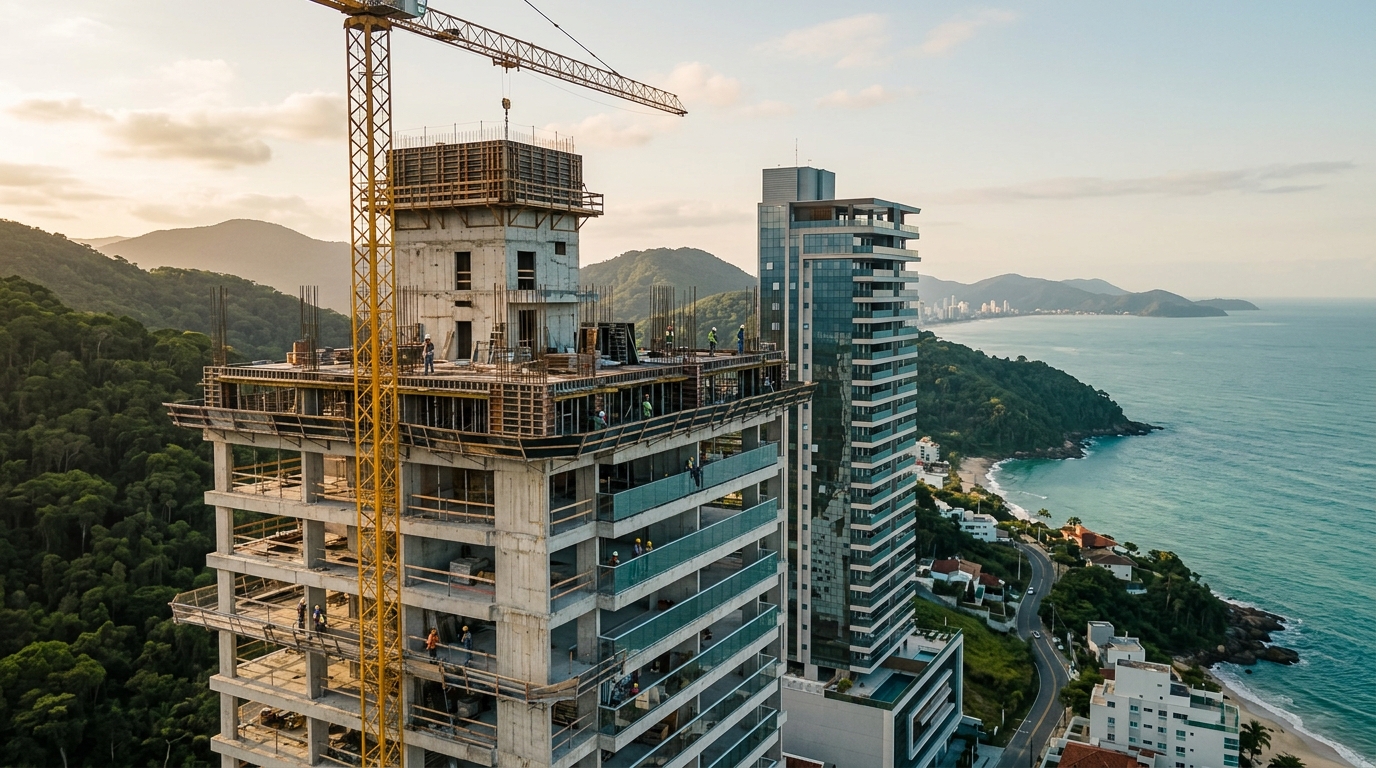
The advertised price per square meter in new off-plan launches in Ressacada, a neighborhood of Itajaí on Brazil's southern coast, closed May 2026 oscillating between R$ 9,200 and R$ 11,800 — roughly USD 1,650 to USD 2,100 at current rates — according to cross-checked figures from Secovi-SC (the Santa Catarina real-estate industry body) and FipeZap (Brazil's reference price index). That is 45% to 60% below what Praia Brava commands within the same survey window. The detail worth noting: the spread was 70% to 80% back in 2023. For an investor entering now, the question is no longer "will Ressacada become the next Brava?" but rather "how much of that spread compression has already been priced in, and how much is still up for grabs?" Answering it requires modeling INCC (Brazil's construction cost index), Selic (the central bank's base rate), the developer's construction cash-call schedule, and Law 13.786 — not sunset photos.
Ressacada in 2026: a neighborhood that changed asset class
Ressacada is an urban-edge district in Itajaí, wedged between BR-101 — the federal highway that connects the Port of Itajaí to the rest of the country and to Navegantes International Airport — and the residential grid that pushes south toward Itapema. For a decade it was warehouse country: low-density horizontal condominiums, scattered logistics sheds, and underused lots. The turn began between 2022 and 2024, when the Praia Brava absorption cycle pushed mid- and high-end developers to look for scale. Brava, geographically boxed in by ocean on one side and topography on the other, simply ran out of land.
2025 figures from CBIC, Brazil's national construction industry chamber, already showed the inflection point in Itajaí: the municipality accounted for more than 18% of all vertical launches along the northern Santa Catarina coast, and Ressacada absorbed a meaningful share of project pipelines (VGV — gross sales value, a developer-side marketing metric) above R$ 200 million. The product profile shifted too. Single 30-story towers, almost no fractional-ownership or short-stay product, a clear focus on three- and four-bedroom units with expanded master suites. This is no longer the R$ 350,000 ticket aimed at short-term rental operators. It is the R$ 1.2 to R$ 2.5 million ticket aimed at end-users or long-term yield investors.
Three infrastructure vectors underpin the thesis and matter for any cash-flow model. First, the duplication of Avenida Osvaldo Reis toward Ressacada, with the city's delivery date set for 2027. Second, the expansion of the BR-101 bypass connecting the neighborhood to the port more directly, cutting logistics friction. Third, the arrival of mid-to-high-end retail operators — premium supermarkets, national-chain gyms, private clinics — which historically front-run residential consolidation and serve as a leading indicator of demand.
Itajaí's price per square meter: what the headline table hides
Most market commentary on Itajaí compares only Praia Brava to "the rest." An investor who reads only that contrast misses the intra-city supply structure, which is what actually prices risk. The table below maps the city's main districts by average advertised square-meter price in May 2026, drawing on public FipeZap data cross-checked against private developer panels.
| Neighborhood / area | R$/m² (delivered) | R$/m² (off-plan) | Off-plan vs. delivered spread | 12-month change |
|---|---|---|---|---|
| Praia Brava | 22,400 | 19,800 | -12% | +11% |
| Cabeçudas | 16,900 | 14,100 | -17% | +9% |
| Downtown (waterfront) | 13,500 | 11,700 | -13% | +7% |
| Fazenda | 12,300 | 10,400 | -15% | +8% |
| Ressacada | 11,100 | 9,600 | -14% | +14% |
Two readings matter. First, Ressacada leads the 12-month change not because delivered prices ran wild, but because the off-plan base jumped — reflecting larger, better-capitalized developers moving in with more expensive product. Second, the 14% spread between off-plan and delivered is now in line with Cabeçudas and Fazenda. In other words, the discount for buying in Ressacada at construction stage is no longer compensating an "emerging neighborhood" risk premium. Whoever bought in 2023 captured a 25% to 30% spread. Today the discount is market-standard, which means the math has to be done with a sharp pencil.
Off-plan versus delivered: the math that decides
An investor benchmarking off-plan property against Brazilian floating-rate fixed income has to model three things in parallel: nominal monthly cash outlay, the INCC impact on the outstanding balance and installments, and the post-handover mortgage rate against the prevailing Selic. Without those three, any comparison against a CDB (Brazilian bank certificate of deposit) or a real-estate fund is narrative, not analysis.
Take a typical Ressacada launch in May 2026: a R$ 1.4 million unit, three bedrooms, 96 m² of private area, delivery scheduled for March 2029. Recent payment schedules tend to land around 30% paid during construction and 70% financed after handover — but distributed unevenly. Down payment of 10% (R$ 140,000) at signing, 20 monthly installments adding to 10%, two annual balloon payments adding another 10%, and the remaining 70% transferred to bank financing through SBPE — Brazil's regulated mortgage system funded by savings deposits — once the certificate of occupancy (habite-se) is issued.
Every installment and every balloon payment is adjusted by INCC-M until handover. With 12-month INCC running around 6.4% in June 2026 and full-year 2026 expected to close between 6.0% and 7.5%, the R$ 1.26 million outstanding balance (the 90% remaining after the down payment) grows by roughly R$ 76,000 in the first full construction year alone, before any installment is paid in. Across three years of construction, even with lower INCC readings along the way, the accumulated adjustment typically adds 14% to 19% on top of the original sticker. A unit bought for R$ 1.4 million arrives at handover with an effective financeable balance closer to R$ 1.58 to R$ 1.62 million.
This is where Selic enters. In the June 2026 scenario, with Selic at 9.75% after the easing cycle that began in the second half of 2025, SBPE residential mortgages at the major Brazilian banks are pricing between TR (the Reference Rate, a low-volatility floor index) + 9.5% and TR + 10.9% per year at LTVs around 70%. On a 30-year Brazilian Price-table amortization schedule applied to R$ 1.1 million financed (the balance after handover, net of the 30% already paid), the opening monthly installment lands between R$ 9,900 and R$ 10,800 — before condo fees, IPTU (the annual municipal property tax) and fire-insurance premiums. If Selic prints above 11% during 2027, the picture changes materially: the installment moves to R$ 11,500 to R$ 12,300 and the project IRR collapses.
"Off-plan property is a long INCC position sold to fund a long position on real neighborhood appreciation. Investors who do not model those two legs separately are just hoping." — analyst at a publicly listed developer with Itajaí operations, in a background conversation with specialized press.
When does buying delivered beat buying off-plan? The defensible 2026 rule of thumb: when the off-plan vs. delivered spread is below 12% and the projected INCC over the construction window runs above 6% per year, buying a delivered unit with a mortgage tends to produce an equivalent or better IRR with near-zero execution risk. When the spread climbs above 18% and the Selic path is clearly declining into the delivery window, off-plan makes sense again. Ressacada today sits in the middle, on average — requiring fine project-by-project selection rather than a broad neighborhood thesis.
The real risks: Law 13.786, contract termination and developer counterparty
Law 13.786/2018, known in Brazil as the Distrato Law (the "Termination Law"), is the most important and least-read document for the typical buyer. It establishes that if the buyer walks away from a contract in a development not protected by patrimônio de afetação — a legal regime that ring-fences each project's assets and cash flows from the developer's broader balance sheet — the developer can retain up to 25% of the total amount paid in. With patrimônio de afetação in place, that retention rises to up to 50%. In practical terms: if you paid R$ 200,000 into a ring-fenced project and decided to exit in year two, you might recover between R$ 100,000 and R$ 150,000. Not a total loss, but also not the "I'll sell if I change my mind" scenario aggressive sales floors imply.
The same law regulates delivery delays from the developer side: a 180-calendar-day grace period beyond the contractual delivery date is allowed with no penalty. Past that, the buyer can request termination with full inflation-adjusted refund, or instead collect a 1% per month penalty on amounts paid. Construction delay remains one of the most underestimated risks at mid-sized developers in Ressacada, especially among projects launched during the 2022-2023 demand peak. Several of those sites already carry schedule amendments.
Developer counterparty risk is measurable, and it demands balance-sheet due diligence, not showroom enthusiasm. Three non-negotiable items before signing any Ressacada contract: confirm the incorporation memorial (memorial de incorporação) is registered at the competent Real Estate Registry (Cartório de Registro de Imóveis), verify the project is under patrimônio de afetação (both the contract clause and the registry annotation), and audit the company's delivery track record over the past five years. For privately held developers, standard financial statements and the list of delivered projects are available on formal request. A refusal to provide them is itself a signal.
There is also local regulatory risk. A construction permit (alvará de construção) issued today does not guarantee a future habite-se. Updates to Itajaí's master plan (Plano Diretor), under discussion for the second half of 2026, may affect height limits in specific zones — although Ressacada is currently outside the revision-pressure areas, the long-horizon investor needs to track the discussion.
The fifth risk, often forgotten, is secondary-market liquidity. Ressacada does not yet have a deep resale market for R$ 1.5 to R$ 2.5 million units. Selling a new off-plan unit before handover, through a cession-of-rights structure (cessão de direitos), typically means accepting minimal premium or even a discount versus the developer's active price list when the same developer still has stock in the same building. It is a binary risk that must enter the model from day zero.
The 2026 macro backdrop: Selic, INCC and the northern-coast window
Brazilian monetary policy in 2026 sets the rhythm of the Santa Catarina real-estate cycle more than any local factor. The central bank's Focus survey of market economists projects a 2026 terminal Selic of 9.25% to 9.75%, with IPCA inflation closing the year near the upper tolerance band at 4.5%. INCC-M is expected to close between 6.0% and 7.5%, sustaining an uncomfortable 200 to 300 basis-point spread over IPCA — precisely the band that erodes the real return of anyone sitting in a multi-year construction cash flow.
According to consolidated figures from Secovi-SC and ABRAINC (the national developers' association), 2025 was a near-full-absorption year for new launches in Itajaí and Itapema, with deceleration in Balneário Camboriú at the ultra-luxury end. For 2026, launch volume in Itajaí is expected to stay flat, but with greater geographic diversification: Ressacada, Cordeiros and Bambuzal absorbing supply that Praia Brava no longer accommodates. That implies rising supply pressure three to four years out — precisely when today's construction cycles deliver.
Foreign demand — mainly Argentine, Paraguayan, and to a lesser extent European — continues to support prices in Brava and Balneário Camboriú, but barely reaches Ressacada. The product does not have direct beachfront appeal. That is, paradoxically, good news for the Brazilian investor: less embedded foreign-exchange volatility in the price, more sensitivity to local fundamentals (Itajaí's median income, port-driven job creation, logistics cycle). Ressacada behaves more like a fundamentals-driven asset than the Brava waterfront, which increasingly trades as an international financial instrument.
For the foreign buyer asking whether SBPE financing is available: the short answer is no, unless you hold a Brazilian CPF tax ID, fiscal residency in Brazil and proven Brazilian-source income. For most international buyers the structure remains cash purchase, direct installment plan with the developer, or — more rarely — international bank financing with the Brazilian property as collateral, which is a slower and more expensive route. Currency hedging on the down-payment installments is a non-trivial line item international investors need to plan from the outset.
The mistakes that destroy the IRR — and nobody mentions in the sales gallery
There is a repeated pattern among first-time off-plan buyers in Ressacada who discover three years later that real returns landed below a Brazilian inflation-linked Treasury bond (Tesouro IPCA+). The mistakes are predictable, and almost all share the same root: confusing list price with total cost, and headline VGV with effective transaction price.
The first mistake is failing to add acquisition costs. ITBI (Itajaí's property transfer tax) ranges from 2% to 3% of the higher of assessed or transaction value. Registry fees run another 1% to 1.5%, and the final deed has its own costs. On a R$ 1.4 million unit, that adds up to between R$ 42,000 and R$ 63,000 — money paid out of pocket at signing, almost never reflected in the "yield" calculated on a broker's Excel sheet.
The second is ignoring IPTU and condominium fees during construction. Most projects start charging condominium fees from the second construction year, ranging from R$ 300 to R$ 900 per month depending on building size. Over three years, that adds between R$ 11,000 and R$ 32,000 of embedded cost. Combined with pro-rated IPTU from the handover date, this invisible drag can wipe out an entire year of projected rental income.
The third is confusing VGV with real price. VGV is the gross sales value publicly announced by the developer — a marketing metric reflecting full list price, with no discounts, no contra-deals, no flexible payment schedules. Real transaction prices for Ressacada towers launched in 2025 landed, on average, 7% to 12% below initial list, according to operators active in the secondary market. Comparing "VGV announced in 2024" with "transaction price in 2026" overstates the gain.
The fourth is underestimating INCC on the balloon payments. Each annual balloon typically runs from R$ 35,000 to R$ 60,000 on mid-ticket Ressacada projects, and each one arrives adjusted by accumulated INCC since signing. An original R$ 50,000 balloon, by the third year, can hit R$ 58,000 or R$ 60,000 depending on the cumulative index. On a mental spreadsheet it does not hurt; on real cash flow, it stings.
The fifth is failing to model the two possible exits separately. "Hold to rent" and "sell at handover" are different theses requiring different layouts, different floor plates and even different floor levels. For annual rentals in Ressacada in 2026, the sweet spot is the two-bedroom unit with one en-suite and a double parking spot — yielding around 0.42% per month on sale value, or roughly 5.0% per year gross. For sale at handover, the unit that appreciates most is usually the largest one, typically three en-suites with an integrated balcony kitchen. Buying the wrong unit for the right thesis cancels most of the upside.
Final checklist by investor profile
Three reasonable investor profiles are entering Ressacada off-plan today, and each one applies a different filter. The conservative profile, benchmarking against Brazilian inflation-linked Treasury bonds and mid-tier bank CDBs, only enters if: the off-plan vs. delivered spread sits above 15%, the developer has delivered more than ten projects and has patrimônio de afetação annotated on the registry, and the cash-call schedule is capped at 30% paid during construction. Below those thresholds, the rational conservative stays in fixed income.
The moderate profile, willing to accept execution risk in exchange for real-asset exposure and working with a five- to seven-year horizon, can accept spreads between 10% and 15% if the location inside Ressacada is on the southern axis (closer to Brava) and the layout is the three en-suite with double parking — historically the strongest performer on resale. Important caveat: model at least three Selic scenarios for the delivery window and hold a cash buffer equivalent to six post-handover mortgage installments.
The aggressive profile, treating real estate as a real-leverage vehicle and prepared to operate in the secondary market, should focus on towers launched within the past 18 months, buy larger layouts that still have flexible stock, and model an exit through cession of rights before handover within a 24-month window after purchase. This is the only profile that can accept spreads below 10%, precisely because the gain does not come from INCC offset by appreciation, but from the information asymmetry between launch sales galleries and the secondary market.
What matters, and what does not
Ressacada in 2026 is no longer "the next Brava at a discount." It is its own neighborhood with its own product, its own demand profile, and — crucially — its own risk profile. The investor entering now is no longer capturing an emerging-neighborhood spread; they are betting on the real appreciation of a consolidating district, against a macro backdrop of still-double-digit Selic on the horizon and corrosive INCC. The thesis works, but it does not work on its own — it depends on fine project selection, a cash-flow plan drawn with a sharp pencil, and a holding horizon that can tolerate delays.
For the investor comparing honestly against fixed income, off-plan in Ressacada pays when three conditions converge: a developer with an auditable balance sheet and registered patrimônio de afetação, an off-plan vs. delivered spread consistent with actual execution risk, and a layout matched to the exit thesis. Without those three, there are lower-friction instruments with shorter carry periods delivering the same return. With those three, the real asset enters the portfolio not as a competitor to short-term floating-rate yields, but as useful decorrelation against interest-rate and currency cycles — particularly relevant for international investors holding USD or EUR who want hard-asset exposure to Brazil without taking the open-ocean Brava premium.
That selection work — project by project, layout by layout, clause by clause — is exactly what SIDE Empreendimentos publishes in its editorial coverage. For readers who want to keep tracking analytical coverage of the northern Santa Catarina coast real-estate market at the depth of this report, it's worth subscribing to the portal's weekly newsletter and receiving the next analyses straight to your inbox.