Coastal Santa Catarina Land Appreciation in 2026
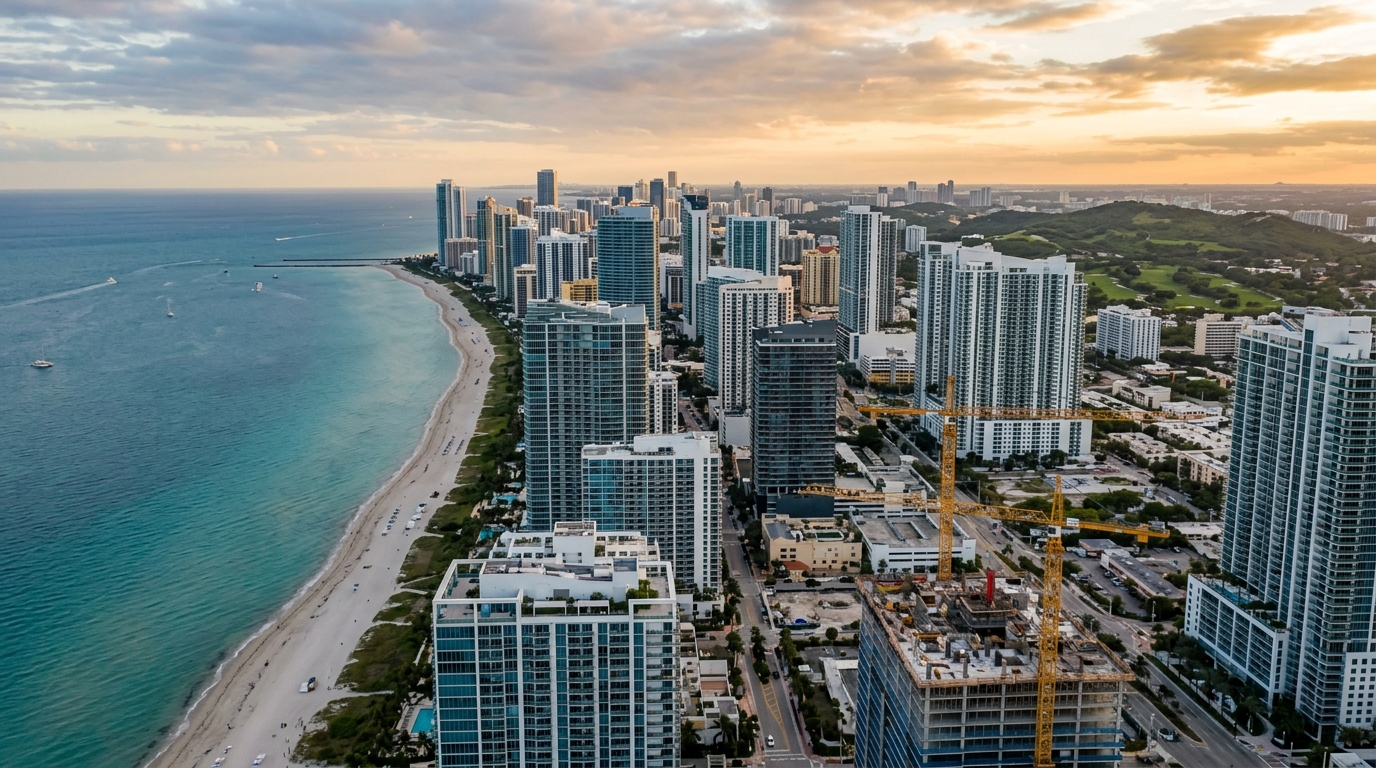
By May 2026, the listed price per square metre of new apartments in Balneário Camboriú was once again flirting with the R$ 12,500 mark, according to the FipeZap index, while neighbouring Itapema traded at roughly R$ 12,200 — a figure that, only five years ago, was effectively the ceiling for Florianópolis. Itajaí, the corporate city that hosts the country's second-largest container port, sits just behind, in a market where well-located urban plots rarely change hands for less than R$ 8,000 per square metre of buildable potential. For the international investor looking at hard assets backed by demographics and infrastructure, the central and northern coast of Santa Catarina has stopped being a frontier thesis: it is now one of the most contested compartments of the Brazilian real-estate balance sheet. The relevant question for 2026 is no longer "is it worth getting in" but "in which micro-region, at what price, and against which risk".
The 2026 picture in numbers: what FipeZap, Secovi-SC and CBIC are saying
The FipeZap index of new residential sales, published in partnership with Secovi-SC (the state real-estate trade body), has placed Balneário Camboriú at the top of the national ranking for more than three years. In its latest 2026 readings, the city posts an average square-metre price in the R$ 12,500–12,700 band, ahead of São Paulo and even certain Rio de Janeiro luxury enclaves on a like-for-like basis. Itapema is hovering near R$ 12,300, and Itajaí — with a thinner inventory of premium product — oscillates between R$ 9,000 and R$ 10,500. Within Itajaí, the gated micro-market of Praia Brava is recording icon-tower launches above R$ 25,000 per square metre.
The relevant figure is not the absolute level but the real variation. Between 2020 and 2025, the CBIC bulletin (Brazil's national construction-industry chamber) and Sinduscon-SC consolidated cumulative nominal growth above 110% in the average sale price in Balneário Camboriú, against an accumulated IPCA (Brazil's consumer price index) of roughly 38% and an INCC-DI (the construction cost index used to update off-plan instalments) of around 56% over the same window. In real terms, appreciation ran between 45% and 55% — a level rarely seen in mature markets. Itapema printed an even sharper move, with real gains approaching 70% in the same period, and Itajaí advanced about 40% above CPI.
The story those numbers tell is unambiguous: the coastal corridor between Itajaí and Balneário Camboriú has behaved as an asset, not as a consumption good. The structural question that follows is how much of that premium is recurring and how much is cap-rate compression driven by a temporary squeeze of low real rates and net inbound migration.
Micro-regions in accelerated cycles: where the entry window is
Treating the Santa Catarina coast as a single market is the first mistake of the foreign investor. In 2026, there are at least four distinct cycles running simultaneously, each responding to its own drivers.
Itajaí is in an industrial-port cycle. The expansion of the Port of Itajaí, the ongoing duplication of the BR-101 federal highway in its northern stretch, and the consolidation of the logistics hub around the regional airport have pushed demand for quality residential product near downtown, the São Vicente district, and especially the Praia Brava peninsula. ABRAINC-Fipe data for 2025 (the housebuilders' association joint index with Fipe) show Itajaí running one of the state's lowest cancellation rates — under 8% — combined with monthly absorption above its historical average, the textbook signature of real, non-speculative demand.
Itapema and Meia Praia remain the most speculative slice of the trio. The supply of land plots cleared for high-rise development shrank dramatically after the 2022 zoning revision, and the inventory-to-monthly-absorption ratio has fallen to six to eight months — the threshold that classically signals an overheating market. Here, land appreciation has decoupled from project feasibility, and a large slice of the premium has already been captured.
The northern coast — Penha, Balneário Piçarras and Barra Velha — is shaping up as the entry window of 2026. The average launch price still sits between R$ 6,000 and R$ 8,000 per square metre, the tourist infrastructure (Beto Carrero theme park, marinas, branded hospitality) has matured, and freshly updated zoning plans grant building coefficients that no longer exist in BC. This is the region where the spread between land cost and project gross sales value (VGV — total sales value of a development at launch prices) still preserves a healthy operating margin for developers.
Finally, the northern tip of Florianópolis island — Jurerê, Canasvieiras, Ingleses, Santinho — runs on a parallel cycle, driven more by second-home demand and high-income remote workers than by permanent inbound migration. FipeZap places Jurerê Internacional above R$ 18,000 per square metre in luxury product, but the trading volume is thin enough to limit the mid-sized investor.
| Micro-region | FipeZap avg. R$/m² (2026) | Real variation 2020-2025 | Inventory / absorption | Cycle profile |
|---|---|---|---|---|
| Balneário Camboriú | R$ 12,500 – 12,700 | +48% | 12-14 months | Mature / luxury |
| Itapema / Meia Praia | R$ 12,200 – 12,400 | +70% | 6-8 months | Overheated |
| Itajaí / Praia Brava | R$ 9,000 – 10,500 | +41% | 9-11 months | Structural |
| Northern coast (Penha / Piçarras) | R$ 6,000 – 8,000 | +33% | 10-12 months | Entry window |
| Northern Florianópolis | R$ 11,000 – 18,000 | +38% | 14-16 months | Niche / second home |
The mathematics of land: why raw plots remain the best proxy
The experienced investor entering coastal Santa Catarina rarely buys off-plan apartments as the primary vehicle. They buy land — usually serviced and with a defined buildable potential — because that is where the widest spread in the cycle sits. The logic is direct: land value is a function of potential VGV minus construction cost, developer margin and operational taxes. When the INCC construction-cost index rises more slowly than the square-metre sale price, the land absorbs almost the entire upside.
In mid-2026, the INCC-DI has been printing trailing-twelve-month gains of around 5.8%, and Sinduscon's CUB-SC index for standard high-end residential construction — the regional benchmark for building cost per square metre, published monthly — is hovering near R$ 4,150. In parallel, the average listed square-metre on the BC–Itapema corridor is climbing between 9% and 12% in the same window. That decoupling — prices rising at nearly twice the speed of costs — is what sustains the underlying thesis.
The building coefficient set by the municipal zoning plan is the variable that defines everything else. Itapema's 2022 revision cut coefficients sharply in already-densified zones. In Balneário Camboriú, the so-called "onerous building grant" — an obligation to pay the municipality for additional buildable area, in force since 2008 and tightened in subsequent revisions — has progressively raised the cost of going vertical. Two adjacent 1,000 m² plots can carry buildable potentials of 4,000 m² or 12,000 m² depending purely on zoning, and that difference accounts for 100% of the financial viability of any operation.
When structuring entry, land-for-units swaps — physical or financial — remain the dominant vehicle. In a physical swap, the landowner receives finished units (typically 15% to 25% of the project's total sales value). In a financial swap, they receive a percentage of sales, usually paid in instalments indexed to the INCC. In an environment of moderate INCC and elevated Selic — Brazil's benchmark policy rate set by the central bank — the financial swap tends to favour the landowner; when INCC accelerates, the physical swap protects better.
The carry cost of land is what amateur investors most often underestimate. The municipal property tax (IPTU), drainage levies, any fencing, security and, for leveraged buyers, financing cost against a Selic at 9.75% (the mid-2026 level) can add up to 6% to 8% per year on market value. In a five-year buy-and-hold, that means the asset has to appreciate at least 35% in real terms simply to break even against Brazilian sovereign fixed income — a benchmark that separates investment decisions from emotional ones.
The risks few people discuss
A five-year run of positive returns on the Santa Catarina coast has produced a narrative of low volatility that does not survive a careful historical check. Between 2014 and 2016, against the backdrop of the Lava Jato anti-corruption probe, the recession under President Rousseff and a sharp currency shock, Balneário Camboriú saw nominal sale prices fall by 8% to 12%, and Itapema posted real losses of 20% on certain product lines. It was a short winter, but long enough to break smaller developers and saddle the market with cancelled inventory for years.
In 2026, three specific risks deserve more attention than they receive in market chatter.
Regulatory risk. The Itapema and BC master plans are entering a revision window, and the historical pattern shows that every revision cycle tends to reduce coefficients in saturated zones and lift the price of the onerous building grant. A plot bought today under a given zoning regime may see its buildable potential cut by 20% or 30% before the investor even files for project approval. A careful reading of the draft bill in the municipal council is an essential part of due diligence — and not something to delegate to the broker.
Environmental risk. The entire coastal strip lies within the Mata Atlântica biome and is therefore subject to the most rigorous federal regime of Permanent Preservation Areas (APPs). The state environmental agency, IMA-SC, has intensified enforcement against plots with irregular vegetation clearing. In some cases, a parcel can only be built upon under environmental compensation rules that sharply reduce the usable area. Hillside plots — common in Itapema and along the Penha shoreline — require additional geotechnical work and may yield far less buildable footprint than the title deed suggests.
Drainage and sea-level risk. Severe flooding episodes on the BR-101 in 2023 and 2024, and accelerating coastal erosion at points in Itapema, Meia Praia and Cabeçudas beach in Itajaí, are signals the market still prices imperfectly. The state civil defence has mapped risk zones that partially overlap with the most appreciated districts. On the fifteen-to-twenty-year horizon — the relevant one for any development thesis or long buy-and-hold — these factors are starting to surface in technical appraisal reports.
"Buying land on the Santa Catarina coast in 2026 is one of the most solid theses in Brazilian real estate. Buying the wrong land is one of the fastest ways to torch capital in a hard asset. The difference between the two decisions fits in three pages of urban-planning due diligence that almost nobody actually does."
Practical strategies for the 2026 investor
Four structures account for more than 80% of the smart operations we see running on the Itajaí–Itapema–BC corridor. Each suits a different capital profile and time horizon.
Five-to-seven-year buy-and-hold on consolidated land. The investor buys a plot in an established zone, ideally in a micro-region with a stable building coefficient and mature infrastructure. They accept the carry cost, wait for the master-plan revision cycle to close (removing uncertainty) and sell to a developer at the start of the next acceleration phase. This works best with own capital, in the R$ 2 million to R$ 8 million bracket — the price range of a corner plot in the second block from the beach.
Direct partnership with a developer via swap. The landowner contributes the raw asset; the developer contributes construction and sales infrastructure; the total sales value is split per agreement. In mature markets like BC, the standard physical swap sits between 18% and 22% of VGV. For plots with complex approval or stretched timelines, the percentage can rise to 25%. The upside is no exposure to construction cost; the downside is locked liquidity until delivery.
Real-estate funds (FII) and structured special-purpose entities (SPEs). For institutional capital or allocations above R$ 5 million, going in through an SPE or a listed real-estate investment fund (FII) offers superior tax treatment and risk diversification. Several Santa Catarina-focused funds are listed on the B3 exchange, and exclusive funds open at tickets from R$ 1 million. Management fees (typically 1.5% to 2% per year) need to be compared against the net spread over Selic — and in a high-Selic cycle that calculation does not always add up.
Buying finished premium product for short-term rental income. A more conservative vehicle, with higher liquidity but lower real appreciation potential. It makes sense in luxury product on northern Florianópolis, in Jurerê, or in icon towers on Praia Brava, where short-stay rentals via international platforms can generate gross yields of 6% to 9% per year. The analysis must subtract vacancy, professional management (15% to 20% of revenue), depreciation and the brutal seasonality concentrated in January and February.
Across all four routes, three due-diligence items are non-negotiable: an up-to-date municipal certificate confirming zoning and building coefficient; an environmental opinion covering Permanent Preservation Areas and tree cover; and a topographical and geotechnical survey at the scale required for the project. Cutting costs here is the expensive mistake of the amateur investor.
Foreign investors should also remember Federal Law 5,709/71, which restricts the acquisition of rural property by non-residents and requires authorisation from INCRA (the federal land-reform agency) in certain perimeters. In consolidated urban land the rule is lighter, but structuring through a Brazilian legal entity or an SPE share remains the more predictable path. Currency exposure to the BRL/USD pair is the other variable that does not show up in any local price sheet but is decisive on a five-year horizon — and a topic worth modelling with a tax-aware advisor before wiring funds in.
Recurring mistakes and what separates a decision from a bet
Three mistakes show up in almost every operation that goes wrong on the Santa Catarina coast, and none of them has to do with bad luck.
The first is confusing nominal appreciation with real appreciation. A square metre that rises 60% over five years looks unbeatable until you subtract IPCA inflation (around 38%) and carry cost (about 30% over the period). What is left is a modest real return, and the investor who ignores that arithmetic thinks they are rich when in fact they are just breaking even.
The second is ignoring the primacy of the master plan. The price of land is not a function of square footage or the view — it is a function of the building coefficient and zoning restrictions. Buying cheap land in a low-coefficient zone is, in practice, buying expensive land.
The third is underestimating time. A development cycle on the coast, from raw plot to occupancy certificate, rarely runs under 36 months. Add master-plan revisions, environmental licensing and any judicial challenge, and the realistic horizon is 60 months. An investor with a shorter horizon should be holding fixed income, not land.
Conclusion: the map for the next twelve months
The central and northern coast of Santa Catarina enters the second half of 2026 with solid structural fundamentals — positive net migration, an economic base diversified across the port, tourism, agribusiness and technology, and residential demand that continues to absorb new launches above the national average. At the same time, the market is starting to display the classic signs of maturity on the Balneário Camboriú–Itapema axis: high inventory in specific product segments, rising sensitivity to interest rates, and zoning revisions that will recalibrate the game over the next two years.
For the investor entering now, the equation is clear: the entry window has migrated to the northern coast — Penha, Piçarras, Barra Velha — and to specific niches within Itajaí, where the spread between land cost and project sales value still preserves a margin. In BC and Itapema, the thesis remains alive, but it demands radical product selectivity, patience through the cycle and absolute discipline in due diligence. The kind of projects SIDE Empreendimentos has been structuring along the Itajaí–Praia Brava corridor — consolidated land, approved projects and calibrated exposure to the master plan — illustrate the kind of thesis that survives both zoning revisions and tightening of the Selic.
To follow weekly cycle analysis, master-plan reviews and ABRAINC-Fipe and Sinduscon-SC indicators applied to each micro-region of the Santa Catarina coast, subscribe to the SIDE portal's analysis column. The next instalment in this series breaks down the mathematics of land-for-units swaps under a pressured INCC and the expected effects of the Itapema master-plan revision on the Meia Praia blocks.