Balneário Camboriú Oceanfront Penthouses: 2026 Prices
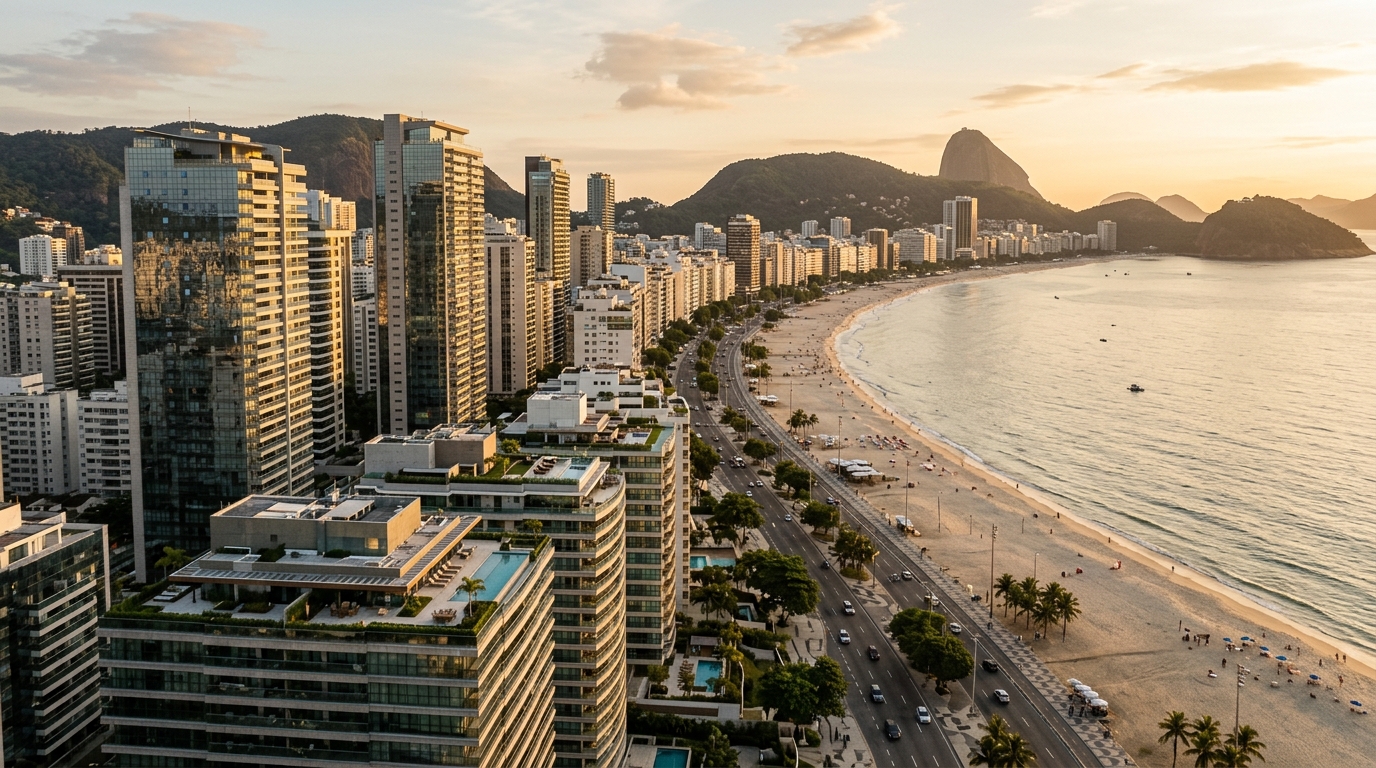
In March 2026, a 740-square-metre duplex in the Barra Sul district of Balneário Camboriú changed hands for R$ 42 million — the highest figure ever recorded by the city's land registry for a single residential unit, according to reporting by G1 SC. In the same quarter, a 240-square-metre penthouse one block back from the sea sold for R$ 4.6 million. The gap between those two numbers, more than eightfold, sketches the quiet anatomy of the luxury vertical market on Brazil's Santa Catarina coast: there is no such thing as an average price for an oceanfront penthouse in Balneário Camboriú. There is a curve, and it runs from roughly R$ 35,000 to R$ 95,000 per square metre — about US$ 6,500 to US$ 17,500 at mid-2026 exchange rates — depending on variables that the unprepared buyer almost always underestimates.
This piece is an analytical reading of that curve. For an international investor with a ticket size of R$ 5 million and up — roughly US$ 925,000 at the moment — understanding why two penthouses with nearly identical floor plans can trade at prices 200 percent apart is the first move before any letter of intent is drafted. The frame is 2026: the first year of Balneário Camboriú's new delivery cycle, with towers launched in the post-pandemic boom now reaching habite-se (Brazil's certificate of occupancy) just as the Selic (Brazil's base interest rate) remains in double digits and the INCC (the country's construction-cost index) continues to refresh the memory of every buyer who signed off-plan between 2021 and 2023.
The actual price band for an oceanfront penthouse in 2026
Public listings in Balneário Camboriú across the first five months of 2026 trace a fairly clear pricing matrix, even if it is rarely reported with the granularity an investor needs. At the floor of the band, duplex penthouses of 240 to 280 square metres in second-row buildings — one block behind Avenida Atlântica, the beachfront strip — start at R$ 4.6 million to R$ 5.8 million. That translates to between R$ 18,000 and R$ 23,000 per square metre. Technically these units have an ocean view, but they do not face the sea directly, and in this market that grammatical distinction is expensive.
One rung up, penthouses in mid-tier signature buildings around 350 square metres, with partial sea frontage and an address between Avenida Brasil and Avenida Atlântica, are trading around R$ 12 million. Price per square metre here already flirts with R$ 35,000. When the asset is a 600-square-metre penthouse on a true beachfront lot along Avenida Atlântica, inside a tower built by a top-tier developer, listings hover around R$ 22.8 million, putting the square-metre figure between R$ 38,000 and R$ 42,000.
The next tier is the so-called signature skyscraper. A unit at Ibiza Towers with 885 square metres of usable area, a private pool and two double parking bays was listed for R$ 29.8 million in February 2026, according to portal Imovelweb — about R$ 33,700 per square metre, counterintuitively lower than the previous example because the larger floor area dilutes the fixed "location component" embedded in every additional metre. And at the absolute top, the R$ 42 million duplex with 740 square metres on two floors of Yachthouse pushes the per-square-metre price into a range between R$ 56,000 and R$ 95,000 once you isolate the most valuable private space.
The FipeZap index for April 2026 puts the average residential price in Balneário Camboriú at R$ 14,512 per square metre — a useful number for macro analysis, but one that masks what is happening at the oceanfront-penthouse end of the market. For that slice, the multiple paid over the city average ranges from 2.4 times at the floor to 6.5 times at the ceiling. That spread has widened over the last twenty-four months, mirroring the structural scarcity of true beachfront lots inside buildings that carry a signature name.
| Tier | Typical size | Price | R$/m² | Key feature |
|---|---|---|---|---|
| Entry | 240–280 m² | R$ 4.6–5.8 M | R$ 18–23 K | Second row, partial view |
| Intermediate | 320–380 m² | R$ 10–14 M | R$ 30–37 K | Partial frontage, mid floor |
| Premium | 500–650 m² | R$ 18–25 M | R$ 35–42 K | True Av. Atlântica frontage |
| Ultra-premium | 700–900 m² | R$ 28–35 M | R$ 33–45 K | Signature tower, private pool |
| Record | 700+ m² duplex | R$ 38–42 M | R$ 55–95 K | Top of a signature building |
What actually drives the price of a penthouse
The first vector, and the one most underestimated by remote buyers, is true beachfront frontage. In the language of Balneário Camboriú's experienced brokers, "frente-mar" — literally "sea-front" — means the building's lot shares a direct boundary with Avenida Atlântica, with no block of any kind separating the tower from the sand. That single attribute, holding everything else equal, adds a 40 to 60 percent premium over an otherwise identical unit one block back. It is not unusual for the same developer, in the same year, to launch mirrored floor plans at prices that differ by exactly that gap in two buildings four hundred metres apart.
The second vector is what the market calls a signature building. In Balneário Camboriú, the short list includes Yachthouse, One Tower, Ibiza Towers, Beverly Hills and a handful of towers from the portfolios of FG Empreendimentos, Embraed and Pasqualotto. This is more than marketing. Those names produce a brand effect comparable to flagged luxury hotels: the name itself adds 15 to 25 percent over what the unit would fetch on square footage and location alone. Secondary-market liquidity follows the same pattern. Yachthouse penthouses, for example, post average time-to-sell of eight to fourteen months, against eighteen to thirty months for towers outside the club.
The third vector is the floor. Each floor above the thirtieth adds roughly one percent to base price in the mid-tier, but the curve goes exponential at the top: between the fiftieth and sixtieth floor the premium jumps to two or three percent per level, and in the final floors of towers above seventy storeys the topmost unit can be worth forty percent more than an identical one twenty floors below. The explanation is not only the view — it is the absolute scarcity of units at that altitude band, compounded by the fact that penthouses, by definition, occupy the very top.
The fourth vector is the bundle of private attributes attached to the unit: private pool on the terrace, double-height ceilings, an open living area larger than 80 square metres, parking count (the floor for a premium penthouse is four bays, but ultra-premium units carry six to eight), a private elevator, an open-air terrace with a churrasqueira (the built-in Brazilian barbecue) and a spa. Each item is priced discreetly, but together they explain the gap between a R$ 12 million listing and a R$ 18 million one at very similar floor areas.
Finally, the developer's financial health and delivery track record make up a fifth vector that is routinely ignored by buyers who look only at the floor plan. In Balneário Camboriú, the developer's name in the corner of the sales brochure carries market value. FG, founded by Fabiano Godoi, has built a portfolio worth more than R$ 12 billion in VGV (the industry's gross sales value metric) over the last five years; Embraed and Pasqualotto have their own records of on-time delivery that justify a small premium. Buying from a lesser-known developer can mean an 8 to 12 percent discount on listed price, but the saving is often handed back, with interest, in the form of construction delays or contract amendments.
Off-plan versus completed: the discount game and the INCC
The price gap between an off-plan penthouse and a comparable completed one in Balneário Camboriú runs between 25 and 40 percent in 2026, given current stock and the scheduled delivery curve. In absolute terms, a penthouse that goes for R$ 18 million ready-to-occupy can be purchased for somewhere between R$ 11 million and R$ 13.5 million at the launch of a comparable tower. That number, however, is before any INCC adjustment is applied to the installments — and the INCC clause is the deciding pitfall.
The typical payment flow for a R$ 15 million off-plan penthouse in Balneário Camboriú involves a 20 to 30 percent down payment (R$ 3 to R$ 4.5 million), monthly installments over 48 to 72 months indexed to the INCC, semi-annual "reinforcement" installments, and a key-handover balloon usually between 30 and 40 percent of the total price. When that schedule is laid against an INCC that has cumulatively run close to 40 percent over the last five years, the so-called list price becomes only the starting point of the real arithmetic.
"The off-plan penthouse buyer in Balneário Camboriú has to understand that the INCC is the developer's invisible partner. In four-to-six-year construction cycles on seventy-storey towers, that adjustment turns a nominal 30 percent discount into an effective discount that can be as low as 8 or 10 percent — and there is still the risk of delay." — analyst at Secovi-SC, Santa Catarina's real-estate trade body, speaking on a luxury-market panel in May 2026.
Delay risk is particularly relevant in towers above sixty storeys, which have become Balneário Camboriú's technical signature. The complexity of foundation engineering, the curing time for structural elements and the logistics of vertical construction sites in the sky stretch real build cycles to sixty or seventy-two months, against the forty-eight months that contracts typically promise. Law 13,786 of 2018, known as the Distrato Law, set clear rules for refunds in the event of cancellation, but at this ticket size practical application almost always involves litigation, since the values at stake justify specialised legal teams on both sides.
The sophisticated buyer in 2026 uses a different ruler when choosing between off-plan and completed. They compare the nominal discount not only to expected INCC but to the opportunity cost of capital tied up in the payment schedule. With the Selic still elevated, R$ 5 million sitting in installments that earn nothing carries an opportunity cost of R$ 600,000 to R$ 700,000 a year in post-fixed fixed income. Over a four-year build, that means the minimum discount needed to justify going off-plan should be 35 percent net of INCC — a threshold few launches today actually clear.
Financing, the Selic rate, and the foreign investor
The Brazilian residential mortgage system was designed for the middle class and is therefore structurally inadequate for a luxury penthouse ticket. The SBPE/SFH regime — Brazil's housing finance pool — operates with a per-unit lending ceiling that shifts with annual regulation but stays close to R$ 1.5 million, an order of magnitude incompatible with even the floor of the segment under discussion. The FGTS, the country's mandatory severance fund that can be used toward home purchases by Brazilian workers, is by extension a decorative reference in this conversation.
Direct financing from the developer remains the dominant channel. Typical 2026 contracts carry installments indexed to a combination of INCC during construction and IPCA (Brazil's official consumer-price index) plus interest after the keys are handed over, with real rates between 9 and 12 percent a year. Some of the larger developers offer more aggressive rates as a sales-package incentive on slow-moving stock, but as a rule the all-in nominal financing cost on direct contracts runs between 13 and 17 percent annually in 2026, close to or above the Selic.
There is also the private banking mortgage channel, offered by institutions such as Bradesco Prime, Itaú Private, BTG and XP through real-estate-backed credit products. Limits are materially higher (R$ 10 million to R$ 30 million per operation), loan-to-value ratios reach 50 percent for in-house clients, but the structure is closer to home equity drawn on existing property than a classic mortgage. For penthouses, this channel serves almost exclusively the buyer who pledges an already-paid-off asset as collateral to lever the new acquisition.
The foreign buyer deserves a separate read. Balneário Camboriú has consolidated itself over the last five years as the country's third largest destination for foreign residential investment, behind only Florianópolis and the Northeast coast. Argentines and Paraguayans dominate, with rising shares from Uruguay and the United States. The mechanics run through the central bank's RDE-IED registry of foreign direct investment, requiring a CPF (Brazilian tax ID), a local real account and, in most cases, a specialised despachante to navigate paperwork. Capital-gains tax on a future sale matches what a resident pays, but repatriating the principal follows a more formal path. That friction is part of why many foreign owners simply hold the asset for appreciation rather than exit — behaviour that further tightens secondary supply.
Real returns: short-term rentals, condo fees and the CDI benchmark
The most common sales pitch for a Balneário Camboriú penthouse is short-term rental income. The gross numbers are seductive: high season (December through February, plus July) records nightly rates of R$ 3,500 for entry-tier penthouses and up to R$ 12,000 for premium oceanfront units with a private pool. Carnival and New Year stretch those numbers by an additional 40 to 70 percent over the January baseline. The problem, as always with short-term rentals, surfaces in the annualised consolidation.
Consider a R$ 12 million penthouse in the intermediate tier, with a weighted average daily rate of R$ 5,500 in high season and R$ 2,200 in low, real occupancy of 65 percent over roughly 90 high-season days and 25 percent over 275 low-season days. Projected gross revenue lands near R$ 471,000 a year. After professional management (20 to 25 percent of gross), condo fees (which in signature buildings run R$ 5,000 to R$ 15,000 a month, averaging R$ 9,000), the progressive luxury IPTU (Brazil's annual urban property tax), maintenance, guest expenses and platform fees, the net falls into a band of R$ 230,000 to R$ 280,000.
On a R$ 12 million capital base, that is a net yield of 1.9 to 2.3 percent a year. The CDI — Brazil's interbank rate, the standard benchmark for fixed income — is projected to exceed 11 percent nominal in 2026 at the floor of the consensus scenario. Even discounting expected inflation of 4 to 5 percent, an investor in post-fixed fixed income earns a real return higher than the rental yield on the penthouse — before any capital appreciation is considered.
This is where the penthouse thesis has to be honest with itself: the operation only closes financially if capital appreciation makes up the gap. Balneário Camboriú's ten-year record shows nominal appreciation of 9 to 13 percent a year in the premium segment, according to Secovi-SC series and ABRAINC (the national developers' association) reports. In acceleration windows — 2020 through 2022 — some signature towers logged nominal jumps of 60 to 90 percent over 24-month cycles. The 2026 question is whether that pattern repeats against a stubborn Selic, a heavy pipeline of penthouse deliveries between 2026 and 2028, and the maturation of icon towers along the Itajaí–Balneário Camboriú–Itapema corridor.
There is also the personal-use component, which in the penthouse segment is rarely negligible. Almost no buyer of a R$ 15 million unit purchases it purely as an income asset; the property serves a patrimonial function, signals status, and accommodates the family in specific seasons. That use, valued at its shadow-rental equivalent, is usually the figure that closes the equation the private banker's spreadsheet, on its own, cannot.
The regional angle and the costliest mistakes
The Itajaí–Balneário Camboriú–Itapema corridor is closing, in 2026, an incorporation cycle that began in 2020 with mass approvals of towers above 50 storeys. ABRAINC and CBIC (the country's main industry bodies) point out that net inventory of premium penthouses scheduled for delivery between 2026 and 2028 along this stretch of coast is the largest in the region's history. That creates a window of pressure on marginal prices at the entry tier of the segment — though not on truly oceanfront ultra-premium units, where supply is structurally scarce.
Itajaí, which has gained traction from port growth and the professionalisation of Praia Brava, in 2026 offers penthouses with a profile similar to Balneário Camboriú five years ago: R$ 22,000 to R$ 38,000 per square metre, with true beachfront frontage in buildings of equivalent construction quality. For an investor who reads the capital migration along the Santa Catarina coast carefully, this is the section of the curve where the risk-return ratio over a five-to-eight-year horizon tends to be more attractive than replaying the Balneário Camboriú trade ten years past its peak.
Five mistakes show up repeatedly among investors new to the segment. The first is confusing sea view with sea frontage — a semantic confusion that costs 40 to 60 percent on resale. The second is underestimating the condo fee: in a signature building, R$ 9,000 a month is the floor, which means R$ 108,000 a year that must be modelled before the decision. The third is ignoring the 2026–2028 supply curve, buying today what will be competing with new stock eighteen months out.
The fourth mistake is failing to check the developer's financial health — a routine step in any corporate due diligence, but one often skipped in a property purchase. Disclosures for publicly traded developers are available at the CVM (Brazil's securities regulator); private ones require more work, but the leading names in Balneário Camboriú generate enough market signal to support a reasonable view. The fifth and most subtle mistake is comparing penthouses on nominal price per square metre without adjusting for floor, view, private attributes and signature building. Done properly, the analysis requires a hedonic pricing model — and that is work. It is the work that separates the investor who buys well from the one who buys high.
The attentive buyer in 2026 is also watching what is happening outside Balneário Camboriú. Cities such as Itapema and the Brava–Cabeçudas axis in Itajaí now offer the combination that Balneário Camboriú offered a cycle ago: developers still consolidating their brand, limited inventory of true beachfront frontage, and a price curve still in the lower third of what the market three kilometres south is charging. Projects such as those by SIDE Empreendimentos along the Santa Catarina coast, focused on signature architecture and world-class construction standards on selected oceanfront lots, illustrate the professionalisation that will define the market's next chapter.
Conclusion
Summarising the oceanfront penthouse market in Balneário Camboriú in 2026 as "expensive" is saying nothing at all. What exists is a price curve that runs from R$ 4.6 million to R$ 42 million, where each rung is a function of specific combinations of frontage, signature building, floor, private attributes and developer. For an investor with a ticket of R$ 5 million and up, the analytical exercise is not comparing one penthouse to another — it is identifying the point on the curve where the trade-off between price, secondary liquidity and expected appreciation makes the most sense for the specific capital being allocated.
SIDE Empreendimentos' weekly analysis tracks this delivery cycle, monitors developer-by-developer movements and publishes the multiples being paid in the premium and ultra-premium bands of the Santa Catarina coast. For the investor who decides with full information, that is the starting point.