High-end real estate capital gains tax in Brazil 2026
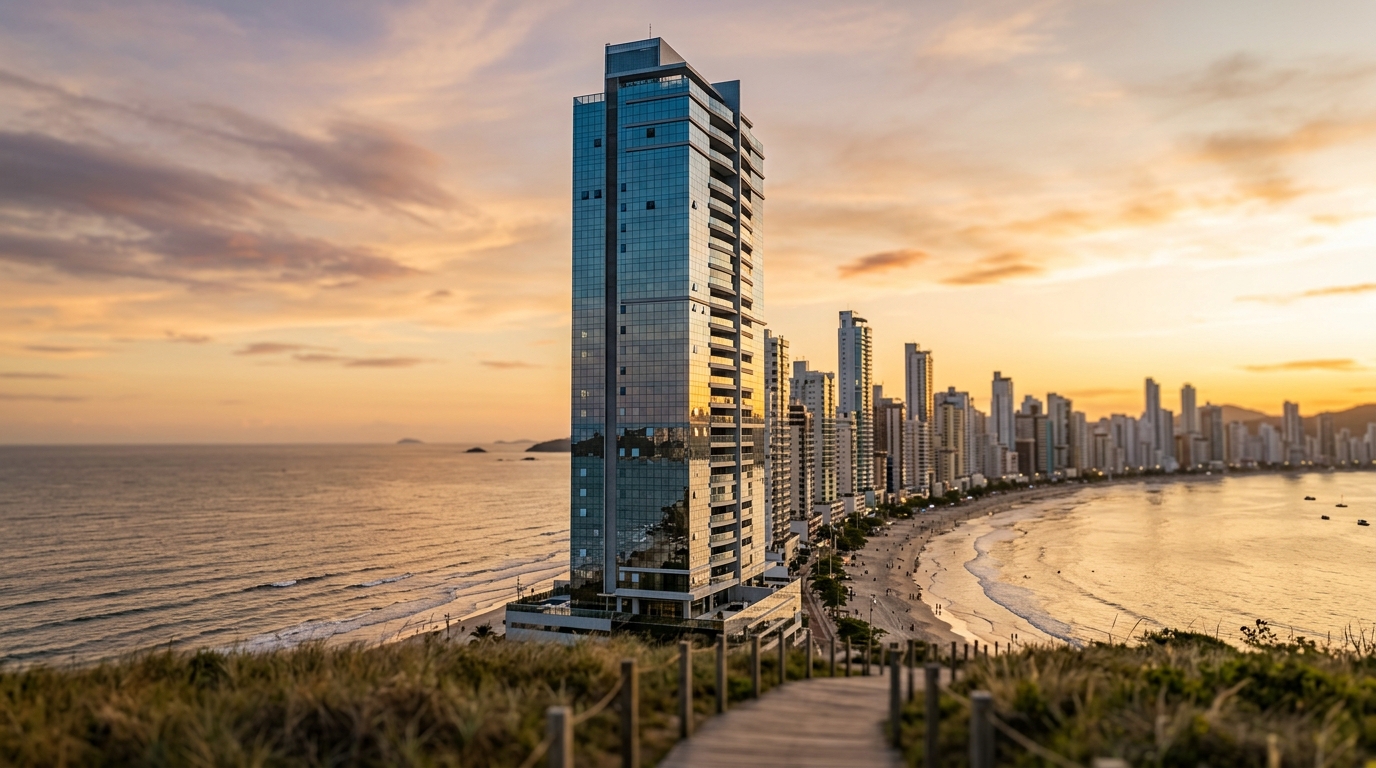
A three-suite apartment on the Balneário Camboriú beachfront sold for R$ 18 million in May 2026 can trigger Brazilian capital gains tax (in Portuguese, Imposto de Renda — IR) of anywhere between R$ 1.1 million and R$ 2.4 million. That spread depends far less on the headline price than on how the investor reconstructs the acquisition cost, applies the statutory reduction factors set out in Law 11.196/2005, and slots the gain into the progressive table that has been in force since 2016. In a market where the price per square metre has cleared R$ 22,000 at several addresses, according to the FipeZap index, getting the math wrong has stopped being an accounting footnote and become a six-figure problem.
Capital gain is the difference between the sale price (valor de alienação) and the acquisition cost of the property, under article 3 of Law 7.713/1988 and the consolidated rules of Normative Instruction RFB 84/2001. The formula reads simply but executes treacherously: every line of cost must be documented, every deductible expense needs a tax invoice issued in the seller's name, and every month elapsed between purchase and sale weighs directly on the effective rate. In the high-end segment, where tickets comfortably clear the first R$ 5 million bracket, those details stop being technical and become financial.
Why high-end capital gains follow their own math
Until 2015, every capital gain on a property held by an individual taxpayer in Brazil was taxed at a flat 15%. Law 13.259/2016 rewrote article 21 of Law 8.981/1995 and introduced the progressive table in force today: 15% on the portion of the gain up to R$ 5 million, 17.5% between R$ 5 million and R$ 10 million, 20% between R$ 10 million and R$ 30 million, and 22.5% above that ceiling. For the average investor selling a mid-market apartment, that progression stays abstract. For anyone operating in the R$ 3 million to R$ 30 million range — the heart of the market in Balneário Camboriú, Praia Brava, Cabeçudas and the premium neighbourhoods of Itajaí — it determines the net result of the deal.
The asymmetry shows up in the numbers. Industry bodies ABRAINC and Secovi-SC reported successive highs throughout 2025 in the VGV (valor geral de vendas — the gross sales value of new launches) along the Santa Catarina coast, with average premium-unit tickets above R$ 6 million in several vertical projects delivered. In other words: simply reselling a unit bought off-plan five or six years ago, with appreciation between 60% and 90%, automatically pushes the investor out of the flat 15% band. That is the first reason the math at the top of the market demands planning, not improvisation.
The second reason is the gap between the acquisition cost recorded in the annual tax return (Declaração de Bens) and the actual money the investor spent over the years. Built-in furniture, structural renovations, the property transfer tax ITBI, the deed itself, post-contract construction add-ons during the build, even the original broker's commission — every one of these items, when documented, adds to the acquisition cost and shrinks the taxable base. Ignored, they become tax overpaid. The high-end segment is where this gap hurts most: every R$ 100,000 forgotten in the cost base costs another R$ 15,000 to R$ 22,500 of IR.
The formula: sale price, acquisition cost and deductible expenses
The equation the Brazilian Federal Revenue Service (Receita Federal) applies is crystallised in the GCAP software it releases each year and in article 17 of IN RFB 84/2001. In plain form: capital gain equals sale price minus acquisition cost minus admitted deductible expenses. The progressive table is then applied to that gain, after the reduction factors FR1 and FR2 where they apply. The result is the tax due, paid through a federal payment voucher called DARF, under revenue code 4600.
The sale price is the amount actually received, net of any taxes passed on to the buyer. The acquisition cost is the value declared on the Assets and Rights schedule of the last income tax return — not the market value, not the municipal cadastral value, not the bank's appraisal. It is the historical cost, except for properties bought before 1988, which still admit a monetary update through the RRR reducer set out in article 96 of the Brazilian Income Tax Regulation (RIR/2018).
Deductible expenses are the blind spot of the high-end taxpayer. Article 17 of IN RFB 84/2001 lets the investor add to the acquisition cost: construction, extension and renovation costs (provided they are backed by valid documentation — tax invoices, receipts identifying the service provider, contracts), broker's commission paid by the seller at the time of acquisition, interest paid on financing of the acquisition itself, and demolition costs where the sale requires it. At the moment of sale, the broker's commission paid by the seller comes off the sale price directly. ITBI and notarial fees, when shouldered by the seller, also fold into the acquisition cost.
A concrete example. An investor acquired a duplex penthouse in Balneário Camboriú in 2014 for R$ 4.2 million. Over six years she spent R$ 980,000 on structural renovation, new floors, kitchen, climate control and home automation — every line backed by a tax invoice on file. She paid R$ 168,000 of ITBI at acquisition. In June 2026 she sells the unit for R$ 14.5 million, paying a 6% broker's commission (R$ 870,000). The adjusted acquisition cost rises to R$ 5.348 million. The net sale price drops to R$ 13.63 million. Gross gain: R$ 8.282 million. Without correctly accounting for the R$ 980,000 in renovations and the R$ 168,000 in ITBI, that gain would balloon to R$ 9.43 million — a R$ 1.148 million swing in the base, which would cost at least R$ 172,000 in extra IR before any reduction factor.
The 2025-2026 progressive table and the bracket effect
The table in force since 2017 has not been changed by Brazil's consumption-tax reform nor by the income-tax reform bills still working their way through Congress as we close this edition. For 2026, the structure remains:
| Capital gain bracket | Rate | IR on the full bracket |
|---|---|---|
| Up to R$ 5,000,000 | 15.0% | R$ 750,000 |
| From R$ 5,000,000 to R$ 10,000,000 | 17.5% | R$ 875,000 |
| From R$ 10,000,000 to R$ 30,000,000 | 20.0% | R$ 4,000,000 |
| Above R$ 30,000,000 | 22.5% | variable |
The right way to read this is as a real, not nominal, progression. An R$ 8 million capital gain does not pay 17.5% on the whole. It pays 15% on the first R$ 5 million (R$ 750,000) plus 17.5% on the R$ 3 million in excess (R$ 525,000). Total: R$ 1.275 million. Effective rate: 15.94%. On an R$ 12 million gain, three brackets stack up: R$ 750,000 plus R$ 875,000 plus R$ 400,000 on the R$ 2 million that crosses into the third band. Total: R$ 2.025 million. Effective: 16.88%.
The inflexion point for the high-end investor sits between R$ 5 million and R$ 10 million of gain. Above that line, each additional R$ 1 million of taxable base costs R$ 200,000 of IR in the third bracket. That is precisely the region where the correct use of reduction factors and deductible expenses decides whether the deal closes at an effective rate of 11% or 19%.
FR1, FR2 and the reducers that change the final result
Law 11.196/2005, in articles 40 onward, introduced two reduction factors applicable to capital gains on residential properties. FR1 reaches properties acquired before December 1995, with the formula 1 divided by (1.0060) raised to the number of months between the acquisition and November 2005. For the investor who bought off-plan in Itajaí or Camboriú in the 1980s and 1990s and still holds the unit, this factor is fat — it can cut the gain by more than 60%.
FR2 is the one that matters to most investors in today's market. It applies to properties acquired from January 1996 onward, with the formula 1 divided by (1.0035) raised to the number of months between the acquisition (or December 2005, whichever is later) and the sale. Every month elapsed shaves the base by roughly 0.35% compounded. Over ten years (120 months), the adjusted gain drops to around 66% of the gross. Over fifteen years (180 months), to 53%. Over twenty years (240 months), to 43%.
Back to the Balneário Camboriú penthouse acquired in 2014. Gross gain of R$ 8.282 million and roughly 144 months between acquisition and sale. FR2 equals 1 / (1.0035)^144, approximately 0.606. Adjusted gain: R$ 5.019 million. Applying the progressive table: R$ 750,000 (15% on R$ 5 million) plus R$ 3,325 (17.5% on the R$ 19,000 in excess). Total due: R$ 753,325. Effective rate on the gross gain: 9.1%. Without FR2, the IR would jump to R$ 1.313 million. The difference — R$ 560,000 — is a full year of rental income from that same unit at current rates on the north coast of Santa Catarina.
FR2 is the most underused instrument in high-end tax planning. The investor who sells before adjusting the acquisition cost, before listing deductible expenses and before calculating the factor from the exact date on the deed is, in practice, handing money to the tax office.
Exemptions, 180-day reinvestment and the DARF calendar
Law 11.196/2005, in article 39, holds the single most relevant exemption for residential-property investors: the capital gain on the sale of a residential property is exempt from IR if the proceeds are reinvested, within 180 days of the sale contract, in the acquisition of another residential property located in Brazil. The exemption is full when the entire amount is reinvested, proportional when only part of it is. The benefit can be used once every five years, under paragraph 5 of the same article.
Three classic exemptions coexist with this one. First: properties acquired up to 1969 see the gain fully exempted under article 18 of Law 7.713/1988. Second: the sale of the taxpayer's only property for up to R$ 440,000, provided no similar transaction was made in the previous five years. Third: residential property swaps, where the capital gain is deferred until the eventual sale of the unit received, under the position consolidated in Cosit Opinion 437/2017. None of the three typically applies to the high-end investor in an isolated transaction, but the 180-day reinvestment is a meaningful lever for anyone migrating between premium projects along the coast — useful, for instance, for the foreign-residency buyer trading up between addresses inside Santa Catarina without taking the cash out of the asset class.
Payment is made via DARF under code 4600, due on the last business day of the month following the sale. A deed signed on 10 June 2026 means a DARF paid by 31 July 2026. Delays trigger a daily fine of 0.33%, capped at 20%, plus interest at the accumulated Selic rate — Brazil's base interest rate set by the Central Bank, which has ranged between 10.5% and 12% per year in 2025-2026. Correct filing requires the GCAP software for the year of the sale, released annually by the Federal Revenue Service, which then imports the data automatically into the following year's Annual Adjustment Return (Declaração de Ajuste Anual).
For instalment sales — common in high-end transactions above R$ 10 million, where buyer and seller split the payment into two or three tranches — the tax is proportional. With each instalment received, a DARF is paid by the last business day of the following month, calculated on the same proportion: total capital gain divided by total sale price, multiplied by the amount received in that instalment. The rate is the one in force on the date of the operation, but month-by-month settlement avoids concentrating the outlay and lets the investor keep cash on hand. For international buyers, this also helps align the IR liability with FX conversion windows, since each tranche can be timed against the real-to-dollar (or euro) rate at the moment of receipt.
Itajaí, Balneário Camboriú and the individual-versus-holding decision
The north coast of Santa Catarina now concentrates the highest density of residential properties above R$ 10 million outside the Rio–São Paulo axis. Secovi-SC surveys show that Balneário Camboriú gathers more than half of the state's vertical launches with VGV above R$ 1 billion, and that Itajaí — propelled by the expansion of Cabeçudas, Praia Brava and the revitalised port-side waterfront — has been closing the gap year after year. For the investor who runs two, three or five residential properties at once, the inevitable question is whether being taxed as an individual is still the most efficient structure.
As an individual, the effective ceiling is clear: 22.5% on gains above R$ 30 million, with FR2 chipping away at the base and the 180-day reinvestment acting as a shock absorber. Inside a real-estate holding company — a Brazilian legal entity with property activity in its corporate purpose and taxed under the deemed-profit regime (lucro presumido) — the sale of residential units can be taxed as gross revenue, with a deemed profit margin of 8% for corporate income tax IRPJ (effective 1.2%) and 12% for social contribution CSLL (effective 1.08%), plus PIS of 0.65% and COFINS of 3% — a nominal total between 5.9% and 6.7% on the sale value rather than on the gain. On deals with a fat margin, that structure tends to be lighter. On thin-margin deals, it can be heavier.
The choice is not universal. A holding makes sense when there is recurring transaction volume, when the investor is already planning estate succession, and when the properties were transferred into the company at historical cost, avoiding tax on the way in. A holding does not make sense for the isolated sale of a single high-end property after ten years of personal use, because transferring the property to the legal entity triggers the ITBI municipal transfer tax (between 2% and 3% in Santa Catarina municipalities) and creates permanent operational costs (accountant, federal filings DEFIS, ECF, ECD). The comparison has to be done case by case, ideally with scenario modelling — and that is precisely the type of analysis that separates the prepared high-end investor from the one who pays IR in the dark.
In Itajaí specifically, with the current pipeline of premium projects in Cabeçudas and Praia Brava, the conversation about tax structure has taken on urgency. SIDE Empreendimentos, active in the segment, observes that a meaningful share of buying investors arrive at the table without having modelled the exit IR on their previous property, only to discover the impact after closing — once the planning window has already shut.
Conclusion
Calculating capital gain in the Brazilian high-end market in 2026 is, in practice, three overlapping calculations: the legal one (correctly defining acquisition cost, deductible expenses and sale price under Law 7.713/1988 and IN RFB 84/2001), the arithmetic one (applying FR1 or FR2 ahead of the progression and respecting the four bands of the table) and the strategic one (deciding between paying the DARF under code 4600, reinvesting within 180 days under Law 11.196/2005, or migrating into a real-estate holding company). In a market where the average ticket in the premium segment clears R$ 6 million, missing on any of the three costs hundreds of thousands of reais — sometimes millions. For weekly analysis on taxation, the property cycle and the high-end market of the Santa Catarina coast, subscribe to the content on the SIDE Empreendimentos portal.