Is a Premium Lot in Praia Brava Worth It in 2026?
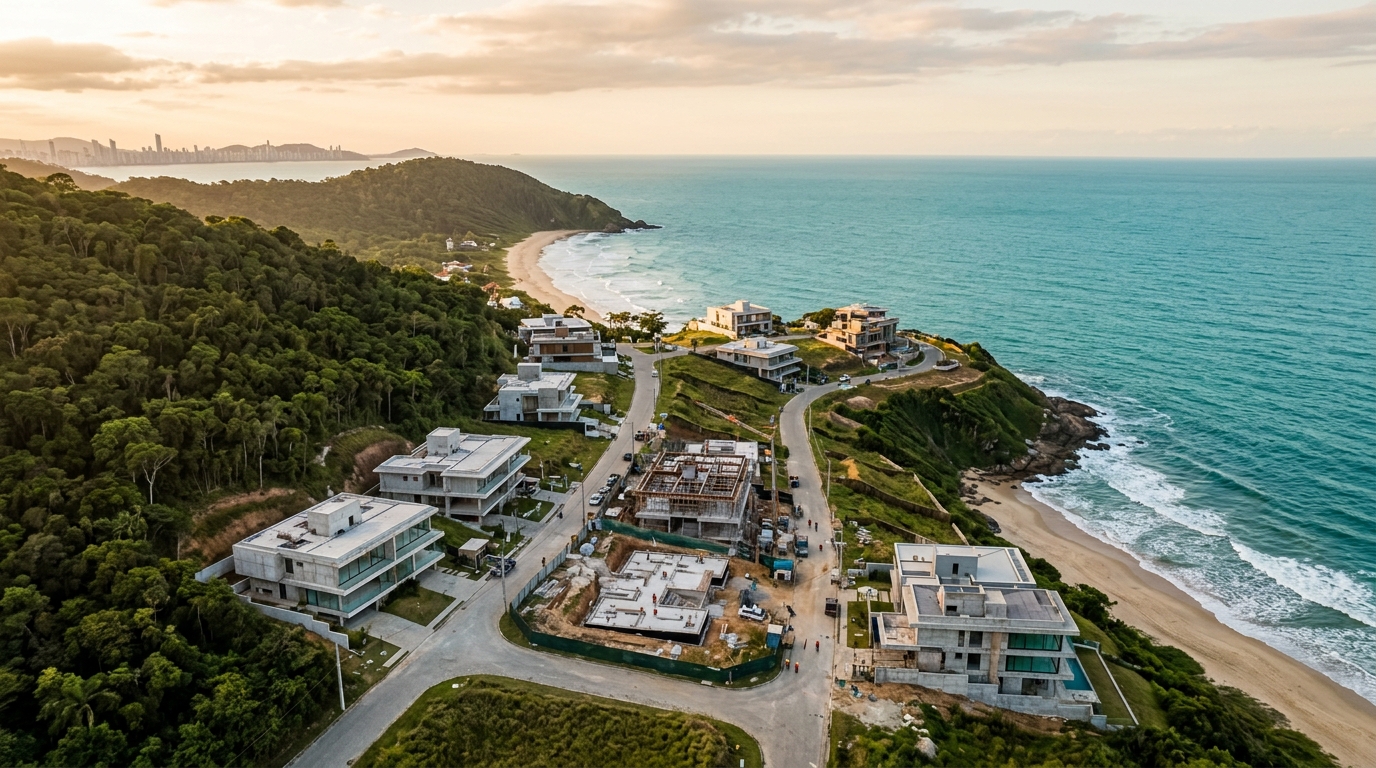
The price per square meter of land inside gated communities in Praia Brava is on track to break the psychological R$ 12,000 barrier in 2026 — roughly USD 2,200/m² at current exchange rates — in beachfront blocks and zones with preserved Atlantic Forest, according to cross-referenced data from FipeZap (Brazil's leading real-estate index) and Secovi-SC (the Santa Catarina property syndicate) for the high-end segment of the northern Santa Catarina coast. Over three years, nominal appreciation is approaching 70% — a window driven by Brazil's base interest rate (Selic) above double digits, the INCC construction cost index eroding developer margins, and an unprecedented queue of foreign buyers paying in U.S. dollars. The question landing on the investor's desk in 2026 is no longer "did the lot go up?" but "is there still upside to enter now?" This article is the math — without the sales-floor romance.
The analysis below follows a single ruler: net-of-tax IRR, true carrying cost, and exit scenarios at 36, 60, and 84 months, anchored on the projections of Brazil's Central Bank Focus survey for Selic, IPCA (the official inflation index), and the exchange rate. In some price brackets, buying a lot in Praia Brava in 2026 remains one of the strongest real-estate theses in the country. In others, it is a classic illiquidity trap. The difference lies in the details — and the serious investor needs to see both sides before signing.
Why land prices have surged: data, structural scarcity, and the BC and Jurerê comparison
The FipeZap residential sale index for Itajaí closed 2025 with double-digit annual appreciation for the third year in a row, more than doubling IPCA inflation over the same period. Praia Brava pulled the city average upward: within Secovi-SC's monitored high-end gated-community segment, the average ticket for a 600 m² lot in a closed condominium climbed from roughly R$ 4.2 million in 2022 to the R$ 7 million range (about USD 1.3 million) in fourth-quarter 2025 closings. That is real appreciation — net of accumulated IPCA — of more than 35% in 36 months.
Three forces sustain the move. The first is structural: Praia Brava has less than 4 km of usable coastline, wedged between Morro do Atalaia and Praia do Cabeço, and the inventory of urbanizable land with ocean frontage is effectively exhausted. The last large private parcels left the map between 2021 and 2024, when developers like FG, Embraed, Procave, and SIDE Empreendimentos itself locked up long-term landbanks. What remains are scattered lots — and when supply collapses against national demand, price finds its own elevated floor.
The second force is the Balneário Camboriú effect. With beachfront apartments in BC trading above R$ 35,000/m² in second-row towers and flirting with R$ 60,000/m² in flagship penthouses, Praia Brava is now read as "the next BC" by capital that migrated from São Paulo and Rio Grande do Sul coastlines. The comparison with Jurerê Internacional reinforces the thesis: in Florianópolis, land prices in Jurerê's premium blocks already trade between R$ 18,000 and R$ 25,000/m², with occasional deals above that. Praia Brava, even after the rally, still trades at a relative discount — and that spread is the heart of the upside thesis for 2026–2028.
The third force is the currency. With the dollar above R$ 5.40 through 2024–2025, premium land in Santa Catarina became cheap for Argentine, Uruguayan, Paraguayan, and increasingly European buyers. In some boutique Praia Brava launches, foreigners absorbed more than 25% of units in 2025 — an unthinkable number five years ago. That buyer pushes prices up and adds a layer of inelastic demand to the market. For international investors, this dollar advantage is the central asymmetry: Brazilian coastal land priced in BRL, but earnings often in USD or EUR, compounds the local appreciation with currency optionality.
Lot vs. pre-construction apartment: real IRR, carry cost, and three exit scenarios
This is where the average investor gets confused. Comparing a lot and a pre-construction apartment side by side, on the same spreadsheet, without adjusting for carrying cost, liquidity, and taxation, produces wrong conclusions. Let's break it down with early-2026 numbers.
Assume two outlays of R$ 3.5 million (about USD 650,000): an 800 m² lot in an established Praia Brava gated community, paid in cash, versus a three-suite apartment in a premium tower in the same neighborhood, paid on the standard schedule (30% through key delivery, 70% financed or settled at handover, with balance indexed to INCC). The Focus survey projects Selic at around 10.5% at the start of 2026, with a gradual bias toward 9% by year-end. IPCA converges to target. INCC runs between 5% and 6% per year. Alternative capital in CDI (Brazil's interbank deposit benchmark) yields roughly 95% of net Selic.
| Variable | Lot (800 m², cash) | Pre-construction apt (3 suites, standard schedule) |
|---|---|---|
| Outlay through delivery | R$ 3.5M upfront | R$ 3.5M spread over 36 months |
| Balance correction | None (already paid) | INCC 5–6% p.a. on outstanding balance |
| Annual carrying cost | IPTU (municipal property tax) + HOA: 0.8–1.2% | Only after key delivery: ~1.5% |
| Liquidity in a down cycle | Low: 9–18 months to sell | Medium: depends on competing launch inventory |
| 36-month exit | Estimated 25–40% nominal gain | 30–50% gain at handover (leveraged) |
| 60-month exit | 50–80% gain if thesis holds | Finished apt competes with new launches |
| 84-month exit | Highest upside potential | Technical depreciation starts to weigh |
| Capital gains tax | 15–22.5% progressive, R$ 35K exemption | Same bracket, with 180-day reinvestment rule |
The lot wins on three fronts: zero exposure to INCC, no construction risk (delays, contract rescission, embargoes), and greater upside in long windows — because scarce coastal land does not depreciate, unlike built property. The pre-construction apartment wins on two fronts: implicit leverage from the payment schedule (you capture appreciation on 100% of the asset while paying only 30% through delivery) and better liquidity if the launch comes from a top-tier developer with an active pipeline.
In 36-month exit scenarios, the pre-construction apartment often delivers higher net IRR thanks to schedule leverage — provided construction delivers on time and the cycle does not turn. In 60- to 84-month windows, the lot tends to win the net-IRR ranking, because it captures the compounding effect of scarcity and avoids the technical depreciation that begins eroding the finished apartment from year five onward. The empirical rule in the Santa Catarina market is clear: investors with horizons under four years buy apartments; patrimonial investors with horizons of five years or more buy land.
Real construction cost: CUB-SC 2026, the coastal multiplier, and Itajaí permit timelines
Anyone buying a lot to build and sell — or to live in and capture the developer spread — needs a different calculation. CUB-SC, the construction cost benchmark published monthly by Santa Catarina's Sinduscon (the civil construction syndicate), closed 2025 with the R-1 High Standard category (single-family premium residence) at around R$ 4,100/m² for the standard's basic finish. In 2026, with INCC projected at 5.5%, this number should run near R$ 4,350/m² in January and exceed R$ 4,500/m² in the second half.
That is the bare CUB. The real cost of building a luxury home in Praia Brava runs 2.2 to 2.8 times that figure — the famous "coastal multiplier" used by the region's boutique builders. Why? Foundations in sandy soil with a high water table, high-performance exterior frames designed for sea-air corrosion, reinforced drainage systems, imported finishes that dominate the local architectural standard, mature tropical landscaping, and technical infrastructure (home automation, climate control, heated pool, outdoor hydromassage) that virtually no Praia Brava home delivers without. Result: a 450 m² residence costs, today, between R$ 4.5 million and R$ 5.5 million to finish ready for move-in — not counting the land.
Add a R$ 7 million lot to a R$ 5 million house and the total VGV (general sales value) of the completed property lands around R$ 12 million. Comparable houses in Praia Brava have transacted between R$ 14 million and R$ 18 million — meaning a real developer spread of 15% to 50%, depending on location and project. But that spread only materializes for those who master the schedule and the permitting process.
And permitting is the silent bottleneck. With Itajaí's post-pandemic flood of applications, the city hall now runs average lead times of 8 to 14 months between project submission and construction permit for premium residences in approved gated communities — without counting environmental rulings from IMA (Santa Catarina's environmental agency, formerly Fatma) and, where applicable, IPHAN (the national heritage institute). The realistic total schedule, from lot deed to certificate of occupancy, runs 28 to 36 months. Anyone who omits that time from the IRR is selling themselves a deal that only exists on the spreadsheet.
Risks: master plan, land registry, ABRAINC/CBIC pipeline, and the USD exit
Five risks deserve the serious 2026 investor's attention.
Master plan. Itajaí revised its Plano Diretor (zoning master plan) in 2024–2025, with relevant changes to floor-area ratios, building height limits, and permeability rates in zones near the shoreline. Some Praia Brava blocks took on additional restrictions, particularly around native vegetation removal and front setbacks. Buying a lot without reading the current decree and the gated community's bylaws is writing a blank check on what you can actually build.
Title and due diligence. Many Praia Brava lots sit in older gated communities (1990s–2000s) and newer ones (post-2018). The older ones generally have cleaner title chains but occasionally carry pending HOA regularization or poorly defined common areas. The newer ones may have the development registration still under review, urbanistic restrictions awaiting homologation, and infrastructure receivables to settle. Full due diligence — updated title certificate, municipal and state tax clearances, federal and labor certificates on the seller, environmental compliance, and land registry verification — is the minimum, not a luxury. "Unmissable" lots with any of these items pending are, almost always, lots that sat unsold for a reason. For foreign investors, additional layers apply: a Brazilian CPF (tax ID) is required to take title, and Banco Central registration of inbound foreign capital protects the future repatriation of sale proceeds.
Pipeline saturation. The 2025 bulletins from ABRAINC (the national developers' association) and CBIC (the national construction chamber) showed record launches along the Santa Catarina coast, with combined Itajaí and Balneário Camboriú VGV exceeding R$ 20 billion in active inventory. That is two sides of the same coin: it confirms the demand thesis, but also signals that, in a downturn, competition for qualified buyers will be fierce. A lot without a house does not compete directly with a finished apartment at sale time — but it competes for the same investor's attention.
"The R$ 7 million buyer in Praia Brava in 2026 chooses among lot, finished apartment, and finished house. The three products fight over the same wallet. In a down cycle, liquidity wins, and the finished house has more of it. In an up cycle, upside wins, and the lot has more. Reading the cycle is the invisible asset of this decision." — synthesis from a Santa Catarina market analyst panel, Secovi-SC, December 2025.
Illiquidity in a down cycle. In windows of high Selic and short-term pessimism, the average time to sell a premium lot in Praia Brava rises rapidly from 4–6 months to 12–18 months. Anyone who needs liquidity in that window sells with discounts of 8% to 15% off the asking price. The investor entering land must, by construction, have the financial patience not to sell at the worst moment.
Foreign buyer in USD. External demand is both a blessing and a risk. Blessing because it sustains prices in hard currency. Risk because, if the real strengthens sharply — possible if the U.S. yield curve inverts and Brazil keeps fiscal discipline — the dollar price per square meter suddenly looks expensive, and the external demand tap closes fast. Domestic investors cannot anchor their exit thesis on the international buyer alone. International investors, conversely, should think in terms of "natural hedge horizon": a 5- to 7-year holding period typically smooths out the FX volatility that dominates shorter exits.
When it makes sense (and when it doesn't): profiles, checklist, and triggers to prefer a finished apartment
A premium lot in Praia Brava in 2026 makes sense for three profiles. First, the patrimonial investor with a long horizon (7–15 years), who sees coastal land as a real store of value and is not rushed for liquidity. Second, the future resident with a 24- to 36-month planning window, who will build the dream home and capture the developer spread while enjoying the use. Third, the small developer running 2–4 lots in parallel, who dilutes fixed project and management costs and sells finished houses in the region's premium standard. For international investors, profiles one and three are the most replicable: profile two requires presence on the ground that most cross-border buyers cannot sustain.
It does not make sense for investors with horizons under 36 months and a need for predictable liquidity. It does not make sense for those who are leveraged in other assets and cannot weather 12–18 months of selling effort in a bad window. It does not make sense for those who do not plan to build and are merely "parking capital" — because without construction, the developer spread disappears, and the investor depends exclusively on land appreciation, which has a naturally lower ceiling.
The eight-item checklist that separates the right lot from the wrong lot in Praia Brava:
- Title certificate updated within the last 30 days, free of liens, with a clean ownership chain going back at least 10 years.
- Gated-community covenants compatible with the intended project — height limits, setbacks, lot coverage, floor-area ratio.
- Municipal approval of the development already consolidated, with delivered and registered infrastructure (water, sewage, power, paving, drainage).
- Current master plan compatible with the desired typology, with specific reading of post-2024 changes.
- Real walking distance to the usable shoreline, measured on foot, not on the broker's map — in Praia Brava, 200 meters of elevation translate to a 30% price difference.
- Direct competition mapped within a 500-meter radius: how many vacant lots, average time to sell, last comparable closing.
- Projected CUB-SC R-1 High Standard for the year of construction, with a coastal multiplier of at least 2.3x for a conservative budget.
- Target developer margin of at least 20% on final VGV, calculated after tax, carrying cost, and a provision for six additional months of selling effort.
Failed three or more items? Probably a finished apartment, not a lot, is the right answer for your capital. The triggers for preferring a finished apartment over a lot are objective: horizon below four years, aversion to construction risk, need for immediate rental cash flow (Praia Brava has a strong December-to-March season with premium short-term rates between R$ 1,800 and R$ 3,500 per night), or a buyer profile that lacks the repertoire to manage luxury construction. In these cases, a finished apartment on Praia Brava's second row, with professionalized short-term rental management, delivers competitive net IRR with far less operational friction.
The international investor's lens: tax, capital flow, and exit currency
For foreign capital, three operational details often decide whether the thesis above translates from spreadsheet to reality. First, the inbound capital must be registered with the Banco Central do Brasil (RDE-IED for direct investment or RDE-Portfólio depending on structure), or the future sale proceeds cannot be wired out at the same official rate they came in. Second, capital gains on Brazilian real estate are taxed in Brazil at the same 15% to 22.5% progressive bracket as for residents, with the R$ 35,000 monthly exemption applicable in many cases — but home-country taxation may still apply, depending on the bilateral treaty. The U.S., U.K., Germany, and France have no double-taxation treaty with Brazil that covers capital gains directly; Argentina, Chile, and Spain do. Third, the exit currency matters: investors who buy when BRL is weak (USD/BRL above 5.20) and exit when BRL is stronger (below 4.80) take a 10%-plus FX hit on top of any local appreciation. Aligning the exit with a weak-BRL window is, in many cycles, more important than picking the perfect lot.
Conclusion: the 2026 signal
Praia Brava in 2026 is no longer an emerging market — it is a consolidated premium market, with characteristics approaching those of Jurerê Internacional five years ago. The premium lot remains, for the right profile, one of the country's strongest real-estate theses: structural scarcity of coastal land, growing national and international demand, and a real developer spread for those who master the construction cycle. But the "bought and flipped in 18 months at 40% return" window has closed. Investors entering now must do so with a 5- to 10-year thesis, surgical due diligence, and the discipline not to sell at the worst moment.
SIDE Empreendimentos publishes weekly analyses using primary data from the Itajaí and Santa Catarina coastal markets — including the block-by-block closing monitor for Praia Brava. For investors who intend to make the decision with the cold rigor it demands, it is the kind of reading that justifies the subscription.