Down Payment to Finance an Apartment in Itajaí in 2026
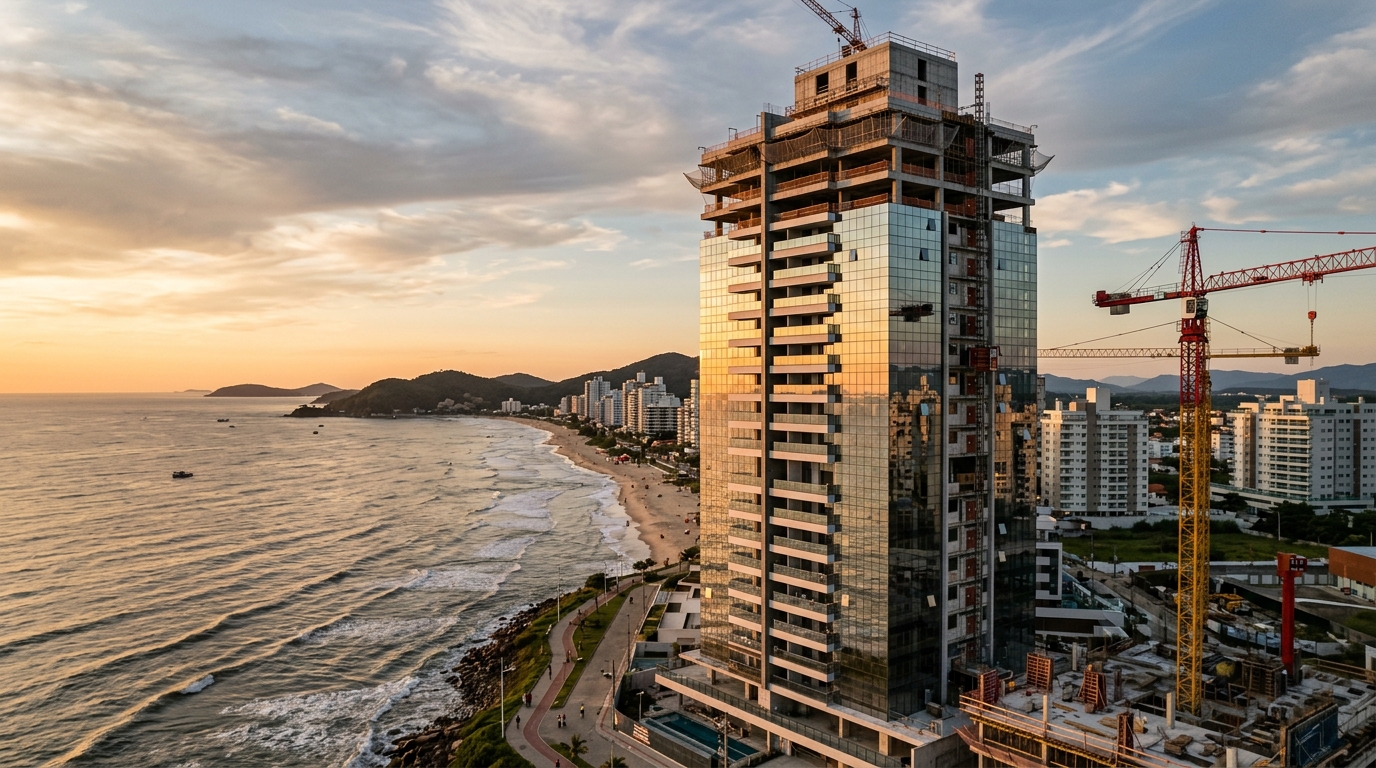
In January 2026, the average asking price for a two-bedroom apartment in Itajaí crossed the R$ 720,000 mark — a 14.2% increase over twelve months according to FipeZap, Brazil's leading residential price index, nearly double the official IPCA inflation reading for the same period. The Selic rate — Brazil's base interest rate — remains anchored at 10.75% after the most recent move by the central bank's monetary policy committee, keeping housing credit expensive but far from unworkable. In that environment, the question that decides whether a deal moves off the spreadsheet and into the notary's office is deceptively simple: how much, really, do you need as a down payment in 2026 to finance an apartment in the city that has become the most sensitive thermometer of Santa Catarina's northern coast?
The short answer is uncomfortable for anyone hunting a single number. In 2026, the required down payment swings between 20% and 50% of the property's value, depending on five variables that banks evaluate in cascade: the buyer's income bracket, whether FGTS — Brazil's mandatory workforce savings fund — is used, whether the loan fits inside SFH (the regulated low-rate housing finance system) or SBPE (the savings-funded mortgage track), the construction stage of the building, and the risk profile assigned by each bank's internal model. Those who understand this machinery pay less. Those who ignore it end up financing even the invisible costs at 11% per year for thirty years — and discover, too late, that the contract's true all-in cost (CET, in Brazilian banking jargon) is closer to 13.8%.
The minimum down payment in 2026 and what the five major banks actually demand
The regulatory starting point has not changed: Brazil's central bank kept the maximum SBPE loan-to-value (LTV) at 80% for used residential properties and 90% for new units financed through specific SFH lines. In practice, however, none of the five major banks — Caixa Econômica Federal, Banco do Brasil, Itaú, Bradesco and Santander — actually lends up to the regulatory ceiling. The effective LTV in Itajaí during the first half of 2026 sits between 70% and 80%, which pushes the real minimum down payment into the 20% to 30% range — calculated, crucially, on the value appraised by the bank, not the price asked by the seller.
That gap between asking price and appraised value is routinely ignored and routinely expensive. When the bank's appraisal report comes in 5% to 8% below sticker — a common occurrence in Praia Brava and in some Centro launches whose project value (VGV, the developer's gross sales target) was inflated by the "spillover from Balneário Camboriú" narrative — the buyer must cover that gap in cash, on top of the nominal 20%. An apartment listed at R$ 800,000 but appraised at R$ 760,000 by the bank requires R$ 192,000 in real cash at closing: R$ 152,000 for the headline 20%, plus R$ 40,000 for the appraisal shortfall. The "real" down payment quietly climbs from 20% to 24%.
Caixa Econômica Federal remains the most aggressive lender in the segment up to R$ 1.5 million, especially when FGTS funds are deployed or the deal fits inside the SFH framework. Its headline rate as of May 2026 starts at TR (a Brazilian floating reference rate) plus 9.49% per year for the Pró-Cotista FGTS line, available to long-term contributors to the fund. But the CET — which folds in mandatory life-and-disability insurance (MIP), property damage insurance (DFI), the appraisal fee and the administration charge — crosses 11.2% on nearly every long-dated contract. Banco do Brasil operates with a similar profile, with a slight edge for high-tier private and Estilo account holders.
Itaú, Bradesco and Santander concentrate their fight in the SBPE bracket above R$ 1.5 million, with fixed or IPCA-linked rates running between 10.5% and 12.3% nominal per year. Here a detail changes the math: private banks usually cap LTV at 70% for properties above R$ 2 million, which raises the minimum down payment to 30%. In Praia Brava, where R$ 3 million to R$ 6 million tickets dominate the new-inventory pipeline, a 30% down payment means R$ 900,000 to R$ 1.8 million in initial cash — before transfer tax, registration and furniture.
The composition of the down payment is itself regulated. FGTS can cover up to 100% of the down payment, provided the three conditions of Resolution 702 of the Fund's Trustee Council are met: the worker must have at least three years of contributions to the fund (consecutive or not, with any employer), cannot hold another active SFH-backed loan in Brazil, and cannot own another completed or under-construction residential property in the same metropolitan region — which, for Itajaí, includes Balneário Camboriú, Navegantes, Itapema and Camboriú.
Itajaí's price per square meter, neighborhood by neighborhood — and what it does to the down payment
Understanding what each square meter costs in each district is what separates a realistic simulation from a spreadsheet fantasy. The numbers consolidated by FipeZap, cross-checked against the monthly bulletins from Secovi-SC (the state's real-estate sector union) and the quarterly reports from ABRAINC (Brazil's incorporators' association), show a market with uneven traction: mature neighborhoods like Centro and Fazenda are rising 8% to 11% year on year, while densifying areas such as Cordeiros and São Vicente are climbing 13% to 17% — a direct spillover effect from Balneário Camboriú, where the average square-meter price has crossed R$ 17,000. Praia Brava, isolated from this statistic, plays in another league entirely.
| Neighborhood | Avg. price per m² (May 2026) | 2BR apartment, 70 m² | 20% down | 30% down |
|---|---|---|---|---|
| Centro | R$ 9,800 | R$ 686,000 | R$ 137,200 | R$ 205,800 |
| Fazenda | R$ 11,200 | R$ 784,000 | R$ 156,800 | R$ 235,200 |
| Cordeiros | R$ 7,400 | R$ 518,000 | R$ 103,600 | R$ 155,400 |
| São Vicente | R$ 6,900 | R$ 483,000 | R$ 96,600 | R$ 144,900 |
| Praia Brava | R$ 22,500 | R$ 1,575,000 | R$ 315,000 | R$ 472,500 |
Reading this table in practice requires three ticket-size simulations to clarify the decision. At the R$ 450,000 cut — today essentially limited to Cordeiros, São Vicente and the outer edges of Centro — a 20% minimum down payment represents R$ 90,000, an accessible number for buyers with a robust FGTS balance and household income above R$ 12,000 per month. Within that range, Caixa still slots the loan into conditions close to SFH, with terms up to 420 months and an initial installment around R$ 3,450 assuming the SAC amortization table and an effective rate of 10.8%.
At the R$ 700,000 ticket, today the average for new inventory in Centro and Fazenda, the 20% down payment climbs to R$ 140,000 — but most private banks demand 25% to 30%, because they consider this ticket above the SFH comfort zone for the average profile. The initial SAC installment over 360 months at an effective rate of 11.2% sits near R$ 5,700, requiring documented household income above R$ 19,000 per month under the standard 30% debt-to-income rule applied by most institutions.
The R$ 1.2 million ticket — dominant in beachfront launches on the second block of Praia Brava and in premium products in Fazenda — requires a real cash outlay of R$ 360,000 to R$ 480,000 once you combine the 30% nominal down payment with the typical gap between sticker and bank appraisal. The initial installment crosses R$ 9,800, and the required income exceeds R$ 33,000. At this level, the loan stops being an acquisition tool and becomes a leverage instrument — operating on different logic from a pure residential purchase, which matters for any foreign investor sizing this market.
FGTS, MCMV and SBPE: which route to choose, and in what order
The single most expensive mistake a buyer makes in Itajaí is treating FGTS, the Minha Casa Minha Vida subsidy program (MCMV, Brazil's main affordable-housing scheme), and SBPE as competing options. They operate in layers, and choosing the wrong layer costs tens of thousands of reais. The practical rule is simple: test eligibility for Minha Casa Minha Vida first, then SFH with FGTS, and only then plain SBPE — and never ignore FGTS when you are eligible, even in SBPE contracts, because the fund can be used to amortize the outstanding balance every two years.
The Minha Casa Minha Vida cap for 2026 was set at R$ 350,000 for Bracket 3 in the metropolitan regions of Santa Catarina covered by the program, according to the February update from Brazil's Ministry of Cities. In Itajaí, that means the program effectively covers part of the inventory in Cordeiros and São Vicente plus some compact units in Centro — it does not cover Fazenda, and it is entirely out of reach for Praia Brava. The subsidized rate in Bracket 3 starts at TR plus 7.66% per year for household incomes up to R$ 8,000, a number significantly below SBPE conditions.
For investors and premium buyers, the real game is SFH with the Pró-Cotista FGTS line stacked on top of complementary SBPE. The Pró-Cotista line covers up to R$ 1.5 million of property value at reduced rates, with the remainder financed under conventional SBPE. This composition, known in the local market as a "mixed loan", trims roughly 90 to 130 basis points from the contract's average CET — savings that, on a R$ 1 million thirty-year loan, exceed R$ 180,000 in nominal interest.
The three-year FGTS rule is the detail that derails most deals at the counter. The borrower must show thirty-six months of formal-employment (CLT) contributions, though time need not be continuous nor with the same employer. Periods worked as a self-employed professional, as a registered micro-entrepreneur (MEI) without voluntary FGTS deposits, or as an unpaid intern do not count. Buyers who have recently switched regimes — going from CLT to a PJ contracting model, becoming a company partner, or moving into public service without FGTS coverage — frequently discover they have lost eligibility for the best rates at precisely the moment they finally have the capital for a down payment.
Foreigners, in turn, can buy urban property in Itajaí without restriction — Federal Law 5,709 only limits acquisitions in rural areas and the international border strip, neither of which applies to the northern Santa Catarina coast. What changes is the financing: Brazilian banks lend to foreigners only with a permanent visa, an active CPF (the Brazilian tax ID), provable income in Brazilian reais or in a convertible source, and, in most cases, a down payment elevated to 40% or 50%. The Argentine buyer who closed in Itapema in 2024 with a 50% down payment and a favorable FX spread became the archetype of this profile — and the engine behind much of Praia Brava's demand over the last eighteen months.
Required income, the 30% rule, and the invisible costs nobody adds up
The 30% debt-to-income ceiling is the standard accepted by every Brazilian bank: the monthly installment, summed with any other active debts, cannot exceed 30% of documented gross household income. The technical detail that catches buyers off guard is that this income must be provable through payroll slips, the annual income tax return (IRPF), or at least six months of bank statements. Variable management fees (pró-labore), one-off profit distributions and informal income enter the calculation at a discount or are excluded entirely.
For a R$ 500,000 loan with 20% down, 360 months, an effective rate of 11.1% per year on the SAC amortization system, the initial installment lands at roughly R$ 5,350. Under the 30% rule, that requires documented household income of R$ 17,850 per month — accessible for a couple of mid-career state civil servants but distant from much of Brazil's middle class. The larger the down payment, the smaller the installment and the lower the income requirement — and this is where the first non-trivial optimization of any mortgage lives.
The invisible costs kill budgets with depressing regularity. Itajaí's property transfer tax (ITBI) remains at 2% of the appraised or transaction value, whichever is higher, under Municipal Complementary Law 296. On an R$ 800,000 apartment, that is R$ 16,000 needed in cash at deed signing, outside the loan. Notary registration, real estate transfer registration and emoluments add another 1.1% to 1.3% — between R$ 8,800 and R$ 10,400. Bank appraisal, credit-file fee and transfer insurance add R$ 4,000 to R$ 7,000 depending on the institution.
The "laudêmio" is the most peculiarly Brazilian cost on the list and the least understood by first-time buyers in coastal zones. Properties sitting on "terrenos de marinha" — federally owned coastal land strips, which include most of Praia Brava, the Centro waterfront, and portions of Fazenda close to the Itajaí-Açu river — owe a 5% laudêmio on the transaction value to the federal Treasury, plus an annual ground-rent (foro). On a R$ 2 million Praia Brava apartment, that is R$ 100,000 of laudêmio due at transfer. The buyer who ignores this line discovers, too late, that they need additional capital equivalent to half a nominal down payment.
"The average buyer in Itajaí calculates the down payment as 20% of the property value and discovers, at closing, that they need another 6% to 8% just to cover transfer, registration and, where applicable, laudêmio costs. Buyers who budget only the nominal down payment enter the contract undercapitalized and weaken the first twenty-four months of the operation." — Secovi-SC bulletin, April 2026
Adding ITBI, registration, bank fees and — where applicable — laudêmio, transaction costs in Itajaí swing between 3.2% and 8.5% of property value. The real cash outlay for an R$ 800,000 apartment without laudêmio rises from R$ 160,000 to somewhere between R$ 185,000 and R$ 195,000. With laudêmio, it crosses R$ 220,000. The practical rule of thumb among experienced Itajaí brokers is direct: set aside 25% of the property value in cash to close the deal, not the 20% printed on the bank brochure.
Off-plan versus ready-to-move-in: how INCC and the handover refinance reshape the down payment
Choosing between buying off-plan and buying ready is not just a matter of taste or move-in timing. It redesigns the structure of the down payment and pushes risk into different time windows. With a finished property, the down payment is paid in full at the deed, the loan is disbursed within sixty days, and installments start immediately. With an off-plan purchase, the down payment is diluted across construction — typically forty to sixty months — but it is corrected monthly by INCC (Brazil's construction cost index), and the deal only becomes a bank mortgage when the keys are handed over.
INCC, calculated by think tank FGV, ran between 0.4% and 0.7% per month through 2025, closing the year near 6.8% — below CUB-SC, Santa Catarina's local construction cost index, which finished at 8.1%. For 2026, market consensus projects annual INCC between 5.5% and 7.2%, with pressure from skilled-labor costs concentrated on the northern Santa Catarina coast, where the launch cycle driven by Balneário Camboriú continues to absorb entire construction crews. The monthly correction of installments during the construction phase must be built into the buyer's cash flow with margin, or the budget breaks in the eighteenth month.
The bank refinance at handover is the most delicate moment of an off-plan purchase and the point where the most deals derail. When the building obtains its certificate of occupancy (habite-se), the remaining balance — typically 60% to 70% of unit value — must convert into a traditional bank mortgage. If the buyer's income has dropped, if their credit score has shifted, if the bank has tightened LTV, or if the unit has been reappraised downward, the operation jams. The buyer becomes responsible for paying off in cash a balance they expected to finance — and that balance can exceed R$ 500,000 in mid-range Fazenda or Centro products.
The advantage of off-plan, when the construction cycle coincides with a buyer's capitalization window, is pure math. Diluting R$ 200,000 of down payment over forty-eight months, even after INCC correction, frees up working capital for fixed-income investments which, at the current Selic of 10.75%, yield above INCC itself. The positive carry, when well executed, returns 8% to 12% of the down payment over the construction cycle — capital that can be redeployed at handover or for furnishing.
The disadvantage is developer-risk exposure. The high-rate cycle running since 2022 has weakened the cash position of mid-sized developers, and Santa Catarina has seen a string of construction delays in the last twenty-four months on projects launched between 2021 and 2022 with optimistic VGV. Analyzing the developer's balance sheet, the project's incorporation record, and the "patrimônio de afetação" — a Brazilian legal device that segregates each project's assets from the developer's general estate to protect buyers in case of bankruptcy — is not a technical detail. It is patrimonial protection. Projects launched by developers carrying the ABRAINC seal of quality and a registered patrimônio de afetação show delivery-default rates 5.3 times lower according to data consolidated by CBIC, Brazil's construction industry confederation.
The six mistakes that inflate the down payment — and how to avoid them
The first mistake is negotiating the price before simulating LTV with the bank. Buyers who lock in a sale value in the purchase-and-sale promise contract before having the bank appraisal report in hand discover, weeks later, that they must cover in cash the gap between the agreed price and the bank's recognized value. In Itajaí, especially in Praia Brava launches with inflated sticker pricing, that gap regularly exceeds 6% — adding tens of thousands of reais to the real down payment.
The second mistake is ignoring FGTS when the ticket is above the SFH ceiling. The Pró-Cotista FGTS line can supplement SBPE deals up to R$ 1.5 million, and the interest savings are structural. Premium buyers who assume that "FGTS is for affordable housing only" leave, on average, R$ 120,000 to R$ 200,000 of nominal interest on the table over the life of the contract.
The third mistake is leaving documentation for the final stretch of negotiation. Banks underwrite based on income provable over the prior three to six months, and recent regime changes (CLT to PJ, employer change, reduction in pró-labore) can reset the credit analysis. The smart buyer locks bank conditions before signing the proposal with the seller — not after.
The fourth mistake is trusting generic online simulators. The public calculators of the five major banks run on conservative assumptions and ignore relationship-tier pricing, career stage, FGTS flow and line combinations. A counter simulation with a relationship manager, after a formal proposal with a signed appraisal, typically reduces the installment by 4% to 9% — and the income requirement in the same proportion.
The fifth mistake is closing without a post-deal cash reserve. ITBI, registration, moving, basic furnishings and the first six months of installments require an additional 8% to 14% of property value in cash. Buyers who zero their account on deed day enter the loan without any margin for the first surprise and, statistically, are the profile most exposed to emergency renegotiation — always more expensive than the original contract.
The sixth mistake is confusing insurance coverage with patrimonial protection. MIP (life and permanent disability) and DFI (physical damage to the property) cover narrower scenarios than most buyers imagine. Prolonged vacancy, divorce with costly division of assets, income loss from corporate restructuring and meaningful drops in market valuation are not covered. An emergency reserve equivalent to twelve installments, sized into the down-payment phase itself, is what separates a well-built mortgage from a dangerous patrimonial leverage — a distinction that grows in importance as the ticket rises and the investor's exit horizon shortens.
What changes for the foreign buyer — and why Itajaí deserves attention
For an international buyer pricing entry into Brazilian coastal real estate, two structural facts deserve attention. First, exchange-rate dynamics in 2026 favor capital coming in from hard currency: with the real trading in the upper half of its multi-year range against the US dollar and the euro, the implicit discount on dollar-priced inventory remains meaningful for buyers underwriting in their home currency. Second, the absence of an interest-bearing tax on the simple ownership of an apartment — IPTU, the municipal property tax, lands at 0.3% to 0.7% per year of appraised value in Itajaí, far below comparable European and US carrying costs — keeps long-hold scenarios compelling even at premium tickets.
For foreign buyers paying in cash, the down-payment question collapses. The real strategic question becomes timing: when to convert FX into reais, how to structure remittance through a Brazilian bank to clear exchange-control reporting, and how to position the asset to capture rental yield through the high season on the northern Santa Catarina coast. Praia Brava already runs short-stay occupancy above 78% in the December-to-February window according to local hospitality data, and unit yields in the right product can offset the lack of leverage that a non-resident buyer would otherwise enjoy.
Conclusion: the right down payment is the one you can afford to put down twice
The down payment to finance an apartment in Itajaí in 2026 is not a fixed number. It is an interval drawn by the intersection of five variables: ticket size, bank, line, income-documentation profile and local transaction costs. The regulatory floor of 20% still holds, but a real operation — with cushion for invisible costs and a cash reserve — requires planning for 25% to 30% of property value in liquid capital at closing. For tickets above R$ 1.5 million, especially in Praia Brava with laudêmio on marinha land, that floor rises to 32% to 38%.
The reward for understanding this machinery before signing is measurable: hundreds of thousands of reais saved in nominal interest, reduced risk of a mismatch between construction and handover refinance, and protection against adverse income scenarios in the first two years of the contract. Over the last decade, Itajaí has become the most sophisticated laboratory in Santa Catarina's real-estate market — pushed by spillover from Balneário Camboriú, by the expansion of the Navegantes port complex, and by an institutional investment cycle that has not yet run its course. Buying here in 2026 is a meaningful patrimonial decision. Doing it with the right down payment is what separates those who capitalize on the trend from those who are captured by it.
To follow the next market readings, monthly updated simulations against the Selic curve and neighborhood reports for Santa Catarina's northern coast, subscribe to the weekly analysis from SIDE Empreendimentos — delivered every Tuesday to registered investors, with the numbers before they become headlines.