Rent vs. Buy in Itajaí 2026: The Decisive Numbers
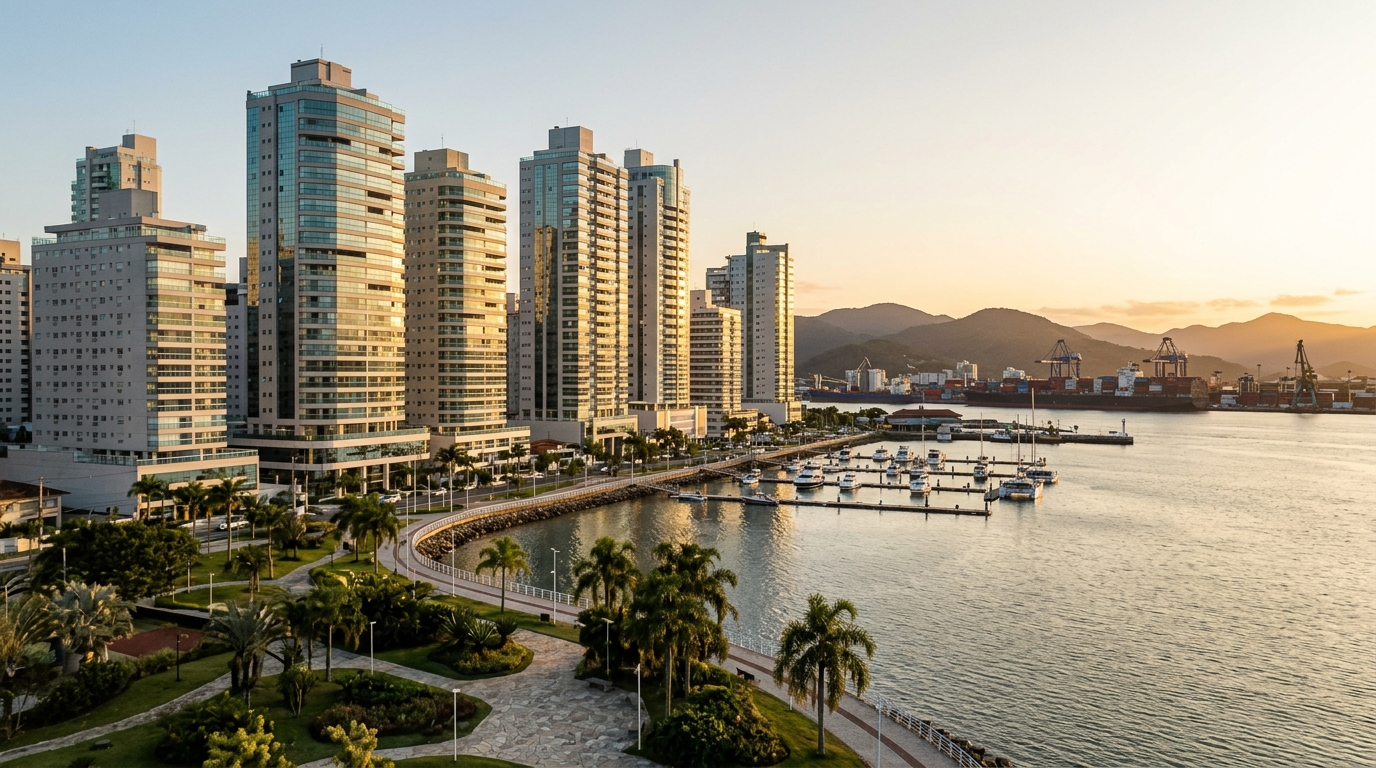
The advertised price per square metre in Itajaí closed April 2026 with a cumulative 24-month rise of 18.7%, according to the FipeZap Index, while average residential rent in the city moved up 13.4% over the same window. Across that same period, the Selic — Brazil's base interest rate set by the central bank — slid from 13.75% to 9.75% per year, and the INCC-M construction cost index lost momentum down to roughly 5.6% in 12 months. The interaction of these four vectors — sale prices, rents, interest rates and construction costs — has reorganised the equation that separates a tenant who renews a lease from a buyer who signs a mortgage. In 2026 the balance has tilted toward the disciplined buyer, but the break-even point is narrower than the sales-floor pitch suggests.
The question has stopped being ideological. Does it pay to leave the rental market and buy property in Itajaí in 2026, when the monthly mortgage instalment is still larger than the rent, but the opportunity cost of the down payment has fallen along with the base rate? Answering it honestly requires isolating four variables — capital tied up in the down payment, the monthly instalment, recurring carrying costs, and the alternative return on that capital — before any decision is taken. This article runs the full calculation with real Itajaí market numbers as of mid-2026.
The 2026 backdrop: the macro frame that changes the math
Copom, Brazil's monetary policy committee, closed the first half of 2026 with the Selic at 9.75% per year, after a gradual easing cycle from the 13.75% peak that held between August 2023 and early 2024. Headline inflation (IPCA, Brazil's official CPI) is running between 3.8% and 4.1% in 12 months, inside the upper band of the 3% ± 1.5 percentage point target. The IGP-M general price index — widely used to reset commercial and many residential leases — has returned to mildly positive territory after several negative months in 2024, sitting near 4.2% in the last 12 months. That is enough to unlock annual rent adjustments that had been compressed during the previous two years.
INCC-M, the construction cost index that escalates the monthly instalments on pre-construction units in Brazil, closed May 2026 at 5.6% in 12 months, according to readings consolidated by FGV and endorsed by CBIC, the national construction industry council. That figure sits well below the 14.7% peak of 2021, but it still runs above CPI and above the inflation implicit in rental contracts indexed to IGP-M or IPCA. For the off-plan buyer, this means each monthly instalment grows at a positive real rate until handover.
The piece that has shifted the most is the regional FipeZap. Itajaí's sale index advanced 9.1% in the 12 months to April 2026, against 6.3% for the average of the 50 cities the index tracks. The city's rental FipeZap rose 7.8% over the same period, also above the national median. Itajaí has firmly entered the cluster of markets with simultaneous acceleration of sale prices and rents — a signature of strong absorption and lean inventory, and historically a precursor of long valuation cycles for existing stock.
The real arithmetic: BRL 600,000, 30 years and the opportunity cost of the down payment
Consider a concrete simulation: a BRL 600,000 unit in Itajaí (around USD 110,000 at the mid-2026 reference exchange rate of roughly BRL 5.40 to the dollar), two bedrooms in a mid-tier neighbourhood, with a 20% down payment (BRL 120,000) and a BRL 480,000 SBPE mortgage — SBPE is the standard Brazilian mortgage system funded by savings deposits — taken over 360 months under the SAC amortisation method, where the principal is paid in equal instalments and total monthly payments decline over time. With a nominal rate of 11.49% per year plus TR (the residual reference rate, near zero in 2026), reflecting the mid-2026 average for the five largest banks, the first instalment lands around BRL 5,890. The last, thanks to the declining nature of SAC, falls to roughly BRL 1,770. The average over the life of the contract is approximately BRL 3,830, and total nominal interest paid exceeds BRL 580,000 — a headline figure that looks frightening but must be brought to present value for a fair comparison, not summed in nominal terms as is common in newspaper coverage.
Rent on an equivalent unit in the same neighbourhood currently runs between BRL 2,800 and BRL 3,200 per month, with a median near BRL 3,000, plus around BRL 650 of average condominium fees and BRL 180 of monthly IPTU (the municipal property tax, paid by the occupant in most lease structures). The buyer absorbs those two items identically — which is exactly the point where the comparison should be levelled: mortgage instalment against pure rent, not against rent plus carrying costs. Mixing everything together is the single most common error in sales-floor simulations.
One last piece almost no one calculates properly: the opportunity cost of the BRL 120,000 down payment. If parked in Tesouro Selic — a Brazilian government bond tracking the base rate, the typical low-risk benchmark for a domestic saver — at 9.75% per year (net yield around 8.1% after the regressive 17.5% income tax for horizons above two years), that capital would generate roughly BRL 9,720 net in the first year. Spread over 12 months, that is approximately BRL 810 per month that the tenant "earns" by not immobilising the down payment, and that the buyer forgoes by having immobilised it.
Add ITBI of roughly 2% of the assessed value (about BRL 12,000 in Itajaí, the municipal property transfer tax due at the closing), notary and registration costs of approximately BRL 8,000 for this ticket size, and a bank appraisal fee averaging BRL 3,500. The buyer enters the contract about BRL 23,500 poorer than the tenant before placing a single piece of furniture, and that gap carries its own opportunity cost across the life of the contract. It is this complete equation that has to appear in the comparison table.
| Item | Disciplined tenant | 30-year SBPE buyer |
|---|---|---|
| Initial outlay | BRL 3,200 (security deposit) | BRL 143,500 (down payment + ITBI + notary + appraisal) |
| Direct monthly cost | BRL 3,000 (median rent) | BRL 3,830 (average SAC instalment) |
| Shared carrying costs | BRL 830 (condo fees + IPTU) | BRL 830 (condo fees + IPTU) |
| Opportunity cost of the down payment | + BRL 810/month (net Tesouro Selic yield) | — |
| Net worth after 10 years* | BRL 285,000–310,000 | BRL 690,000–740,000 (property − remaining debt) |
| Net worth after 20 years* | BRL 680,000–760,000 | BRL 1.05–1.18 million |
*Assumptions: real property appreciation of 4% per year, real net return of 7% per year on the alternative portfolio, annual rent adjustments by projected IGP-M, and a disciplined tenant who consistently invests the monthly difference between rent and the mortgage instalment.
The buyer finishes the ten-year horizon with a net worth 35% to 50% higher than the disciplined tenant. The gap narrows to almost zero — and in some scenarios reverses — if the tenant does not invest the monthly surplus, which is the empirical rule observed by private wealth managers and by studies from Cemec-Fipe, the centre of capital market studies tied to FIPE, on Brazilian middle-class household behaviour.
The crossover point — when the math stops favouring rent — sits at roughly five to seven years under 2026 conditions, shorter than the Brazilian historical average of eight to ten years identified by ABECIP, the national real estate credit association, in the 2014–2022 cycles. The reason is precisely the lower Selic: it has cut the opportunity cost of both the down payment and the monthly surplus that the tenant would otherwise invest.
Why Itajaí has changed: port, record VGV and qualified migration
The northern coast of Santa Catarina state has become the hottest real estate corridor in Brazil over the past three years, and Itajaí is the nerve centre of that cycle. The Port of Itajaí handled roughly 1.42 million TEUs in 2025 — a historical record according to data consolidated by ANTAQ, the federal waterway transport regulator — and investments in expanding the back-yard port logistics zone, dredging and doubling road access have injected sustained, qualified residential demand. The core of that demand is made up of engineers, executives from the export-oriented agribusiness sector, merchant marine commanders, technology professionals attracted by the local yachting and shipbuilding hub, and international trade lawyers.
The combined VGV — Gross Sales Value, the Brazilian developer metric for total launched inventory at list price — released in Itajaí across 2024 and 2025 exceeded BRL 9 billion according to Secovi-SC, the state real estate trade association, in a window where ABRAINC, the national association of developers, was reporting a slowdown in national launches as the dominant trend. Monthly absorption of new units stayed above 70% in several mid-to-high-end projects delivered in the period — a rare figure for a year still operating with double-digit interest rates, and one that confirms the thesis that the Santa Catarina market has decoupled from the Brazilian average.
Three neighbourhoods concentrate most of the buyer interest and behave very differently — which is worth understanding separately before any purchase decision. Praia Brava has consolidated as the premium address on the northern coast, with advertised square-metre prices between BRL 18,000 and BRL 32,000 in oceanfront launches and historically tight inventory. The pipeline of SIDE Empreendimentos and other local developers in that strip concentrates units starting at BRL 2.5 million, with a buyer profile dominated by wealth allocators — second home, high-end short-term rentals, and a hedge against currency cycles for international holders.
Central Itajaí, modernised along the Avenida Coronel Marcos Konder axis and by the waterfront revitalisation next to the port, offers mid-to-high-end stock with square-metre prices between BRL 9,000 and BRL 14,000, and absorbs the strong rental demand tied to port activity and to the corporate offices of logistics and foreign trade firms. It is the neighbourhood with the deepest rental liquidity in the city — a critical feature for anyone buying with the option of eventually turning the unit into an income asset. Cabeçudas, with a more residential and family-oriented profile, attracts buyers looking for waterfront with lower density: BRL 11,000 to BRL 18,000 per square metre, sustained appreciation over the last 36 months, and a slower launch cadence that protects existing-stock prices.
Qualified internal migration — buyers from São Paulo, Paraná and Rio de Janeiro looking for quality of life with reasonable urban infrastructure — is the demographic vector sustaining the premium rental curve in the city. Itajaí has recorded positive net migration since 2018, peaked in 2024 and held an elevated level in 2025, according to cross-referenced data from the IBGE census bureau, the state Board of Trade and the electoral domicile transfer records of the superior electoral court.
Cash, financed or off-plan: where INCC and the cash discount decide
Choosing between the three acquisition modes depends less on personal preference and more on three objective variables: liquidity available in personal or family cash, expected interest-rate path over the life of the contract, and likely holding or resale horizon. Paying cash captures the standard market discount — in Itajaí, between 5% and 12% off the list price on completed projects with mature inventory. That discount is the direct counterpart of the cost of money the developer would otherwise pay while waiting for instalments, plus the carrying cost of unsold stock.
In an SBPE mortgage, nominal rates in 2026 still start in double digits. Financing pays off when the sum of the alternative return on capital, plus a reasonable expectation of property appreciation, plus residual tax benefits (FGTS use, occasional deed-level deductions, specific exit regimes) exceeds the total weighted cost of credit. In 2026, with the Selic at 9.75% and SBPE rates ranging between 10.5% and 12% plus TR depending on banking relationship, a long mortgage starts to make mathematical sense for profiles whose conservative investments yield 8% to 9% net — the opposite of the 2022–2024 window, when SBPE financing was a mathematically poor deal and only signed for lack of alternatives.
Buying off-plan is the preferred path for those chasing a lower entry list price, a payment flow spread across the construction window, and willing to accept two relevant burdens: INCC adjusting the instalments until handover, and execution risk on the development itself. In 2026, with INCC-M running at 5.6% per year, a BRL 4,000 instalment signed today becomes something between BRL 4,480 and BRL 4,700 in 24 months at the contract anniversary — an effect that has to be embedded in the affordability calculation, on pain of the household budget tightening already in the second year.
FGTS — the mandatory payroll-funded severance fund Brazilian formal workers accumulate, releasable for housing under specific rules — can be used either to amortise the outstanding balance at handover or as part of the down payment, provided the worker has at least 36 cumulative months of formal employment contributions and the property fits SFH criteria: a value cap of BRL 1.5 million in most markets including Itajaí, and a documented residential purpose. For typical city tickets (BRL 500,000 to BRL 1.2 million), FGTS can finance between 8% and 18% of the total, depending on length of formal employment and family composition. Foreign buyers without a Brazilian labour history will not have this lever available and should plan accordingly.
The market typically sells off-plan as always cheaper. In 2026, with INCC eroding every instalment until handover and the Selic still in double digits at the start of the contract, the headline discount only translates into a real advantage for buyers who hold the asset for at least four years after the keys. Before that, the financial cost embedded in the indexation, plus transaction charges, swallows the list-price gain — and discounted ready stock often wins by a comfortable margin.
The real risks: liquidity, contract termination and concentration
The first trap is asset liquidity. Property is not a sovereign bond, and that sentence deserves to be said out loud before any deed. During high-Selic cycles, average time-to-sale in Itajaí has crossed 180 days for tickets above BRL 1 million, according to surveys by CRECI-SC, the regional realtors council, with the city's main agencies. In hot cycles it drops to 45 to 60 days. Buyers need both the financial and emotional capacity to carry the asset through at least one full interest-rate cycle without being forced to discount aggressively — generally three to five years.
Termination of an off-plan contract — known as "distrato" — is the most underestimated risk in the segment. Federal Law 13,786 of 2018, the distrato statute, set a cap of 25% of paid amounts retained by the developer in standard projects, rising to 50% under the "patrimônio de afetação" segregated-assets regime — a special structure most mid-to-high-end Santa Catarina developers adopt, precisely to lower construction credit costs and shield buyers against cross-default between projects. In absolute terms, a buyer who has paid BRL 250,000 on a BRL 1.2 million unit and needs to withdraw three years in can receive back between BRL 125,000 and BRL 187,500, with no inflation correction on the INCC paid during the period. That is a six-figure hit that rarely makes it into the initial simulation.
The third risk is portfolio concentration. Middle and upper-middle-class families in Itajaí with total net worth between BRL 1.5 million and BRL 4 million frequently end up with 70% to 85% of net value allocated to a single residential property. When that property sits in the same region where the family works and where its primary income is generated (port, yachting hub, naval industry, foreign trade), the investor simultaneously concentrates sector-economic and asset risk in one geographical point — an exposure any professional allocator would consider unbalanced, and one that is usually corrected by geographic diversification of the real estate portfolio or by allocation to long-duration uncorrelated financial assets. For an international buyer, geographic diversification is usually already built in, which actually softens this specific risk relative to a local family.
There is also the life-event risk, which the market tends to dismiss as noise when it is in fact the engine behind a meaningful share of discounted sales: divorce, an unexpected job transfer, serious illness, a child moving cities for university. The average Brazilian buyer stays 7.2 years in the same residential unit, according to consolidated ABECIP data — a horizon dangerously close to the mathematical break-even point in several 2026 scenarios, which means a relevant share of buyers will sell before the purchase has beaten renting on the full equation.
When renting still wins — and the costliest first-time buyer mistakes
Renting continues to win in three clear situations, and recognising them is more useful than insisting on buying at the wrong stage of personal life. The first is short horizon: anyone with a realistic probability of moving cities or neighbourhoods within less than five years almost never benefits from buying, because transaction costs (ITBI, notary, brokerage on resale, possible renovation to make the unit marketable) consume most or all of the appreciation margin. The math on that horizon favours renting by a wide margin under any reasonable rate scenario.
The second is upward professional mobility. Professionals on a rising career path who may still change employer, city or country — or open a business — need to preserve liquid capital and decision flexibility. Buying property is the opposite of that: it is a monetary, geographic and psychological vote of permanence. For this profile, the rational optimisation is to rent well and build net worth in financial assets until life stabilises geographically. For international buyers, this also applies in reverse: until you have spent enough time on the ground to know whether Itajaí is the right anchor, renting first is the disciplined move.
The third is the absence of an emergency reserve. Buying a residential property without at least six months of household expenses parked in liquid reserve turns any shock — job loss, illness, drop in variable income — into default risk. And default on an SBPE mortgage progresses to extrajudicial foreclosure in 12 to 18 months, with potential loss of the entire down payment and of everything paid in amortisation. The disciplined buyer has, in strict order, an emergency reserve, a down payment for the target ticket, and comfortable affordability on the instalment. With the first item missing, renting is not surrender — it is rationality.
The costliest first-time buyer mistakes in Itajaí follow a repetitive pattern any seasoned financial planner can identify. Comparing the mortgage instalment with rent without including the opportunity cost of the down payment is the most common and the most damaging — it flips the decision the wrong way in more than half of the cases analysed by specialised advisors. Underestimating recurring carrying costs on the purchased unit is second: condominium fees in premium Praia Brava buildings exceed BRL 2,500 per month; façade maintenance, common areas and elevators in oceanfront buildings generate extra assessments that, across a typical maintenance cycle, sum to roughly 0.8% of property value per year.
Ignoring INCC in off-plan purchases and sizing affordability only by the initial instalment is third — the jump in the instalment during the second year is the main cause of distrato requests in Santa Catarina projects. Fourth, choosing a neighbourhood by fashion rather than by rental liquidity: leaving a lease for an address with poor rental absorption locks the future exit through rental income, sacrificing the valuable optionality of converting the property into a yield asset if life changes before the planned horizon.
Conclusion
Leaving the rental market and buying in Itajaí in 2026 has stopped being a dogmatic decision and become a math problem with few variables and different answers for each buyer profile. For those with at least a 20% down payment, six months of emergency reserve, a minimum horizon of five to seven years in the same property and the discipline to choose a neighbourhood with proven rental liquidity, the equation again closes in favour of buying — something that was not mathematically true between 2022 and mid-2024, when a Selic at 13.75% inflated the opportunity cost of the down payment and dominated any reasonable simulation. For anyone entering the contract without a reserve, with a short horizon, with high professional mobility, or comparing only instalment against rent without the opportunity cost of the down payment, renting remains mathematically superior in 2026 and will likely remain so in 2027.
The weekly analysis from the SIDE Empreendimentos portal tracks the evolution of FipeZap Itajaí, the Selic, INCC-M and regional VGV so that subscribers can recalibrate the decision with each meaningful turn of the cycle — not with each headline. Subscribing is the most direct way to avoid making the highest-ticket decision of a financial life on the basis of the market mood the week the contract was signed.