Real Airbnb Occupancy in Balneário Camboriú 2026
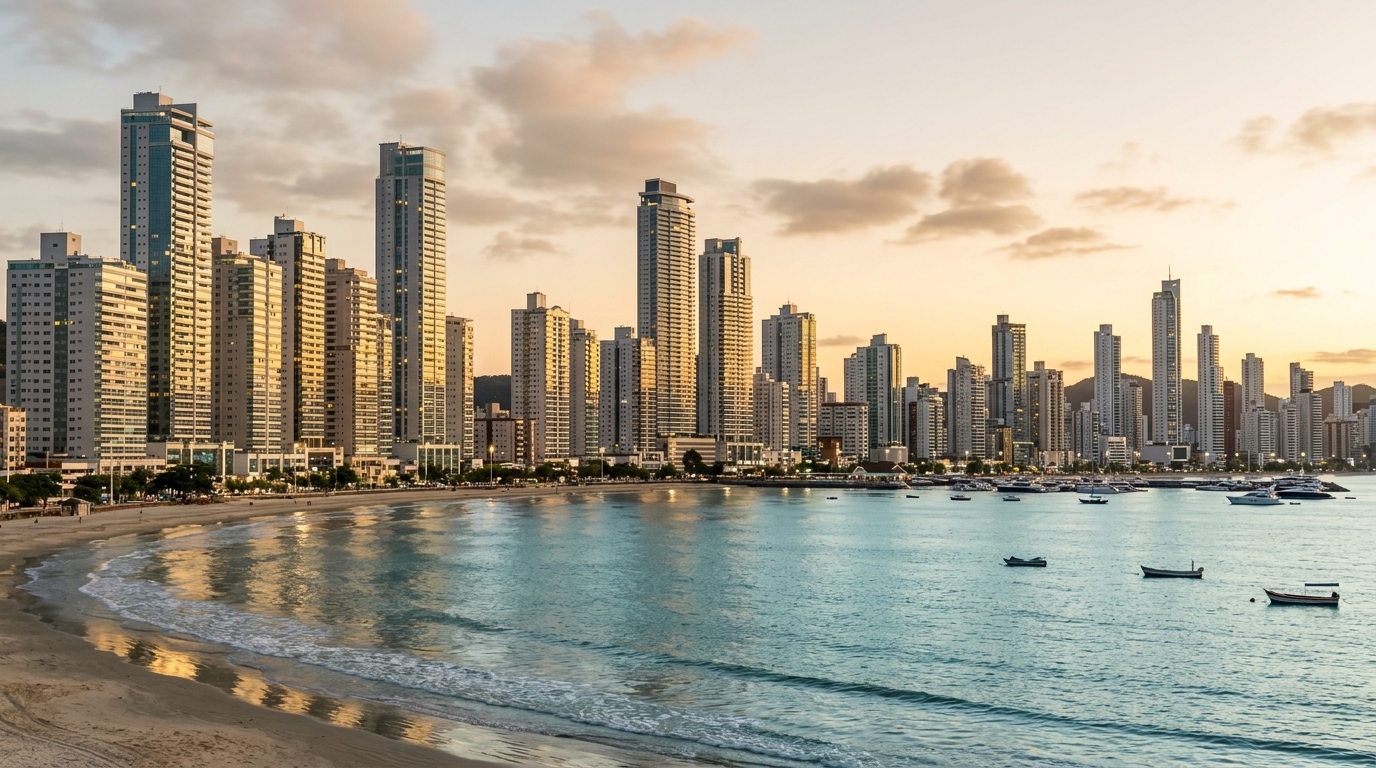
In January 2026, AirDNA recorded a 46% annual average occupancy rate for short-term rental properties in Balneário Camboriú. That same month, AirRoi marked 34.5%. The three largest local property managers, which together operate more than four thousand active units across Barra Sul, the downtown core and Praia Brava (Itajaí), reported occupancy between 51% and 58% on their investor calls. The spread between the extremes reaches 24 percentage points. In a feasibility analysis of a R$ 1.8 million apartment in Barra Sul, those 24 points translate to something close to R$ 100,000 in gross annual revenue appearing or disappearing purely based on which data source you choose.
That gap is not fraud. It is method. Each provider measures something different, excludes a different slice of inventory and defines "occupancy" differently. Anyone investing in short-term rentals on the Santa Catarina coast in 2026 — where new tower supply keeps rising and the vacation rental market is no longer a secret — needs to understand what each source is actually counting before signing a contract. This article decodes the three metrics, translates the numbers observed in 2025 and early 2026, and shows how to use each one in the decision.
The three occupancies: gross, adjusted and perceived
The confusion starts with the word "occupancy" itself. In traditional hotel reporting, occupancy is a simple fraction: room-nights sold divided by room-nights available. In the vacation rental universe, "available" turns ambiguous. The property that sat off the platform for three months because the owner was using it — does that count as "available" or not? What about the listing created in October with a calendar opened only for New Year's Eve? Or the brand-new unit delivered in March? Each provider answers differently, and the answer dictates the headline number.
Gross occupancy is AirDNA's preferred metric. It counts every active listing in the municipality, including those with calendars closed most of the year, and divides nights actually sold by the theoretical total of nights in the period (365 days per listing). It is the most conservative metric because it dilutes inventory with semi-dormant units — ghost listings, second homes that the owner's family occupies during peak season, properties under renovation. In Balneário Camboriú, this calculation delivered 46% in January 2026, with a mildly declining trend since the 49% peak observed at the end of 2024.
Adjusted occupancy, used by AirRoi and by part of the internal toolset of professional managers, removes from the denominator the days when the listing was blocked for a clear reason (maintenance, personal use, temporary withdrawal). The number gets cleaner, but it forces a judgment call on what counts as a legitimate block. Because AirRoi applies stricter criteria than most managers, it paradoxically delivers a lower figure — 34.5% — by treating as "available" anything that is listed, even during historically dead windows. It is the least generous of all three metrics.
Perceived occupancy, finally, is what appears in local manager reports and in sales presentations from developers. Here the denominator is only the days actually put up for sale — net of technical blocks, gaps between guests and days off-market for refurbishment. It is occupancy from the operator's point of view: of the days the property was actually in the game, how many were sold? That is why it lands at 51–58%. It is not an inflated number; it is a number with a different base. The problem is that it does not answer the question the investor actually needs to ask: "how many nights per year does this property generate revenue?"
The real 2025–2026 numbers and the regional benchmark
Reconciling the three sources for the trailing 12-month period ending May 2026, the realistic gross occupancy range for apartments of up to three bedrooms in Balneário Camboriú sits between 40% and 52%, with a median close to 45%. ADR (Average Daily Rate) ranged from R$ 300 to R$ 650, heavily dependent on view, floor and distance from the main beach. RevPAR (Revenue Per Available Room) — the product of occupancy and ADR — landed between R$ 135 and R$ 320 per available night, with Barra Sul pulling the upper end because it concentrates the newest, top-tier inventory with permanent ocean views.
For a foreign investor reading these figures: the Brazilian real (R$) traded between R$ 5.20 and R$ 5.70 per US dollar through the first half of 2026, meaning a R$ 1.8 million ticket sits in the US$ 315,000–US$ 345,000 range. The comparative analysis with neighboring municipalities is where the thesis sharpens. Florianópolis, with inventory spread across many neighborhoods and tourism distributed throughout the year, delivers higher gross occupancy — around 53% — but a median ADR of R$ 380, resulting in a RevPAR close to Balneário's. Itapema, the direct neighbor, runs with occupancy similar to BC (44–48%) but ADR consistently 15% below, reflecting younger inventory and direct competition for the same tourist. Porto Belo, with an even more seasonal profile, posts low annual occupancy (38–42%) but New Year peaks that pay almost half of annual revenue in three weeks.
| Municipality | Gross occupancy 12M | Median ADR (R$) | Estimated RevPAR (R$) | Seasonal concentration |
|---|---|---|---|---|
| Balneário Camboriú | 45% | 480 | 216 | High (40% of revenue in DJF) |
| Itapema | 46% | 410 | 189 | High (38% in DJF) |
| Porto Belo | 40% | 520 | 208 | Very high (47% in DJF) |
| Florianópolis | 53% | 380 | 201 | Moderate (29% in DJF) |
| Praia Brava (Itajaí) | 43% | 590 | 254 | High (41% in DJF) |
The figures above are medians; the spread within each municipality is enormous. In Balneário, the gap between the bottom and top deciles of ADR runs from R$ 240 to R$ 1,150 per night. Anyone comparing their own property against the municipal average without considering where it sits in the decile distribution is making a structurally flawed calculation. The number that matters is not "what is BC's occupancy?", but "what is the occupancy of properties comparable to mine — same ADR band, same neighborhood, same bedroom count — over the past 24 months?"
Extreme seasonality and why the annual average lies
Balneário Camboriú has one of the most seasonal profiles among urban beach destinations on the Brazilian coast. December, January and February concentrate between 38% and 42% of annual short-term rental revenue. Peak occupancy — December 26 to January 20 — exceeds 85% and reaches 92–95% in well-positioned units. The New Year ADR can triple compared with the annual average. Outside that narrow window, the destination breathes at a different rhythm. May, June and August run with occupancy between 18% and 28%; July rises to 40–50% thanks to school holidays and a long municipal break; September and October enter a slow recovery at 25–35%.
The operational consequence is brutal. A property delivering 45% annual average occupancy is NOT rented 45% of days uniformly. It is rented 90% of days in January, 22% in June, and zero on stretches in absolute low season. That changes everything: it changes the working capital required, the cash flow profile that any financing must absorb, the household investor's tolerance for negative months, and the pressure to price the peak aggressively (and not miss the window that pays for the year).
"The annual average is a marketing statistic. The responsible investor prices in three blocks — peak, shoulder and low — and calculates break-even on the low block. If the property doesn't cover its operating costs on its own in June, the asset is a bet on the high season, not an income investment."
The INCC (the Brazilian construction cost index used to adjust off-plan installment balances) reached 6.9% over the 12 months to April 2026, with the labor component pulling above average. That means the cost of linens, small annual refurbishments and routine maintenance is eroding the real RevPAR for everyone who entered the market in 2023–2024 under lower inflation assumptions. Anyone redoing the operating budget without lifting ADR above INCC is losing real margin, even with stable occupancy.
2026 Airbnb algorithm, new tower supply and municipal regulation
The Airbnb algorithm went through two material changes in 2025 that continue to compress occupancy in destinations with oversupply. The first was a heavier penalty for listings with cancellation rates above 3% — a factor that reduces ranking in last-minute searches, precisely the queries that pay the peak. The second was the rising weight of the "fit" score between the listing's title/photos and guest expectations; generic listings lost visibility to listings with a clear narrative (family with kids, couple with pet, young group, executive traveler). Operators on autopilot, inheriting templates from their manager, are losing positions to competitors who rewrote everything from scratch.
In parallel, new supply keeps coming online. Consolidated data from ABRAINC and Secovi-SC (the Brazilian developer trade groups) indicate that VGV — Valor Geral de Vendas, the gross sales value launched by developers — for Balneário Camboriú and adjacent municipalities held above the historical average in 2024 and 2025, with a strong concentration of investor-oriented projects: 60–90 m² apartments, layouts optimized for short-term rental, amenity decks designed as listing showcases. A large share of that pipeline is either delivering now or in advanced construction, with completion (habite-se) scheduled for 2026–2028. The expected effect: more supply chasing the same peak demand, with continuous downward pressure on occupancy and ADR outside the high season.
Regulatory debate has gained weight. The Balneário Camboriú City Council moved forward in 2025 with discussion on minimum requirements for short-term rental listings — municipal registration, a specific ISS (municipal service tax) charge, minimum identification standards for the responsible party. The final wording is still in process, but the direction is clear: the model will migrate toward something closer to Florianópolis or to European capitals, where the informal operator loses competitiveness against the professional one. Anyone entering in 2026 should budget as if the regulation lands this cycle, not the next.
The differentiation factors that sustain above-market occupancy have shifted. A permanent ocean view remains the leading one, but it has lost margin to three variables that climbed in importance: walkable distance to restaurants (400 m radius), Wi-Fi with at least 100 Mbps upload, and independent covered parking. The guest paying high ADR in 2026 no longer accepts a property dependent on valet service, unstable internet or a long walk to services. Projects strong on those three variables hold occupancy above 52%; those that fail on two drop below 38%.
The honest investor math: real costs, break-even and the CDI benchmark
The feasibility math that typically circulates in sales presentations starts from an optimistic occupancy figure (usually perceived occupancy, close to 55%), applies the building's peak ADR as the average ADR, and ignores half of the operating costs. The result is a marketed net return of 14–18%. Reality observed in mature portfolios (more than 24 months in operation) is more sober. Considering the current ticket for a two-bedroom in Barra Sul (R$ 1.6 million, or roughly US$ 290,000), a realistic gross occupancy of 45% and a median ADR of R$ 480, gross annual revenue lands around R$ 78,000. From that revenue, the following deductions apply:
The platform's service fee (around 14–15% of revenue, combining host and indirect guest service fees), the professional manager's commission (15–25% depending on the package — basic management, full service, or premium hospitality), cleaning and linen costs per stay (R$ 90–180 per check-in, passed partially or fully to the guest depending on the market), the condo fee (in a premium Balneário building, R$ 1,200–2,400 per month), property tax — IPTU (1.1–1.4% of assessed value), property and liability insurance, and the annual maintenance/replacement reserve (3–5% of gross revenue for linens, appliances, paint).
Adding it all up, operating costs consume between 52% and 64% of gross revenue. Net operating revenue lands at R$ 28,000–R$ 38,000 per year, or 1.75% to 2.4% of the ticket. Adding the expected capital appreciation — which ran around 9–12% per year in Balneário during 2024–2025 according to the FipeZap index, but is expected to decelerate as new supply enters — total honest return falls between 6% and 12% per year, with a median of 8–9%.
The comparison with Selic (Brazil's base interest rate set by the central bank) is unavoidable. With the policy rate at 10.75% in June 2026 and CDI (the interbank reference rate used to remunerate fixed-income products) tracking close to it, a CDI-linked bond delivers 100% of that rate, net of tax, with daily liquidity and zero operational risk. In other words: the investor who chooses short-term rental in BC in 2026 is agreeing to trade liquidity, simplicity and zero risk for a combination of capital appreciation potential, tax advantages (in certain cases), personal use of the property, and the bet that operations will outperform the fixed-income floor over the next five years. It makes sense for certain profiles. It does not make sense for an investor making the call based solely on the "advertised occupancy" number.
How to use real occupancy in the buying decision
The practical point: occupancy is not a number, it is a set of numbers that answer different questions. Before closing on a property intended for short-term rental in Balneário Camboriú, the responsible investor needs to collect and cross-reference at least five data series — not one. First, gross occupancy from AirDNA or equivalent for the exact micro-region of the property (not for the whole municipality). Second, the median ADR of the 25 most comparable nearby properties, reading at least 18 months of history. Third, the monthly RevPAR curve of comparables to identify seasonal concentration. Fourth, the estimated new supply entering within an 800-meter radius over the next 24 months. Fifth, the candidate property's position within the ADR decile distribution — knowing the average is not enough; what matters is which end of the curve it gravitates toward.
The minimum due diligence checklist in 2026 looks like this: ask the property manager for the 24-month operating history of comparable units they already manage in the same building or neighborhood; insist on the paid AirDNA competition report (no shame in paying for it) or hire an independent analyst; cross-check the manager's perceived occupancy estimate against AirDNA's gross occupancy — if the divergence is more than 12 points, ask for the calculation memo; budget operating costs on the conservative floor and revenue on the realistic interval (occupancy 40%, median ADR). If the thesis closes under that scenario, it is robust; if it only closes with occupancy above 50% and ADR in the top decile, it is a bet, not an investment.
The comparison between buying off-plan (na planta) and buying ready in 2026 has gained important nuances. Buying off-plan today in Balneário Camboriú means absorbing INCC indexation over 24–36 months of construction (which under a base case adds up to 14–20% over the outstanding balance), with the upside of an extended pre-handover installment schedule and the potential appreciation between the current price list and the price list at delivery. Buying ready means generating revenue immediately and working with real occupancy rather than projected — but paying the full ticket using SBPE bank financing (Brazil's regulated mortgage system funded by FGTS, the workers' severance fund, and savings deposits), whose real rate sits between 10.5% and 12.5% per year in 2026. Foreign buyers face additional friction in accessing SBPE financing and typically use cash or international financing, which changes the calculation entirely. The choice depends on the horizon and on which variable the investor trusts less: INCC inflation, or the initial operation.
For 2026–2028 scenarios, the reasonable expectation is the following. Gross occupancy tends to oscillate between 42% and 48% in BC, with downward pressure starting in 2027 as new towers deliver. Median ADR should rise below general inflation due to competition, but ADR in the top decile (permanent view, genuine premium) should rise in line with INCC or slightly above it. RevPAR essentially flat in real terms. Anyone entering now earns less from operations and more from holding a position in the most appreciated micro-region of the Santa Catarina coast. It is a game of fine selection — not a game of market averages.
Conclusion
The three Airbnb occupancy rates in Balneário Camboriú in 2026 are not in conflict; they answer different questions. AirDNA measures the whole inventory and tells you how much of everything listed is being occupied. AirRoi measures with strict criteria and gives you the conservative floor. Local managers measure the operation and tell you how well the team is selling the available days. The professional investor uses all three: AirDNA to frame the market, AirRoi as a stress test, and the manager to judge execution. None of them alone sustains a thesis on a R$ 1.5 million ticket.
SIDE Empreendimentos tracks the short-term rental cycle on the Santa Catarina coast closely and publishes a weekly condensed analysis covering the main market indicators — occupancy, ADR, RevPAR, new supply and the regulatory landscape. Subscribing to that weekly read is the cheapest way to avoid making an eight-figure decision based on a single source. The right number exists; it just does not fit on a single slide headline.