Minha Casa Minha Vida Itajaí 2026: Who Qualifies
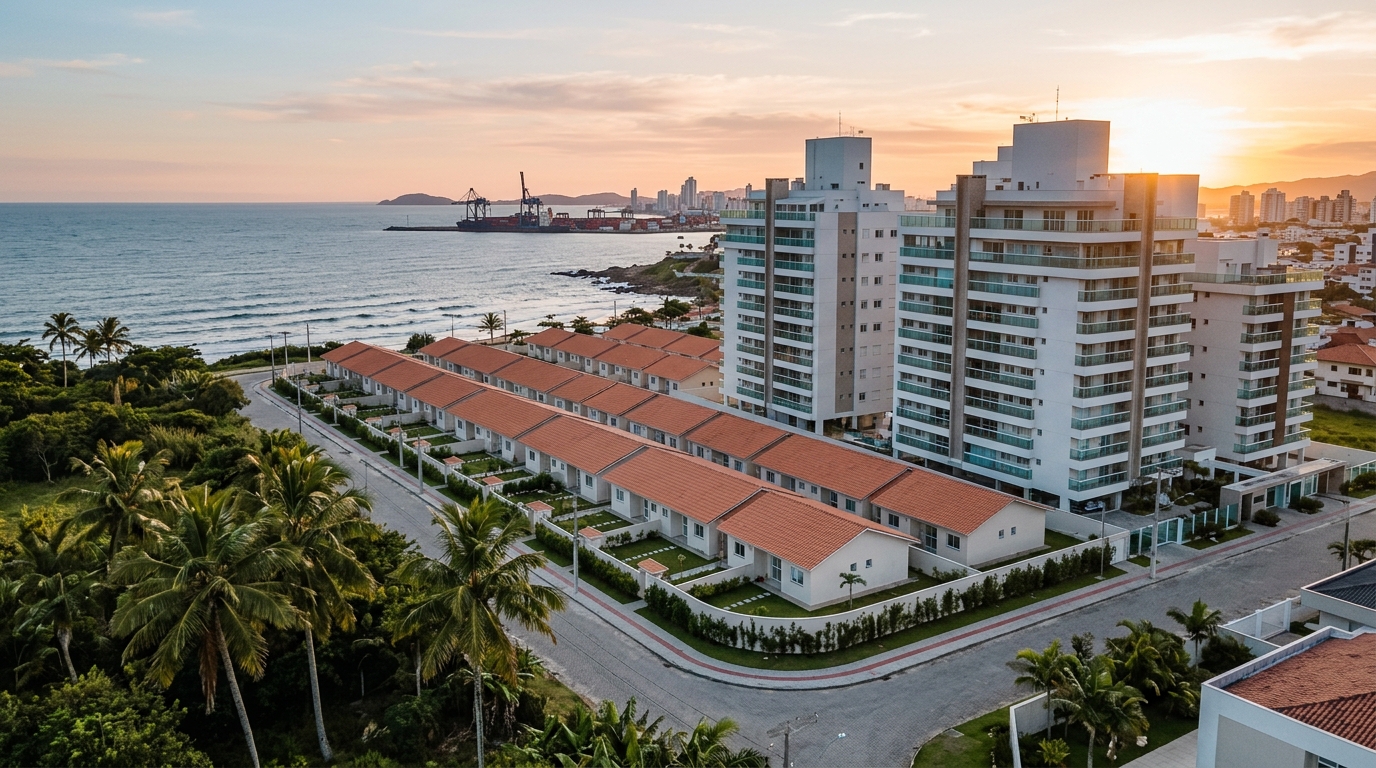
On February 12, 2026, Brazil's federal bank Caixa Econômica Federal released the updated tables for Minha Casa Minha Vida — the country's flagship social housing program — with one detail that reshaped the math for thousands of families in Itajaí: the maximum financing term rose to 420 months, or 35 years, and the urban income ceiling for Tier 4 eligibility was lifted to R$ 12,000 per month (about US$ 2,200 at mid-2026 exchange rates), or R$ 13,000 in selected metropolitan regions. In a city where residential VGV — the development industry's term for total sales value at launch price — crossed R$ 9 billion in 2025 and the average square meter on the seafront flirts with R$ 18,000, understanding exactly who qualifies for the program in 2026 has stopped being a question only for social-housing candidates. It has become, in parallel, a tool for reading the local market that anyone investing in Itajaí now needs to hold in their head.
Itajaí is an atypical case. Inside the same municipal perimeter, you find the most expensive coastline pricing in the state of Santa Catarina — Praia Brava, Cabeçudas — and a rising housing pressure driven by port expansion, the arrival of BYD's Brazilian factory in neighboring Camboriú, and the constant inflow of construction workers feeding the boom. The Municipal Housing Secretariat is currently working with an active queue of roughly 8,000 registered families, according to the department's own March update, and the federal program returned to the center of the conversation after the April policy changes.
This piece unpacks, with official figures and verifiable sources, who actually qualifies for Minha Casa Minha Vida in Itajaí in 2026 — tier by tier, rule by rule — and why the investor who landed here researching the program almost certainly needs to look at a different product.
Who qualifies in 2026: the four tiers, in concrete numbers
Minha Casa Minha Vida was restructured by the federal government in 2023 and received its second material update in April 2026. The tiered structure remains the program's spine, now with adjusted income ceilings and differentiated interest rates by profile.
Tier 1 serves families with gross monthly household income up to R$ 2,850 (the cap widened in April, from R$ 2,640). This is the tier that depends on public referral: the beneficiary does not approach Caixa on their own. The City Hall, through a municipal housing registry, selects who enters a housing complex funded by FAR (Residential Lease Fund) or FDS (Social Development Fund). The subsidy is comprehensive, the monthly installment is capped at 30 percent of household income, and the interest rate is minimal.
Tier 2 covers monthly income between R$ 2,850.01 and R$ 4,700. Here the individual subsidy can reach R$ 55,000 (the maximum in the 2026 schedule). Annual interest runs from 4 percent to 4.75 percent for FGTS contributors — FGTS being Brazil's mandatory worker severance fund, which doubles as a low-cost mortgage credit source — and the contract is signed directly with Caixa, no longer requiring municipal referral. According to first-quarter data from ABRAINC, the developers' trade association, this is the tier that grew fastest by contract volume in Santa Catarina.
Tier 3 runs from R$ 4,700.01 to R$ 8,600 of monthly income, with annual rates between 5.5 percent and 7 percent and subsidies that decrease as income rises. It is the typical tier for a state civil servant, an early-career bank employee, or a couple in which both partners hold formal jobs in retail or in Itajaí's port operations.
Tier 4, created in the 2023 overhaul and broadened in 2026, covers monthly income from R$ 8,600.01 to R$ 12,000 (R$ 13,000 in selected metropolitan regions, which does not include Itajaí). Rates reach a ceiling of 8.16 percent per year — still significantly below traditional SBPE financing, Brazil's savings-account-funded mortgage system, which is running between 11 percent and 12 percent annually on market lines in June 2026. There is no direct cash subsidy in this tier, but borrowers gain access to FGTS funds and to the program's interest-subsidized terms.
A rural variant of the program also exists, covering gross annual income between R$ 50,000 and R$ 134,000 and aimed at construction, renovation, or purchase of housing in rural areas. It is rarely used inside Itajaí proper and matters more for neighboring municipalities such as Ilhota and Penha.
Across every tier, the basic 2026 requirements for the beneficiary are:
- A valid CPF (Brazil's individual taxpayer registry number) in good standing with the federal tax authority;
- The applicant cannot be the owner, possessor, prospective buyer, or assignee of any residential property anywhere in Brazil;
- The applicant cannot have been a previous beneficiary of any federal housing program with subsidy (MCMV, PAR, prior versions of MCMV, or predecessors);
- Minimum age of 18, or legally emancipated;
- For foreigners, a permanent visa or an indefinite-term residence authorization is required;
- No disqualifying credit-bureau restrictions (Serasa or SPC, the two main Brazilian credit bureaus, are checked for Tiers 2 through 4; Tier 1 is assessed on a socioeconomic basis, where credit restrictions alone do not block enrollment).
Itajaí in 2026: the Casa Catarina program, 200 new units, and a queue bottleneck
The municipal picture has shifted noticeably over the last eighteen months. Casa Catarina, a state-level program launched by the Santa Catarina government to complement the federal MCMV, delivered in Itajaí, in early 2026, a complex of 43 houses in the Cordeiros district. Investment came in around R$ 4.9 million, with municipal counterpart funding for infrastructure — earthworks, paving, water mains. The selection criteria combined the municipal housing registry with the income ceilings of MCMV Tier 1: whoever fits the federal program enters the state program's funnel automatically.
In parallel, the City Hall announced in the first half of the year a contract for 200 additional housing units funded through combined FAR and FGTS resources, distributed across two hubs: the Espinheiros district and an expansion of Jardim Napoli. Jardim Napoli, in particular, has turned into a case study. It began as a private-initiative low-cost subdivision with lots starting around R$ 75,000, and was partially absorbed by the Housing Secretariat for MCMV Tier 1 and Tier 2 units. The social mix is deliberate — it prevents ghettoization and broadens the neighborhood's income profile.
The critical point is the queue. Roughly 8,000 active municipal registrations mean that, even with 243 units in the declared pipeline (Casa Catarina plus the 200 new units), direct Tier 1 fulfillment covers less than four percent of the demand registered in 2026. That is why, in practice, Tiers 2, 3, and 4 — which skip the municipal referral and can be contracted directly at any Caixa branch — account for the majority of keys handed over each year in Itajaí.
There is also a spillover effect that matters for anyone reading the market: a significant share of Tier 2 and Tier 3 buyers ends up purchasing units in Navegantes, in the inland portion of Itapema, or along the BR-101 federal highway corridor toward Camboriú, where the program's R$ 350,000 ceiling still buys new product. Inside Itajaí, that ceiling gets tighter the closer you move to the city center or the seafront.
How to enroll in practice: municipal registry versus direct contracting
The path the beneficiary follows in 2026 depends essentially on their income tier — and this is the part that generates the most confusion at the Secretariat's counter.
For Tier 1, the process is municipal. The applicant fills out the Municipal Housing Registry — in Itajaí, via the intranet2.itajai.sc.gov.br portal, or in person at the Housing Secretariat at Rua Hercílio Luz, 1,140. The required documents include: ID and CPF for every household member over 18; proof of residence; proof of income (a signed employment booklet, an affidavit for self-employed workers, or documentation of social benefits such as Bolsa Família and BPC, Brazil's continuous-payment welfare program for the elderly and disabled); birth certificates for minor children; marriage, divorce, or stable-union certificate; school enrollment proof for dependents; and a medical report if a household member has a disability.
The registry is valid for 24 months and must be updated within that window, otherwise the application is dropped. Selection follows federal and municipal priority criteria: female-headed households; families with a person with disability or an elderly member; families in areas of risk mapped by Civil Defense; and length of residence in the city (Itajaí applies a minimum of 24 documented months).
For Tiers 2, 3, and 4, there is no municipal registry. The applicant picks the property — new or used, within the R$ 350,000 ceiling for Itajaí — submits the documentation directly at Caixa (or at an accredited correspondent), passes through a conventional credit analysis, and signs the financing. Choosing a developer already enrolled in the program speeds things up: Caixa's in-house engineering team has already pre-approved the project, which compresses the cycle from offer to signed contract.
One technical detail worth noting for 2026: a Ministry of Cities ordinance published in April simplified income documentation for informal workers in Tiers 2 and 3 — it now accepts twelve months of bank-account activity as proof of repayment capacity, complemented by an income tax return where one exists. A small change with an outsized effect: it expanded the eligible universe at the edges of the service economy, which in Itajaí means tourism, restaurants, and neighborhood retail.
Subsidy, interest rates, and real simulations at R$ 2,000, R$ 4,000, and R$ 8,000 of income
The interest table in force since April 2026 looks like this, and these are the numbers that matter once you put a calculator next to the household budget:
| Tier | Monthly income | Annual rate (FGTS contributor) | Annual rate (non-contributor) | Max subsidy | Term |
|---|---|---|---|---|---|
| Tier 1 | up to R$ 2,850 | 4.0% | — | up to 95% of property value | up to 420 months |
| Tier 2 | R$ 2,850.01 to R$ 4,700 | 4.75% | 5.25% | up to R$ 55,000 | up to 420 months |
| Tier 3 | R$ 4,700.01 to R$ 8,600 | 5.5% to 7.0% | 6.0% to 7.5% | up to R$ 20,000 | up to 360 months |
| Tier 4 | R$ 8,600.01 to R$ 12,000 | 7.66% | 8.16% | — | up to 360 months |
The average square-meter price in Itajaí, taking the FipeZap aggregate from May 2026, stands at R$ 11,800 — but that average hides a violent dispersion. In the core of the Cordeiros, São Vicente, and Espinheiros districts, the new-construction square meter that fits within MCMV ceilings runs between R$ 6,500 and R$ 8,000. That is where the simulations below sustain themselves.
Income of R$ 2,000 (Tier 1): the maximum installment allowed is R$ 600 (30 percent of income). In a Tier 1 housing complex with a unit appraised at R$ 180,000, the federal subsidy can cover 80 to 95 percent of the price; the financed balance lands between R$ 18,000 and R$ 36,000 over up to 420 months, producing an initial installment in the R$ 250 to R$ 450 range. Viable, conditional on municipal referral.
Income of R$ 4,000 (Tier 2): installment capacity of R$ 1,200 (30 percent). Target property at R$ 280,000 in Itajaí. With R$ 30,000 of FGTS savings plus a R$ 40,000 subsidy and a R$ 10,000 down payment from savings, the R$ 200,000 financing over 420 months at 4.75 percent annual rate produces an initial installment of roughly R$ 1,150. It fits.
Income of R$ 8,000 (Tier 3): installment capacity of R$ 2,400 (30 percent). Target property at the R$ 350,000 ceiling. With R$ 50,000 of FGTS and R$ 35,000 of down payment, R$ 265,000 is financed over 360 months at 6.5 percent annual rate, producing an initial installment near R$ 1,870. The budget has slack — and this is the tier where running the SBPE simulation in parallel makes the most sense.
"The 2023 reform stitched MCMV and SBPE into an unprecedented zone of overlap. Today, Tier 4 and SBPE-with-FGTS-ceiling compete for the same client. Anyone living in Itajaí with income between R$ 9,000 and R$ 12,000 absolutely has to run both simulations before deciding." — Marcelo Vieira, economist, speaking at a real estate credit panel hosted by Sinduscon-SC, the construction industry union of Santa Catarina, in May 2026.
The gap between an SBPE rate of 11.5 percent per year and a Tier 4 rate of 8.16 percent looks small on paper, but compounded over 30 years it represents between R$ 200,000 and R$ 300,000 of additional interest paid — on a typical R$ 300,000 mortgage. That is roughly the equivalent of a second full down payment.
Who does NOT qualify: the exclusions that only appear at the counter
The bulk of complaints at the Public Defender's office and at Caixa branches comes from exclusions — situations the applicant only discovers when the denial letter arrives. The main ones in 2026:
Previous beneficiary of a federal housing program. Anyone who has already received MCMV, PAR (a prior federal housing program), the FGTS Construction Material Credit Letter in certain scopes, or any of the predecessors of MCMV, is permanently excluded. Caixa's system cross-checks the CPF against the national registry maintained by the Ministry of Cities — there is no workaround. The same applies to the spouse: if either partner has previously been served, the couple is out.
Owner of residential property. Some nuance here. Commercial property does not disqualify. Rural property without habitable housing does not either. But residential property in the applicant's name or the spouse's name — in any Brazilian municipality — kills the enrollment. Registered ownership, an active mortgage still being paid off, or even a recorded informal purchase contract all count as ownership.
Credit-bureau restrictions in Tiers 2 through 4. Tier 1 does not require a credit score; it is a social program. But Tiers 2, 3, and 4 are bank-grade contracting — Serasa and SPC scores, plus Caixa's internal credit history, all weigh. An active CPF restriction, a debt under unfinished renegotiation, or a very low credit score will block the operation. In 2026, Caixa began accepting debt clearance at the time of contracting as a suspensive condition, which unblocked a portion of the borderline cases.
Informal income with no banking trail. Even with the April flexibilization, a fully informal worker with no bank-account movement and no minimal income tax filing cannot contract under Tiers 2 and 3. The practical solution is to open a digital account, route income through it for twelve months, and re-apply.
Duplicate registration. A family that enrolls simultaneously in two municipalities, or that splits a single household across two CPFs to "double their chances," is disqualified. The federal cross-check catches it.
Foreigner without a permanent visa. A tourist visa or a temporary work visa (up to four years) does not qualify. A permanent visa, an indefinite-term residence authorization, or naturalization is required. In Itajaí, with its established Haitian, Venezuelan, and Cuban communities, this is the point that most frequently surfaces in social services intake — and it is generally solvable through Brazil's Federal Police, though it takes time.
Does it make sense as an investment? No. And that is the honest answer.
This is the question that typically brings the international or domestic investor to this kind of research, and the direct answer is no. Minha Casa Minha Vida is, by legal design, a social housing program — not an investment vehicle.
Three locks make this non-negotiable. First, the resale restriction: a property financed through MCMV cannot be sold for ten years from the signing of the contract (the term was raised in 2023; it used to be five). Attempts at "sale by power of attorney" or off-the-books contracts are extremely fragile — the title stays with the original beneficiary, and the informal buyer risks losing everything if Caixa identifies the maneuver.
Second, the rental prohibition. The unit has to be occupied by the beneficiary family; renting to third parties is treated as misuse and triggers repossession with forfeiture of payments. Enforcement intensified in 2024 and remains active.
Third, the nature of the product. Due to the price ceiling, MCMV units in Itajaí sit in peripheral neighborhoods or in neighboring municipalities. The asset does not show the kind of appreciation profile compatible with investment — it tracks the housing inflation of the lower-end segment, historically running close to INCC, Brazil's construction cost index, without the location premium that lets an investor make money on this coastline.
For anyone who arrived here researching the program but, underneath, wanted to read the Itajaí real estate market with an investor's eye, the takeaway is different. The Itajaí–Balneário Camboriú corridor is living through a cycle of tight premium-product supply, with INCC eating into developer margins, Selic — Brazil's base interest rate — descending slowly (9.75 percent annual in June 2026), and SBPE banks pushing aggressive deposit-attraction lines. Off-plan property, in serious development companies, with SBPE financing or self-funding, remains the natural vehicle — not MCMV.
This is the type of reading that SIDE Empreendimentos translates into product: real estate development with planned VGV, full construction governance, and curated location across the northern Santa Catarina coast. Whoever lives in Itajaí and fits MCMV should use MCMV — it is public money designed precisely for that family. Whoever invests should look at the other side of the shelf.
Conclusion: two readers, two opposite decisions
An article about Minha Casa Minha Vida in Itajaí in 2026 ends up serving, in practice, two readers who need to make opposite decisions. The resident-reader finds here the updated income tiers, the enrollment path, the most common exclusions, and the confirmation that the program, even after reform, remains the cheapest mortgage credit vehicle available in Brazil for that income range. The next step is the municipal registry (if Tier 1) or the simulation at Caixa (Tiers 2 through 4).
The investor-reader, on the other side, walks away with the confirmation that MCMV is not the right product — and with the market context that goes with it: Itajaí in 2026, with residential VGV above R$ 9 billion, Selic descending, INCC pressuring developers, and new inventory concentrated in a handful of launches on the northern Santa Catarina coast. Anyone who wants to follow that analysis week by week — with the numbers for Itajaí, Balneário Camboriú, Itapema, and Bombinhas, and the moves of developers and notary offices that signal real transactions — can subscribe to the portal's weekly analysis. It is the kind of reading where investor time compounds the fastest.