Off-Plan Property in Itajaí 2026: Investor Checklist
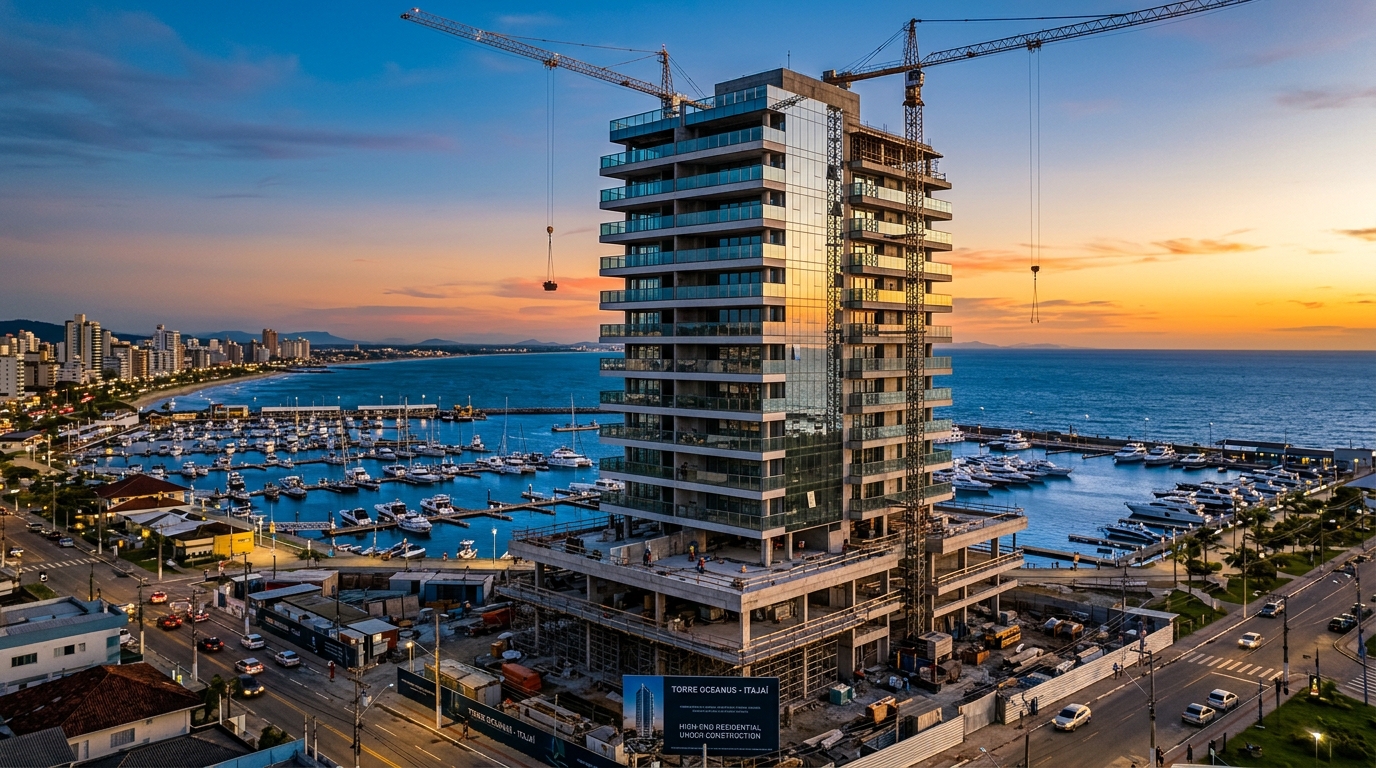
Between January and April 2026, Itajaí concentrated more than 38% of all sales volume (VGV — the Brazilian metric for total project sales value) launched in the high and ultra-high segments along the Santa Catarina coast, according to combined data from ABRAINC and Secovi-SC, the two leading developer associations. Over the same window, the FipeZap index recorded a 2.1% rise in the city's average price per square metre — nearly double the national mean — while Brazil's base interest rate (Selic) held at 12.25% per year and the twelve-month construction cost index (INCC-M) ran at roughly 7.4%. For the international investor weighing entry into an off-plan launch in Fazenda, Praia Brava, São Vicente or Cordeiros, the question is no longer whether the market is hot. The question is which specific unit, inside that hot market, actually supports the return thesis over the 30-to-48-month window from contract to delivery.
This article condenses 27 objective checks — organised in four blocks: company and documentation, location, build quality, and contract — that separate a negotiable premium launch from an asset whose resale liquidity at handover will disappoint. The logic is that of an investment committee: each item is either a deal-breaker or a lever on fair price.
The 2026 picture: why Itajaí became the high-end axis of Santa Catarina
Balneário Camboriú remains the international showcase of the Santa Catarina coast, but the new inventory above R$ 25,000 per square metre has shifted north. The Q1 2026 National Real Estate Indicator from CBIC (Brazil's industry confederation) shows Itajaí leading the state in percentage growth of new launches, ahead even of Itapema. The reason is geographical before financial: the Itajaí Master Plan, under revision through 2030, has widened floor-area ratios in specific zones of Fazenda and São Vicente, and unlocked building heights that Balneário — constrained by shadow-line rules on its beachfront — cannot replicate.
The second factor is the airport. Navegantes International has operated since the second half of 2024 with a 2,300-metre runway, taking direct flights from São Paulo (Guarulhos), Belo Horizonte (Confins), Brasília and — since December 2025 — a weekly direct service from Buenos Aires. The Argentine buyer, historically concentrated in Camboriú, now reaches the apartment door twelve minutes faster if it sits in Fazenda. Add the Itajaí marina, the Beto Carrero theme park forty minutes away and the logistics spine of the port, and the equation for a corporate investor chasing premium short-term-rental yield becomes competitive against rival Brazilian coastlines.
The buyer profile has shifted in parallel. Secovi-SC data for the first four months of 2026 shows that 41% of sales in high-end launches across the micro-region were closed by corporate entities, 18% by foreign nationals — overwhelmingly Argentine, Paraguayan and Uruguayan — and the balance by Brazilian individuals, of whom roughly half were pure investors with no plan to occupy. That mix is what drives the contractual sophistication discussed below: the seller has five distinct profiles around the table and, as a rule, the party with the least negotiating leverage is the unprepared retail investor.
Block 1 — Developer and paperwork: seven deal-breakers
The first filter on the checklist is legal. None of the items below is negotiable; the absence of any single one of them shifts the asset from the "investment" category into the "speculation on shaky ground" category.
1. Registration of the Incorporation Memorial (Federal Law 4,591/64, art. 32). Without the memorial recorded against the land title at the relevant Land Registry, the development cannot legally be marketed. Ask for the title number, the memorial registration number, and the recording date. Verify it at the registry itself — twenty reais buy you a current certificate.
2. Ring-fenced Equity (Patrimônio de Afetação, Law 10,931/04). Ring-fencing separates the project's accounts from the developer's general balance sheet. In practical terms, if the company collapses because of another project, this one keeps going. In the high-end segment, insist on it. Verify the annotation on the land title and the special 4% tax regime (RET).
3. Clearance certificates for the developer and its partners. Federal, state, municipal, labour-court and protest clearances. On top of that, civil-court distribution and bankruptcy certificates in every jurisdiction where the company operates. A partner with a multi-million tax-enforcement case in another state is information that surfaces — and matters.
4. Delivery track record. List the developer's last five projects: promised deadline, actual delivery, finish quality delivered versus memorial. Visit at least one. Building managers talk. Complaints filed with Itajaí's consumer-protection office talk too.
5. ABRAINC-Procon seal and PBQP-H Level A. These are not cosmetic stamps. PBQP-H Level A, run by the Ministry of Cities, audits the production process; the ABRAINC seal binds the developer to contractual transparency. Their absence in a developer selling above R$ 20,000 per square metre is a warning sign.
6. Builder versus developer. They are distinct roles. The developer sells; the builder executes. They are often affiliated companies, but not always. Know who each one is, what the cross-shareholding is, and review the builder's technical record on its own.
7. Construction permit and environmental licence. Construction permit issued by Itajaí City Hall and, in the case of Praia Brava, environmental licence from the state environmental authority (IMA-SC), where applicable. A project marketed without a current permit is selling expectation, not real estate.
Block 2 — Location: five items that price the right neighbourhood
Itajaí is not one neighbourhood. The differences in price, tenant profile and resale potential between the premium districts are enough to invert the thesis behind an investment.
8. Micro-neighbourhood and census tract. Praia Brava is the showcase: beachfront, high-rise allowance, average ticket above R$ 28,000/m². São Vicente is the densification bet: growing 9% a year in launched VGV, still under R$ 18,000/m², with views over the bay. Fazenda is the established residential core, ticket between R$ 15,000 and R$ 22,000/m². Cordeiros is inland, with more affordable units and end-user demand rather than investment demand. Do not confuse them.
9. Actual driving distance to Navegantes Airport. Measured in road kilometres, not as the crow flies. From Praia Brava to the terminal is 11 km via the Beira-Rio corridor, around 18 minutes off-peak. From Fazenda, 7 km. That number is decisive for short-term rental yield.
10. Distance to the marina and nautical hub. The Itajaí marina concentrates the demographic that wants to dodge Camboriú prices. A unit within ten minutes of the marina is priced differently.
11. Master Plan and surrounding building heights. In the Itajaí Master Plan, under revision through 2030, check the floor-area ratio and the maximum building height permitted on the lots next to yours. If the adjacent block can rise thirty storeys and block your ocean view, the asset loses double digits in resale value at handover. The plan is publicly accessible through the city hall website or via formal request.
12. Saturation versus pipeline. How many launches have been filed on your block in the last 24 months? Praia Brava entered a phase of relative saturation in 2025; it still absorbs supply, but average sales velocity in the launches Secovi-SC tracks dropped from 9.4 to 6.1 units per month. Saturation does not invalidate the thesis — it demands a tighter resale calculation.
Block 3 — Build quality: eight items that decide the resale ticket
The descriptive memorial is the only document that legally binds what will be delivered. Negotiating before signing is cheap; negotiating after is impossible.
13. Minimum ceiling height of 2.80 m in social areas, 2.90 m in the living room. The Camboriú high-end benchmark settled at 3.00 m. Below 2.70 m in the living room, the unit will not compete on resale three years out.
14. PEX plumbing, not PVC. Cross-linked polyethylene is silent, does not scale up and lasts roughly twice as long. Above R$ 20,000/m², it is the expected standard.
15. Laminated acoustic glazing on the ocean-facing and west-facing façades. Minimum 8 mm in double-pane configuration. For beachfront apartments, this is what separates a paying guest's good night's sleep from a complaining guest's review.
16. Home automation on an open protocol (KNX, Z-Wave or Matter). Proprietary solutions trap the owner on maintenance. KNX is the European standard — and the Argentine buyer paying in dollars recognises it.
17. Common areas that command a premium. Heated rooftop pool and outdoor kitchen, spa with dry and steam sauna, climate-controlled wine cellar, coworking space with acoustic booths, children's room with high-durability flooring. Each of these adds between 4% and 9% to resale price, according to hedonic analyses by FipeZap applied to the Santa Catarina market.
18. Covered double parking with an EV charging point. Minimum 220 V / 32 A outlet, wallbox-ready. Santa Catarina's electric-vehicle fleet grew 71% in 2025 (Fenabrave-SC data); a 2026 launch without a charging point is already outdated on delivery.
"The Itajaí high-end matured too fast between 2022 and 2025. Today's buyer asks about ESG certification, solar panels and rainwater reuse before asking about the powder room. Whoever is still developing to 2019 specs will feel it on sales velocity." — analysis attributed to a Secovi-SC executive at an industry forum in April 2026.
19. Solar generation on common areas and rainwater reuse. They cut the condominium fee by up to 22% — an edge that shows up in the resale listing. In projects without solar, the monthly fee on a high-end three-suite apartment in Praia Brava currently runs between R$ 2,100 and R$ 2,800.
20. PBE Edifica Level A energy-efficiency certification. An Inmetro seal, still voluntary, but increasingly an implicit requirement among corporate investors with an ESG mandate.
Block 4 — Maths and contract: seven items that separate thesis from trap
This final block is where the average investor loses ground. The financial engineering behind an off-plan launch contains three classic pitfalls — payment schedule, indexation and exit clauses — and four contractual items that warrant line-by-line reading.
21. The 30/40/30 schedule and INCC absorption capacity. The dominant model in Itajaí 2026 is a 30% down payment, monthly and intermediate instalments adding up to 40% during construction, and 30% at handover via mortgage or own funds. The blind spot is the INCC: instalments indexed to the INCC-M or INCC-DI compound monthly. With the INCC running at 7.4% over twelve months, a R$ 25,000 instalment contracted today will be R$ 26,850 a year out. Multiply across the instalment count and the construction window and real outlay can run 18% to 24% above the headline number.
22. Selic, SBPE mortgages and the financing window at handover. With Selic at 12.25%, mortgage rates on the SBPE system for properties above R$ 1.5 million (outside the subsidised SFH bracket) run between TR + 10.5% and TR + 11.8% per year at the major banks. The FGTS workers' fund, capped at properties up to R$ 1.5 million, rarely reaches the high-end ticket. The investor needs to model three scenarios: bank mortgage, full settlement from own funds, and pre-handover resale.
23. VGV, sale price and projected resale price. Do not confuse VGV (the total sales value of the development) with unit price. More to the point: ask the developer for the price-table escalation curve applied in past launches. A Praia Brava project launched in 2023 at R$ 22,000/m² is reselling at handover for R$ 31,000 to R$ 34,000/m² in 2026, per FipeZap data. The question is whether the cycle repeats.
The table below summarises, based on cross-referenced 2026 averages from FipeZap, Secovi-SC and ABRAINC, the typical behaviour of the three premium districts of Itajaí over a 36-month horizon.
| Neighbourhood | Launch ticket R$/m² | 36-month average appreciation | Estimated gross STR yield | Sales velocity (units/month) |
|---|---|---|---|---|
| Praia Brava | R$ 26,000 – 32,000 | 32% – 45% | 6.2% – 8.1% p.a. | 6.1 |
| Fazenda | R$ 15,000 – 22,000 | 28% – 38% | 5.4% – 6.9% p.a. | 7.8 |
| São Vicente | R$ 14,000 – 18,000 | 35% – 48% | 4.8% – 6.3% p.a. | 9.2 |
| Cordeiros | R$ 9,000 – 13,000 | 22% – 30% | 3.9% – 5.1% p.a. | 11.4 |
24. The 180-day tolerance clause and late-delivery penalty. Federal Law 13,786/18 — known as the Distrato Law — allows a 180-day calendar tolerance from the contracted handover date. Beyond those 180 days, the buyer may rescind with full refund adjusted for inflation (no developer retention) or claim a monthly contractual penalty, typically 1% of the corrected amount paid. Verify that the contract provides both paths and on what terms.
25. Distrato and retention percentage. The same Law 13,786/18 caps the developer's retention if the buyer rescinds: up to 25% of the amount paid in ordinary incorporations and up to 50% in ring-fenced ones. That is one of the reasons ring-fencing benefits the developer more than the buyer — know what you are signing.
26. Correct indexer and assignment of rights. The INCC-M (compiled by Fundação Getulio Vargas) is the most common indexer, but some contracts use the INCC-DI or the IGP-M up to handover, then switch to the IPCA consumer-price index. Each compounds differently. On assignment: check whether the contract allows you to assign the contractual position to a third party before handover, at what consent fee, and whether the developer holds a right of first refusal. For an investor planning a pre-handover flip, that clause is worth its weight in gold.
27. The foreign investor workflow. A non-resident foreigner can buy an apartment in Brazil, but needs: a CPF tax number issued by the Federal Revenue (via consulate or through a local representative with power of attorney); a non-resident account at a Brazilian bank (Central Bank Resolution 4,844/2020 and its updates); inbound currency registered in the Central Bank's electronic system under the correct transaction code; and, if financing, alignment with each bank's criteria — which, in practice, in 2026, mostly bar mortgages to foreigners without local income. The common path is cash purchase or instalments paid directly to the developer, with FX handled by a licensed institution and a separate FX contract closed on each remittance. The recurring mistake: trying to pay by wire transfer without a formal FX contract — the tax authority flags it and issues penalties.
Recurring mistakes and what to watch from here
Three mistakes repeat among investors who entered premium Itajaí launches between 2022 and 2024 and today complain about returns. The first is underestimating the INCC: buying based on the headline price and discovering, on the 24th instalment, that the real outlay is 20% higher. The second is ignoring surrounding building heights: signing on the assumption of permanent ocean views that the Master Plan does not guarantee. The third is confusing sales velocity with resale liquidity: a project that sold 90% in 60 days does not mean your unit will resell quickly at handover three years later, under a different Selic or IPCA regime.
What to watch from here: the Itajaí Master Plan revision, due for completion by 2027, will redraw allowable heights in Praia Brava and São Vicente — discrete regulatory events shift prices. The Selic trajectory, which the June 2026 Focus report projects between 10.5% and 11.25% by year-end, will rewrite the financing equation at handover. And, on the international front, any Argentine FX move above 15% over two quarters reshapes foreign-buyer demand, which currently supports between 15% and 22% of sales in Praia Brava.
Conclusion: 27 items, one committee logic
The 27 items on this checklist are not a wish list. They are the filter that separates, within the 2026 Itajaí high-end market, the asset that holds up under interest-rate stress, INCC compounding and resale-cycle risk from the asset that looks good in the brochure and disappoints at handover. The systematic reading — paperwork, location, build, contract — is what a professional investment committee would do facing any illiquid asset. An off-plan launch is exactly that: an illiquid asset with a contractual maturation window of 30 to 48 months.
SIDE Empreendimentos publishes weekly market analyses, neighbourhood-level absorption indicators and readings of regulatory shifts that affect coastal-Santa-Catarina investors. For anyone about to sign a contract of R$ 1.8 million or more in the next twelve months, subscribing to the portal's weekly briefing pays for itself: an informed decision at this ticket size returns its weight from a few lines read at the right moment.