First Apartment in Itajaí 2026: Cheapest Districts
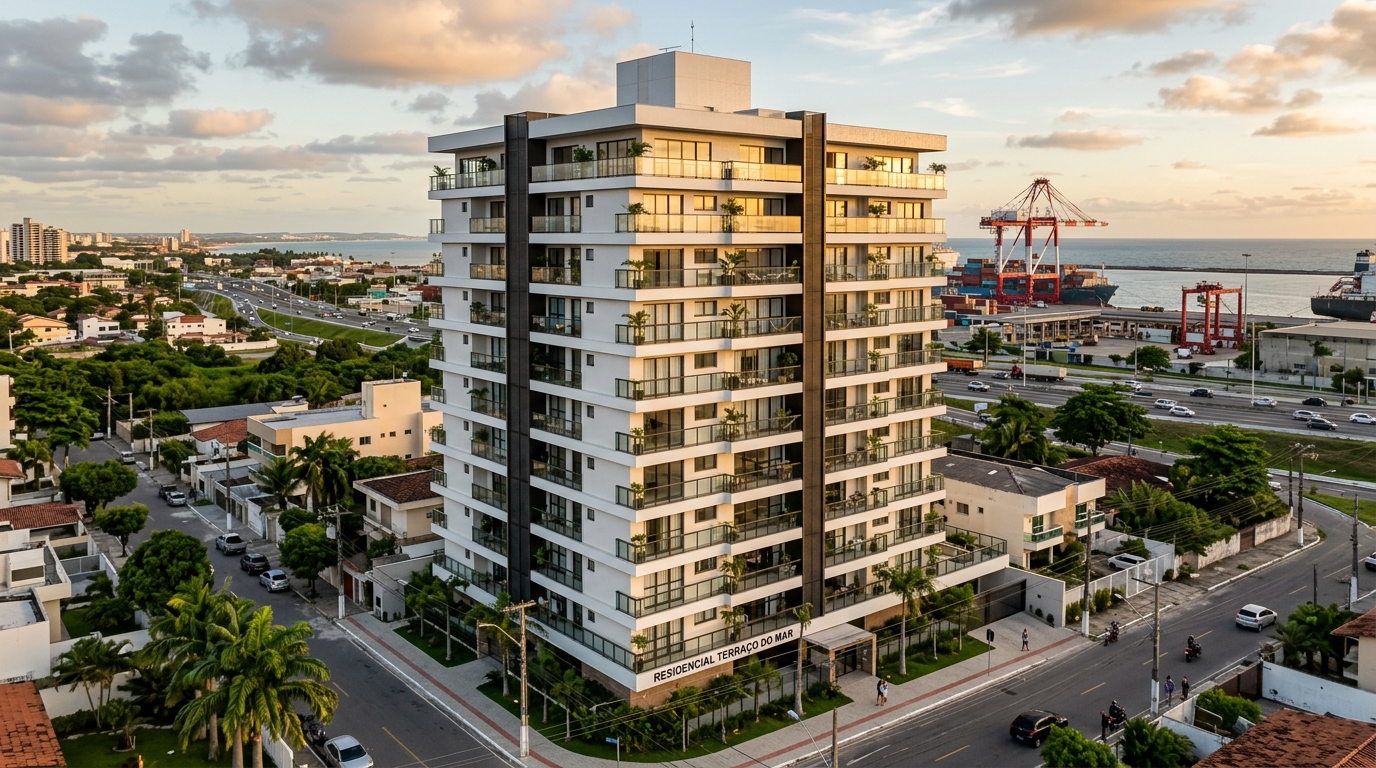
Itajaí closed the first quarter of 2026 with an average apartment sale ticket near BRL 726,000 (roughly USD 145,000 at the year's working exchange rate), according to cross-readings from FipeZap — Brazil's leading real-estate price index — and reports from Secovi-SC, the regional housing developers' union. It is a number that both lies and reveals. It lies because it pushes anyone shopping for a first apartment under BRL 350,000 off the map. It reveals because, inside the same municipality, the gap between the price per square metre on the beachfront and the same square metre in a working-class district reaches a factor of four. Between Praia Brava and Cordeiros — two postcodes less than fifteen minutes apart by car — the buyer switches markets, switches thesis, switches risk. This is the real terrain on which a first apartment in Itajaí is bought in 2026, and the first lesson, whether you live in São Paulo or are wiring funds from Lisbon, Miami or Frankfurt, is that "cheap" only makes sense once you open up what the price hides.
Itajaí's 2026 price map: the average that distorts the market
The consolidated FipeZap figure for April 2026 places Itajaí's listed apartment market around BRL 11,200 per square metre, with a heavy long tail. The average ticket of BRL 726,000 is pulled upward by the vertical, high-end launches of Praia Brava, Cabeçudas and the redeveloped downtown — a segment in which three- to five-bedroom units with full leisure infrastructure trade between BRL 1.1 million and BRL 4 million. In the same data, the base of the market — compact two-bedroom apartments, no covered parking or a single parking space, in outer districts — closes deals from BRL 220,000 to BRL 290,000 for resale stock, and between BRL 320,000 and BRL 420,000 for budget launches eligible for Minha Casa Minha Vida, Brazil's federal subsidised housing programme (today branded Casa Verde e Amarela in its revised form).
The distortion is geographic before it is statistical. Itajaí grew on three axes: the port economy around the Porto de Itajaí complex and the private Portonave terminal, the high-end vertical expansion of the Brava–Cabeçudas oceanfront, and the residential urbanisation of the Itajaí-Açu river basins and the neighbourhoods bordering federal highway BR-101 and the new Contorno Viário bypass. Each axis carries its own price per square metre. When an international headline repeats the line that "Itajaí has overtaken Balneário Camboriú in appreciation", it is describing Praia Brava — not the city as a whole.
For a first-time buyer, foreign or domestic, this redraws how the market should be read. The headline average of BRL 11,200 per square metre is irrelevant: what matters is the per-square-metre figure of the neighbourhood that actually fits the budget, and the spread between that neighbourhood and the premium poles. That spread is the thermometer of catch-up potential — and equally of the risk that the asset will sit idle for years without qualified demand.
The five cheapest neighbourhoods for a first apartment
Cross-referencing active listings on FipeZap, the regional CRECI-SC realtor registry base and the ABRAINC monitoring of new launches across Santa Catarina, five neighbourhoods today concentrate Itajaí's affordable apartment supply. They are not the most glamorous. They are, on the other hand, where the maths still closes for a buyer leaving the rental market — or for an international investor looking for a real, occupied product rather than a marketing render.
Cordeiros is the name that appears most often. A consolidated residential district, with local commerce, schools and bus lines linking to downtown and the port, it attracts young families and workers from port-adjacent companies. São Vicente follows closely, with a similar profile and a large inventory of four- to eight-storey buildings raised between 2010 and 2022. São João — more industrial, closer to BR-101 — is the cheapest in absolute terms and offers the most aggressively priced compact apartments. Dom Bosco preserves the character of a traditional neighbourhood with selective recent verticalisation, especially near Avenida Sete de Setembro. And Espinheiros, together with the Limoeiro pocket, behaves as the emerging axis: still cheap, but already feeling the pressure of launches tied to the Contorno Viário bypass and to cargo logistics, which is reorganising the city's growth vector.
| Neighbourhood | Avg. BRL/m² (apt, 2026) | Typical 2-bed ticket | Profile |
|---|---|---|---|
| São João | BRL 5,900 – 6,800 | BRL 230k – 310k | Cheapest, BR-101 corridor |
| Cordeiros | BRL 6,400 – 7,400 | BRL 260k – 360k | Consolidated residential |
| São Vicente | BRL 6,600 – 7,800 | BRL 270k – 380k | Recent vertical stock |
| Espinheiros / Limoeiro | BRL 6,000 – 7,200 | BRL 240k – 340k | Emerging, logistics-led |
| Dom Bosco | BRL 7,000 – 8,200 | BRL 290k – 400k | Traditional, new launches |
| Itajaí average | ≈ BRL 11,200 | BRL 480k – 620k | Pulled by oceanfront stock |
| Balneário Camboriú | ≈ BRL 16,500 | BRL 720k – 980k | Vertical beach, high end |
The raw spread is the point. Buying at BRL 6,500 per square metre in Cordeiros while the municipal average runs at BRL 11,200 and neighbouring Balneário Camboriú trades above BRL 16,000 gives the asset a mathematical margin for re-rating. This is not, however, automatic. The thesis only materialises if the neighbourhood receives, over the coming cycles, infrastructure investment, a deeper services layer and a population mix that justifies the price advance. Without those drivers, the spread becomes a ceiling — not a trampoline.
Off-plan versus finished: INCC, Selic and SBPE in a real example
The second great cut in Itajaí's market lies between resale stock and off-plan launches. Buying a finished apartment, in any of the five neighbourhoods above, generally means a 20% to 30% down payment and a SBPE bank mortgage — the standard system financed by savings deposits, which is Brazil's main non-subsidised mortgage channel — for the balance. Buying off-plan in the same neighbourhood spreads that down payment in monthly instalments throughout the construction window, but eats into the apparent gain because of the INCC, the national construction cost index, which adjusts the contract every month.
The INCC-M closed 2025 at +4.8% and is running at a projected 5% to 6% for 2026, according to CBIC, the Brazilian Chamber of the Construction Industry. On a balance of BRL 250,000 spread over 36 months of construction, this represents roughly BRL 35,000 to BRL 45,000 of indexation built into the instalments during the build — a silent cost that the developer's invoice spreads smoothly across the months, but that has to enter the buyer's spreadsheet before any contract is signed.
On the bank financing side, the Selic — Brazil's base interest rate, set by the central bank — at around 10.25% in 2026 sustains SBPE rates between TR + 9.8% and TR + 11.5% per year for the main lenders (TR being a regulated reference rate, currently near zero). For a BRL 350,000 property with a 20% down payment (BRL 70,000) and a BRL 280,000 mortgage taken over 30 years on the Tabela Price amortisation schedule, the opening instalment runs around BRL 2,900 to BRL 3,100. Total payments exceed BRL 1 million across the life of the contract, and the instalment only fits the local prudential rule of 30% of gross income if household earnings are at least BRL 9,700 to BRL 10,300 per month.
The FGTS changes the equation. The Workers' Severance Indemnity Fund is a mandatory savings account funded by employers on behalf of every formal worker in Brazil. Its balance can be used to top up the down payment, amortise the mortgage every two years and, in many cases, unlock eligibility for Minha Casa Minha Vida — the federal subsidised housing programme — for households earning up to around BRL 8,000 per month. Inside that programme, the rate drops to a band of 4.5% to 8% per year, depending on the income tier and FGTS use, cutting the opening instalment on the same BRL 280,000 mortgage to something between BRL 1,800 and BRL 2,300. It is the difference between affording the unit and not affording it. For an international buyer with no FGTS balance, this layer is closed — financing options narrow to a higher loan-to-value SBPE deal, equity-only purchase, or a structured arrangement with a Brazilian co-buyer who can carry the subsidised slot.
The five cheapest neighbourhoods in Itajaí still hold inventory with tickets compatible with the Minha Casa Minha Vida ceiling — generally up to BRL 350,000 for new units inside the programme, after the latest updates. Praia Brava, Fazenda and Cabeçudas do not. This is the concrete frontier between the subsidised first apartment and the premium residential investment.
The invisible costs that destroy a first buyer's budget
The headline price is only the beginning. In Itajaí, on a BRL 350,000 purchase, the municipal property transfer tax (ITBI) is levied at 2% — BRL 7,000 — payable in full at the moment of registration. Notary registration and the deed itself, according to the official schedule of the Santa Catarina state court (TJSC), add a further BRL 5,500 to BRL 7,000. The bank's mandatory property appraisal under SBPE costs between BRL 3,500 and BRL 4,500. Closing costs land between BRL 16,000 and BRL 19,000 — between 4.5% and 5.5% of the property value, paid in cash, on top of the down payment.
Annual IPTU, the municipal property tax in Itajaí, varies with the official valuation roll, but for a 60- to 70-square-metre apartment in the neighbourhoods analysed it runs between BRL 800 and BRL 1,800 per year. Condominium fees are the line item that surprises buyers most. In buildings with no lift and no leisure infrastructure, common in São João and parts of Cordeiros, they run between BRL 280 and BRL 450 per month. In newer buildings, with lifts, a party room and a swimming pool, they scale up to BRL 600 to BRL 950 and, in some launches with broader common areas, surpass BRL 1,200 — quietly consuming the margin of any buyer who planned only around the mortgage payment.
There is a cost almost nobody calculates: the reserve. A finished apartment requires both a sinking fund and a personal contingency cushion. The prudential rule among Brazilian financial planners is to keep at least 5% of the property value available in liquid form during the first year after purchase. For a BRL 350,000 apartment, that is a BRL 17,500 cushion. A buyer who zeroes the current account to pay the ITBI takes on real default risk at the first unexpected event — a broken air-conditioning unit, a special assessment from the condominium, an unplanned medical bill.
The cheap-neighbourhood risk: liquidity, appreciation and the distrato trap
A cheap neighbourhood is, by definition, a thinner-demand neighbourhood. In Cordeiros, São Vicente and Dom Bosco, the median time on market for a two-bedroom apartment ran between 90 and 150 days in 2025, according to Secovi-SC cross-readings. In São João and Espinheiros, it is common to exceed 180 days. That is liquidity. It means that, if a forced sale becomes necessary — job loss, relocation, divorce — the seller faces an 8% to 15% discount off the listed price to unfreeze the deal. For an international investor, this is the difference between an asset that can be exited within a quarter and one that may need a full year of marketing.
Historical appreciation also demands an honest reading. Between 2020 and 2025, Itajaí's budget neighbourhoods accumulated nominal price growth of 55% to 80% in BRL per square metre, against 110% to 160% on the Praia Brava–Cabeçudas axis, according to FipeZap and ABRAINC series. In real terms, after subtracting the cumulative IPCA inflation index close to 32% in the period, the real appreciation of the cheap neighbourhoods landed between 17% and 36%. Real and positive — but a long way from the "doubles every five years" line that circulates in sales videos. And for a foreign investor, that real return still needs to survive the BRL/USD exchange-rate volatility on the way out.
"The cheap neighbourhood is a good entry door when the buyer understands that they are paying less per square metre in exchange for less liquidity and less speed of re-rating. It is a trade-off, not a free lunch." — recurring reading from Santa Catarina-focused wealth managers in 2026.
The distrato risk is the third side of the triangle. Buying off-plan means signing a contract with the developer governed by Federal Law 13.786/2018, which allows the developer to retain, in case of buyer withdrawal, up to 25% of what has been paid, or 50% in projects with patrimônio de afetação — a legal ring-fence that separates the project's assets from the developer's general balance sheet. In other words: a buyer who cannot finish paying during construction, or who fails to obtain bank financing at the moment of key delivery, can lose up to half of what was contributed. Due diligence here is not aesthetic. It is contractual.
Before signing, three points are worth confirming. First, the formal incorporation memorandum (memorial de incorporação) registered at the notary office, as required by Federal Law 4.591/64, identifying the project, the land and the developer. Second, the construction company's track record — how many projects delivered, the average delay, the quality of post-delivery technical support. Third, the existence of the patrimônio de afetação ring-fence, which insulates the project from the developer's broader liabilities in case of financial trouble. Three questions. Twenty minutes. They prevent twenty years of regret.
The common mistakes of the first-time buyer in Itajaí
The first mistake is to confuse an affordable instalment with an affordable property. The 30% income rule only measures debt service and ignores ITBI, condominium, IPTU, maintenance and liquidity reserve. The buyer who stretches to the ceiling of the instalment becomes a hostage of the monthly budget, with no margin to absorb a condominium fee increase, a structural repair or an insurance premium hike.
The second mistake is to enter an off-plan launch without pre-approved bank financing. Delivery of the keys requires the outstanding balance to be either cleared or financed. Families that see their income deteriorate during the 36 months of construction discover, at the worst possible moment, that the bank no longer approves the mortgage — and they fall into the distrato trap.
The third mistake is to ignore the building's tenant mix. In Itajaí, a significant share of the inventory in districts like São João and Espinheiros was bought by small investors for short-stay rentals linked to the port and to logistics workers on temporary contracts. That means high turnover inside the building, condominium costs pressured by intensive use of common areas and, in some cases, a relative depreciation of the residential atmosphere. It is not a universal problem — it is a variable to be checked before signing.
The fourth mistake is to treat past appreciation as a forecast. Itajaí's budget neighbourhoods did appreciate well between 2020 and 2025, lifted by the port logistics boom, by migration of families from other Brazilian states and by spillover from the high-end inventory of Balneário Camboriú. There is no guarantee that the next five years repeat the pace. A Selic at 10.25%, IPCA at 4.3% and an INCC that is pressing again project a slower cycle, one in which the selectivity of demand compresses any asset without a clear differential.
The fifth mistake is to buy without visiting the surroundings at two different times of day. A neighbourhood in Itajaí changes substantially between noon and 9 p.m. Cargo traffic, factory noise, street safety, lighting. These are factors that do not appear in the listing or in the architectural rendering, but that decide day-to-day habitability — and, in the end, the resale liquidity of the asset.
Conclusion: buying cheap in Itajaí is a portfolio decision, not an impulse
The first apartment in Itajaí in 2026 fits a household with a gross income from BRL 6,500 to BRL 7,000, uses FGTS, qualifies for Minha Casa Minha Vida and accepts living in the five neighbourhoods that still trade below BRL 7,500 per square metre: Cordeiros, São Vicente, São João, Dom Bosco and Espinheiros/Limoeiro. The maths closes — provided the buyer understands that they are paying less today in exchange for less liquidity and less speed of re-rating tomorrow. It is a legitimate trade-off, especially for those seeking shelter and wanting to leave the rental market; it is a demanding bet for those chasing pure yield. For the international investor reading from abroad, the same logic applies, with one extra layer: currency. A 30% real appreciation over five years can be entirely wiped out by an adverse swing in the BRL/USD or BRL/EUR cross — or, equally, amplified by a favourable one.
The honest reading is that "cheap" only reveals its value after deducting ITBI, registration, condominium, INCC during construction, INCC after construction, liquidity reserve and the contractual risk of distrato. Whoever does this maths clearly buys well. Whoever looks only at the cover price buys twice — the second time, in regret. To follow weekly analysis of the Santa Catarina real-estate and financial market with this same lens, it is worth subscribing to the newsletter of the SIDE Empreendimentos portal: it is where we discuss, number by number, what the price per square metre hides in each new cycle.