Studio vs 1-Bedroom Airbnb in Brazil: Which Wins 2026
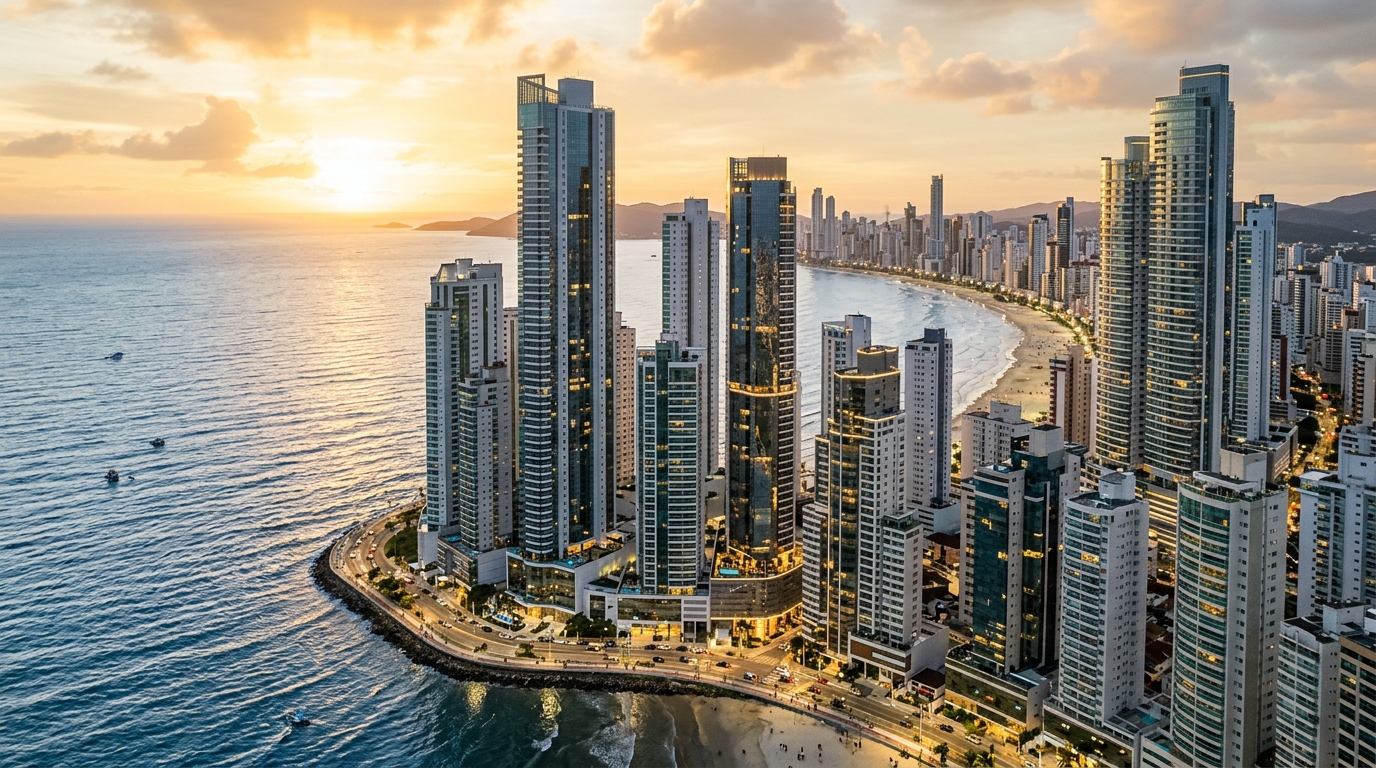
Brazil's short-stay revenue on Airbnb crossed R$ 8 billion in 2024 — up 17% from 2023, according to the platform itself — and the country's southern and southeastern capitals are already posting average nightly rates above R$ 380 (roughly USD 70) in high season. For international investors deploying between R$ 400,000 and R$ 700,000 (USD 73,000 to USD 128,000) into Brazilian short-let real estate, the question has stopped being "is Airbnb still worth it?" and turned into a far more technical decision: compact studio or one-bedroom apartment? Both formats compete for the same ticket and, along the northern coast of Santa Catarina, the difference in net annual yield between them can swing by 2.4 percentage points — enough to flip the allocation thesis for anyone building a portfolio in digital rental income.
The 2026 picture: Brazil's short-stay market in numbers
Brazil's vacation-rental market entered 2026 in consolidation mode. Data from AirDNA shows that the country's main destinations — São Paulo, Rio de Janeiro, Florianópolis, Balneário Camboriú and Salvador — concentrate just over 62% of all nights sold on Airbnb and comparable platforms. Average annual occupancy in these cities closed 2025 at 58%, against 51% in 2023, with a peak of 84% during the Santa Catarina summer (December through February in the southern hemisphere).
The Central Bank of Brazil held Selic — the country's base interest rate — at 11.25% through the first half of 2026, after gradual cuts that began mid-2025. The CDI (the interbank benchmark that prices most Brazilian fixed income for individuals), after regressive income tax, currently pays between 8.8% and 9.2% per year net. That is the floor any income-oriented real-estate investment must justify itself against — and short stay is the segment that promises most to clear it, while also being the one that most often gets the math wrong at the spreadsheet level.
ABRAINC (the national developers' association) reported 9% growth in launches of compact units (up to 45 m²) between 2024 and 2025, with a marked push from projects branded "ready to rent" or "smart living". Secovi-SP, the São Paulo real-estate council, points out that more than 40% of the city's new launches in the final quarter of 2025 were studios or one-bedroom units. Supply is climbing — and that, in turn, will pressure future nightly rates anywhere demand is not structurally tight.
Along the Santa Catarina coast, the trend is even sharper. Itajaí and Balneário Camboriú lead the state in VGV (Valor Geral de Vendas, the total contracted sales value of new developments) aimed at short stay, according to regional Sinduscon-SC reports. The CUB-SC (the state construction cost index) climbed 6.8% in the twelve months to April 2026, raising replacement cost — and partially shielding investors who bought before the cycle turned. The right question, then, is not just "which one yields more" but "which one yields more per dollar of capital deployed inside a regulatory and tax window that is narrowing".
Studio vs one-bedroom: technical definition and guest profile
Even though the market often treats the two as synonymous, the differences matter once a check is being written. A studio is a single-room unit, typically 22 m² to 32 m² (about 240 to 345 sq ft), with kitchen, living area and sleeping zone integrated, an independent bathroom, and usually no balcony. A one-bedroom apartment has a wall separating bedroom from living space, an area between 38 m² and 55 m² (410 to 590 sq ft), a balcony in most coastal launches and, frequently, a dedicated parking spot — something the studio typically outsources to a rotating or paid spot.
The price ticket differs as well. In Itajaí, an off-plan studio in the central area or near the Marina starts at R$ 380,000 and reaches R$ 520,000 at premium addresses (roughly USD 70,000 to USD 95,000 at mid-2026 exchange rates). A one-bedroom on the same axis runs from R$ 540,000 to R$ 780,000. In Balneário Camboriú, the range shifts upward: studios between R$ 480,000 and R$ 720,000; one-bedrooms between R$ 650,000 and R$ 980,000 — and in Barra Sul or Praia Brava, the ceiling is easily breached by signature developments.
Guest profiles diverge sharply. Studios are dominated by short visits of one to three nights, child-free couples, traveling executives and solo tourists. The one-bedroom, with its better comfort and acoustic isolation, attracts stays of four nights or more, couples with a small child, small groups of friends and the long-stay corporate audience — a segment that pays less per night but dramatically reduces vacancy and cancellation rates.
Construction cost per square meter tells another important story. Because a studio packs all hydraulic and electrical fixtures into a smaller footprint, its per-m² cost is typically 12% to 18% higher than that of a one-bedroom within the same development. For the developer, that is margin; for the investor, it means every square meter paid for in a studio carries more "installation per m²" and less "resale floor space" — a factor that surfaces at exit liquidity.
The real math: an Itajaí 2026 worked example
The exercise below uses conservative parameters and AirDNA market averages for Itajaí and surroundings (Praia Brava, Cabeçudas, Marina) for base year 2025, projecting 2026 with implicit IPCA inflation (Brazil's official consumer price index) and INCC adjustment (the national construction cost index, used to correct off-plan installments) where applicable.
Scenario A — 28 m² studio acquired for R$ 450,000, fully furnished and operational, no financing. Projected average nightly rate: R$ 285. Average annual occupancy: 62%. Gross annual revenue: R$ 64,532. Operating costs (management company 20%, Airbnb fees, IPTU property tax, condo fees, maintenance, cleaning, utilities, internet, linen replacement) absorb 41% of gross revenue, leaving R$ 38,074 of net income. Net annual ROI on total capital deployed (including R$ 35,000 in furnishings): 7.85%.
Scenario B — 42 m² one-bedroom acquired for R$ 620,000, furnished, no financing. Projected average nightly rate: R$ 395. Average annual occupancy: 58% (the higher ticket repels some pure short-stay demand). Gross annual revenue: R$ 83,598. Operating costs total 38% of revenue (the fixed cost base per m² is diluted more efficiently). Net income: R$ 51,831. Net annual ROI on R$ 670,000 total capital (with furnishings): 7.74%.
| Indicator | Studio 28 m² | 1-bed 42 m² |
|---|---|---|
| Acquisition price | R$ 450,000 | R$ 620,000 |
| Furnishings + operational setup | R$ 35,000 | R$ 50,000 |
| Total capital deployed | R$ 485,000 | R$ 670,000 |
| Projected nightly rate | R$ 285 | R$ 395 |
| Annual occupancy | 62% | 58% |
| Monthly RevPAR | R$ 5,378 | R$ 6,967 |
| Gross annual revenue | R$ 64,532 | R$ 83,598 |
| Operating costs over revenue | 41% | 38% |
| Net annual income | R$ 38,074 | R$ 51,831 |
| Net ROI on capital | 7.85% | 7.74% |
| Net income per m² (monthly) | R$ 113 | R$ 103 |
The table shows a technical tie on nominal ROI, with a slight edge for the studio. But the decisive indicator is the last one: net revenue per square meter. The studio generates 9.7% more income per m² in operation — an advantage that holds up in almost every concentrated Brazilian tourism market. For the investor thinking in portfolio terms, what matters is not a single unit but how many units fit inside the same check and what the sum of their RevPARs looks like at year-end.
There is, however, a layer those numbers do not reveal: how the asset behaves outside the short-stay hypothesis. If the investor is forced to migrate to traditional long-term leasing — whether by condo regulation, operational fatigue or a macro cycle shift — the one-bedroom rents for R$ 2,600 to R$ 3,100 monthly in Itajaí, against R$ 1,700 to R$ 2,100 for the studio. In a market stress scenario, the one-bedroom offers a sturdier safety net — and that weighs heavily on any horizon beyond five years.
Measured against a net CDI yield of around 9%, neither beats the financial floor on a purely nominal basis — and that is the part most real-estate marketing materials avoid acknowledging in 2026. The attraction of residential short stay lies in the combination of current income, capital appreciation (the FipeZap index records 11.2% growth over twelve months in Balneário Camboriú through April 2026, with Itajaí close behind at 9.4%) and the implicit inflation protection of a real asset. Without that second leg, the operation does not close against fixed income.
Invisible costs and the tax framework that changes the game
The classic mistake for the beginner investor is treating "Airbnb revenue" as if it were net income. The real spreadsheet begins when every line of erosion that separates gross from what actually lands in the account is enumerated.
The professional management company charges 15% to 25% of gross revenue — 18% is the 2026 market average in Itajaí and Balneário Camboriú. Operating solo saves that slice but costs in hours and lost bookings: the learning curve to extract real dynamic pricing from Airbnb runs six to twelve months. The platform itself retains around 14% to 16% per reservation, combining the service fee charged to the guest and the host fee in most models.
Seasonal vacancy hits coastal markets especially hard. In Itajaí and Balneário Camboriú, winter occupancy (June through August in the southern hemisphere) rarely exceeds 38%, against 90% or more between December and February. The investor who projects the year based on summer is in for a disappointment; the one who projects on weighted annual averages sizes the operation correctly and builds enough cash to ride out winter without surprises.
Realistic maintenance — including appliance replacement, paint touch-ups, linen turnover and small repairs — runs at 6% to 9% of gross revenue over a five-year horizon. Increasingly restrictive condominium bylaws — several Balneário Camboriú buildings approved in 2025 outright bans or limits on rentals shorter than 30 days — have become a real risk. Before any purchase, reading the full condo convention and house rules has stopped being optional: it is due diligence on the same level as checking the property registration.
On the tax side, three regimes compete for optimization. Individuals pay income tax on rental income on a progressive table, hitting up to 27.5% on the upper bracket of revenue. MEI (the simplified micro-entrepreneur regime) does not apply to residential rental. Setting up a Brazilian holding company for asset administration, under the lucro presumido regime ("presumed profit", a simplified Brazilian corporate tax regime), brings the effective combined rate (federal social contributions PIS and COFINS, plus corporate income tax IRPJ and social contribution CSLL) to between 11.33% and 14.53% on gross revenue — a significant advantage above R$ 60,000 of annual income. A full asset-holding structure becomes relevant from two or three units operated by the same family upward and is mostly valuable for estate-planning purposes, not on the first property.
"Airbnb has stopped being easy arbitrage. In 2026, it requires a thesis, scale and a proper legal structure. Investors who walk in without those three legs give back almost all the advantage in opex and taxes." — incorporation analyst interviewed for this article.
Location, building profile and when each format wins
The right asset in the wrong market is a loss. The decision between studio and one-bedroom is, in truth, dependent on microlocation and the building's true vocation. Three criteria separate the strong addresses from mediocre ones.
First, demand generators within walking distance. In Itajaí, those are the Port Complex, the Marina, the Beira-Rio waterfront avenue and the university poles. In Balneário Camboriú, they are the central beachfront, Barra Sul, Praia Brava and the perimeter of the iconic high-rise towers. Properties beyond 1.2 km of these poles lose between 14% and 22% in average nightly rate, according to Airbnb data cross-referenced by local consultancies.
Second, infrastructure compatible with short stay. 24-hour reception, digital key access, shared laundry, a functional gym, a coworking space, and high-speed Wi-Fi included in the building contract. Developments without these items force the investor to deliver everything inside the unit — and the furnishing budget climbs 30% to 50% above the scenario with infrastructure built into the condo.
Third, the dominant profile of the other owners. Buildings with more than 70% of units already operating in short stay face two simultaneous risks: tariff cannibalization (everyone competes on the same platform, with similar photos and rates collapsing in low season) and growing pressure for restrictive bylaws coming from the minority of permanent residents. Buildings with 30% to 50% of units in short stay tend to strike the ideal balance between operational scale and condominium peace.
When the one-bedroom beats the studio: business-driven cities (São Paulo, Brasília, Curitiba), family tourism markets (Gramado, Foz do Iguaçu, Porto de Galinhas), or neighborhoods in Itajaí and Balneário Camboriú with strong winter seasonality, where the long stay saves the year. It also wins on resale — the liquidity of a well-located one-bedroom in any Brazilian city above 200,000 inhabitants is structurally higher than that of the studio, with average time-on-market 35% to 50% shorter according to FipeZap series.
When the studio beats the one-bedroom: short-break tourism cities (Florianópolis downtown, Rio de Janeiro downtown, Recife Boa Viagem), markets with very high demand from solo travelers and executives (Vila Olímpia and Pinheiros in São Paulo), and addresses where premium pricing per square meter rules out a one-bedroom under R$ 700,000. It also wins on the portfolio effect: two studios generate more combined revenue and more operational diversification than a single one-bedroom of equivalent total capital.
The mistakes that destroy ROI before the second season
Five mistakes show up in almost every investor who lands on Airbnb without a thesis.
The first is projecting revenue from peak-season nightly rates. The correct calculation uses RevPAR — revenue per available room — which blends rate and occupancy across the year. An investor who agrees to pay for a property on the assumption of R$ 600 per night, ignoring that annual RevPAR will be R$ 240, pays an implicit premium of 60% over the asset's fair value.
The second is underestimating opex. As shown, total operational cost routinely lands in the 35%-45% range of gross revenue. Anyone modeling at 20% is lying to themselves. The difference between 25% and 40% opex moves ROI by more than 2 percentage points — enough to make the investment lose its edge against an inflation-linked Brazilian Treasury bond.
The third is ignoring local and condominium regulation. In Balneário Camboriú, the municipality is discussing mandatory short-term rental registration, with an annual fee and cross-checking against ITBI (the property transfer tax) and ISS (the municipal services tax). Investors who enter without mapping these moves can discover, with the development already delivered, that their thesis operates under imminent regulatory risk — and the discount on resale arrives at the wrong moment.
The fourth is overlooking opportunity cost. R$ 500,000 parked in a property yielding 7% net, in a world where the CDI pays 9% net, demands a very clear justification — and that justification only exists when there is real capital appreciation, inflation coverage and patrimonial diversification. Raw yield analysis, without the capital-gain leg, is not enough to sustain the decision against a well-built fixed-income portfolio.
The fifth is buying off-plan without internalizing the INCC adjustment. Between launch and delivery, a typical Itajaí development absorbs 22% to 30% in adjustments tied to the National Construction Cost Index — and the outstanding balance grows at the same pace. For the investor with cash-flow headroom, this is an advantage: R$ 450,000 of property is acquired at present value and paid for over three years in installments adjusted to an index that historically trails the asset's own appreciation. For the investor who underestimates the curve, it becomes a personal-treasury trap.
Conclusion
The choice between studio and one-bedroom apartment for Airbnb operation in 2026 has no universal answer — it has a thesis-driven one. The studio delivers more net revenue per square meter and fits more times into the same check, ideal for the investor assembling a portfolio in dense capitals and short-break markets. The one-bedroom offers superior resale liquidity, a robust plan B in traditional rental and captures corporate and family demand — a profile that makes particular sense along the northern coast of Santa Catarina, in high-interest-rate cycles and on horizons beyond five years.
For international buyers, two practical reminders complete the picture. Brazilian banks generally do not finance non-resident buyers, so most foreign investors fund the purchase with their own equity or arrange financing in their home jurisdiction; this makes off-plan, installment-paid developments particularly attractive, since payment stretches over the construction period. And rental income, whether short stay or long term, must be repatriated through a registered foreign-exchange contract — a step that any Brazilian tax advisor coordinates routinely, but which should not be left for after closing.
In Itajaí and Balneário Camboriú, SIDE Empreendimentos has been structuring launches that speak directly to this debate: compact units with short-stay infrastructure embedded in the condominium and floor plans designed for flexibility between seasonal rental and permanent residence. More than picking the product, the investor who decides well is the one who decides with numbers in hand — projected RevPAR, realistic opex, optimized taxation and a regulatory scenario monitored month by month.
To receive future analyses on short stay, new launches along the Santa Catarina coast and high-end real-estate market indicators, subscribe to the SIDE portal weekly newsletter — it is free, and every edition delivers an actionable thesis, with no passive-income hype.