Praia Brava Studio in 2026: The Real Investor Math
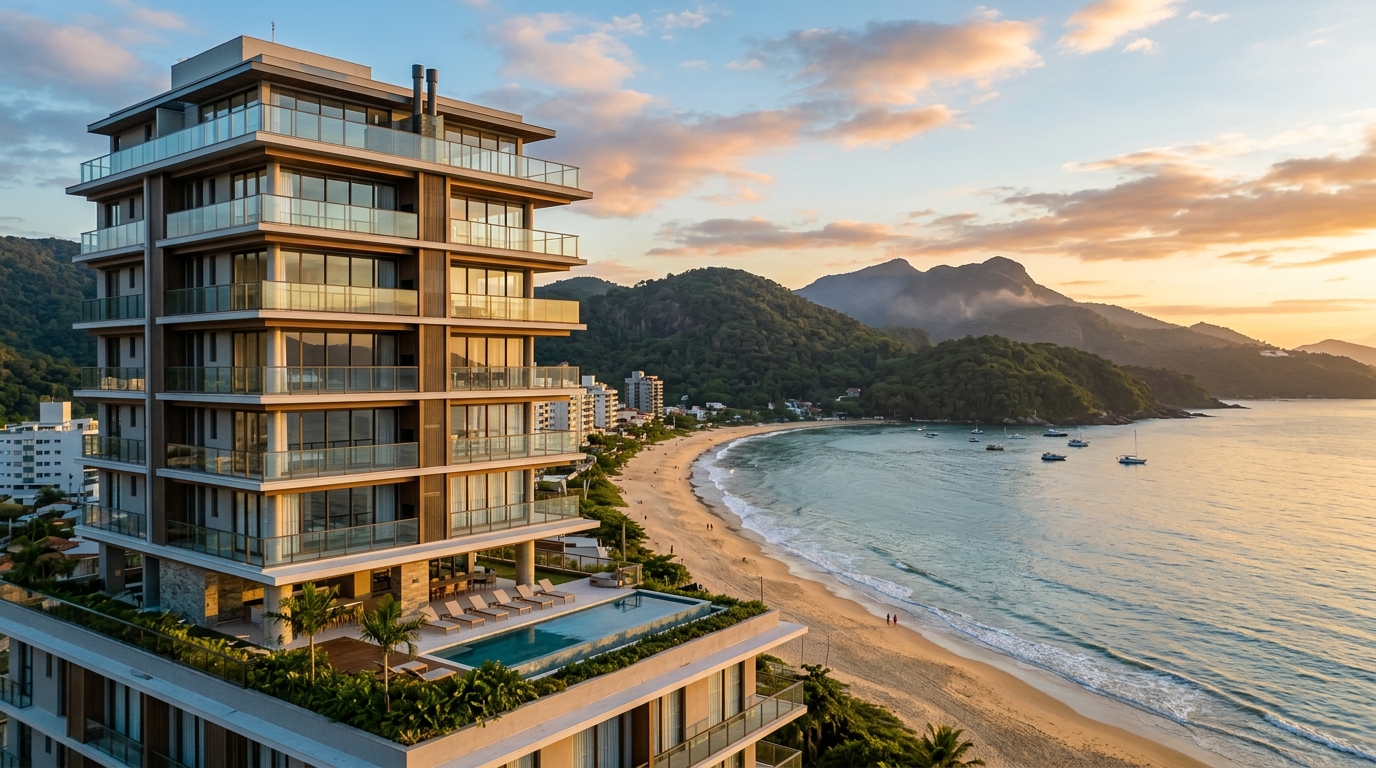
Between January 2024 and the close of 2025, the average advertised square-metre price on Praia Brava climbed from the R$ 14,000 range past R$ 18,000, according to cross-referenced data from FipeZap and local brokerages — an increase of more than 28% over twenty-four months, in a period when Selic (Brazil's base interest rate) stayed above 11% for almost the entire span. The investor stepping into 2026 with an eye on a 30 to 45 m² oceanfront studio has to answer one question before signing anything: does the math survive once you strip away the brochure shine and lay a real spreadsheet on top? This piece is not selling the dream of the northern Santa Catarina coast. It takes apart the calculations circulating in the market, stress-tests the 15.5% gross yield that has become a sales-floor refrain, and shows what is actually left — for better or for worse — once condominium fees, commissions and taxes have all been combed through.
Why studios became the dominant product on Praia Brava's investor radar
Praia Brava has stopped being just a Santa Catarina summer destination. The consolidation of the Itajaí–Navegantes port complex, which handled more than 1.8 million TEUs in 2024 according to APM Terminals and Portonave, created a permanent demand for executive short and medium-stay accommodation. Ship captains, inspection crews, logistics professionals and offshore operators now sustain a layer of occupancy that simply did not exist between March and November — precisely the months when leisure tourism recedes.
Layered on top of that is the profile of the high-season tourist who chooses Praia Brava: a higher ticket than Balneário Camboriú or Bombinhas, a clear preference for privacy, full leisure infrastructure inside the condominium, and proximity to the Beto Carrero theme park and Navegantes airport. This is not a guesthouse crowd. They want an apartment, a proper bed, an equipped kitchen and digital check-in. The studio — 30 to 45 m², one bedroom, balcony with built-in barbecue — fits this profile with a lower acquisition cost and a higher average daily rate per square metre than two or three-bedroom units.
The 2026 macro backdrop reinforces the thesis. With Selic projected by the Focus bulletin to run between 10% and 11% through the year, the post-tax CDI (Brazil's interbank benchmark rate, the reference yield for fixed income) delivers something close to 8.5% to 9% net for an individual in medium maturities. Any real estate asset therefore has to clear that frontier not on the gross number but on the net — and that is exactly where many vacation-rental studio investments stumble.
The real math: daily rate, occupancy, RevPAR and net cap rate
A widely repeated claim in the market puts Praia Brava among Brazil's four most profitable beaches for short-term rentals, with annual gross yields around 15.5%. The figure appears in commercial rankings published by property-management platforms and is not invented — but it deserves a magnifying glass. Almost always it refers to a gross return on a specific acquisition price, before condominium fees, commissions, income tax and vacancy. Once the net filter is applied, the number dehydrates.
A realistic 2026 spreadsheet starts with the daily rate. In high season (15 December to 28 February plus Carnaval), a well-furnished studio in a building with full leisure amenities on Praia Brava works between R$ 650 and R$ 1,100 per night, depending on floor, view and proximity to the sand. In low season, the rate falls to R$ 220 to R$ 380. Realistic occupancy — discounting maintenance blocks and empty windows between check-outs — runs between 60% and 75% over the year for well-managed units. Anyone projecting 85% or 90% is looking only at the peak.
The RevPAR (revenue per available unit) of a 35 m² studio calibrated for this mix averages, over 365 days, between R$ 220 and R$ 340. Multiplied across the year, that is gross revenue between R$ 80,000 and R$ 124,000. For a property bought at R$ 850,000 — a typical ticket for current launches, roughly USD 160,000 to 170,000 at mid-2026 exchange rates — that means gross yields between 9.4% and 14.6%. The 15.5% reference exists, but at the top of the curve and before any cost. The table below sketches three typical scenarios, from conservative to aggressive.
| Variable | Conservative | Moderate | Aggressive |
|---|---|---|---|
| Acquisition price | R$ 950,000 | R$ 850,000 | R$ 780,000 |
| Average daily rate | R$ 320 | R$ 380 | R$ 450 |
| Occupancy | 60% | 68% | 75% |
| Gross annual revenue | R$ 70,080 | R$ 94,316 | R$ 123,187 |
| Gross yield | 7.4% | 11.1% | 15.8% |
| Total costs (~32%) | R$ 22,426 | R$ 30,181 | R$ 39,420 |
| Net annual income | R$ 47,654 | R$ 64,135 | R$ 83,767 |
| Net cap rate | 5.0% | 7.5% | 10.7% |
The net cap rate — the metric that actually matters when comparing against fixed income — sits between 5% and 10.7% depending on the scenario. The conservative case loses to net CDI. The moderate case ties. Only the aggressive case, with an average rate above the curve and occupancy at the top, clears the bar comfortably. The investment thesis is therefore not universal: it depends on specific micro-location within Praia Brava, floor, view, the quality of the furniture package and the calibre of the manager. Buying a vacation studio in the dark is asking the asset to perform in a way it may not be built to deliver.
The invisible costs: condominium fees, IPTU, commissions, taxation
What kills the unprepared investor's math is rarely what is in the storefront. It is what comes after. In new Praia Brava buildings with heated pool, gourmet hall, fitness, sauna, shared laundry and 24-hour concierge, the monthly condominium fee on a studio rarely lands below R$ 950 — and on premium developments it crosses R$ 1,400. Over the year, that means R$ 11,400 to R$ 16,800 absorbed before a single real of net income shows up.
IPTU (the municipal property tax) in Itajaí oscillates between 0.3% and 0.8% of assessed value, with periodic revisions to the official valuation grid. For a studio with an assessed value near R$ 600,000, expect an annual bill between R$ 1,800 and R$ 4,800. Add the waste-collection fee and the mandatory fire-insurance levy charged by the condominium, and the fixed annual cost floor of the property already passes R$ 15,000 in almost any scenario.
The next layer is commission. Airbnb and VRBO charge, under the split model, between 15% and 18% of each booking, already including the guest and host fees. Operating directly on those platforms demands time, messaging, check-in, laundry, inspection — a routine many investors try for three months and then abandon. The alternative is a local property manager, who charges between 20% and 30% of gross revenue and in exchange handles everything from multi-channel listing to post-stay follow-up. Either way, it is revenue that leaves before it ever arrives.
The layer that erodes results the most, however, is taxation. Operating as an individual with short-term rental income means filing monthly via the carnê-leão (Brazil's monthly self-assessment regime for individuals), at progressive rates that climb quickly to 27.5% on relevant tickets. Operating through a corporate vehicle under Simples Nacional (Brazil's simplified tax regime for small business), Annex III, when the activity code is compatible, drops the effective rate to between 6% and 11% of gross revenue, depending on the trailing-twelve-month turnover. Brazil's tax reform, with the new IBS and CBS consumption taxes phasing in from 2026 onward, will also introduce a hybrid rate on hospitality services that must be monitored — the sector expects combined burdens in the 8% to 12% range for service-classified operations, with specific regimes for short-term rental still under design. Anyone planning to buy as an individual out of inertia is leaving meaningful money on the table.
Off-plan versus delivered: INCC, construction timeline and distrato risk
The choice between buying off-plan and buying delivered in Praia Brava in 2026 has no single answer. It has concrete trade-offs that need to be sized. Off-plan, the investor puts down 15% to 25% as a signing payment, pays the balance in instalments during construction, indexed to INCC (Brazil's construction cost index, published by FGV), and only starts operating 24 to 36 months later. INCC closed 2024 around 6.8% and ran 2025 between 5.5% and 7.2%. CUB-SC, the regional sectoral index published by the local builders' union Sinduscon, moved in the same band. Over a 30-month build, the compounded effect can add 14% to 20% to the original contract value — a real pressure on the buyer's cash flow.
"The appreciation between launch and delivery on a consolidated beach like Praia Brava typically delivers a premium of 18% to 30% over the launch price, but that materialises only if the project's absorption cycle is healthy and the macro angle does not turn. Anyone buying off-plan needs to understand they are betting, simultaneously, on the developer, on the interest-rate cycle and on future demand."
On the upside of off-plan, there is the appreciation between launch and delivery — historically between 18% and 30% on high-demand beaches of the northern Santa Catarina coast, according to data from Secovi-SC and CBIC, the regional and national construction industry bodies. There is also the financial advantage of pacing payments: the investor instalments instead of disbursing the whole asset at once, allowing capital to keep earning CDI in fixed income during the build. And there is a wider menu of available units, floors and views.
On the risk side sits construction delay, which even at traditional developers is rarely zero on coastal projects. There is the distrato — the regulated cancellation, governed by Federal Law 13,786/2018 — which limits the refund to a withdrawing buyer to between 50% and 75% of what was paid, an important brake for anyone who might need to exit before delivery. There is absorption risk: simultaneous launches can flood the segment and cap the price curve. And there is developer risk — the so-called patrimônio de afetação (Brazil's project ring-fencing mechanism, which legally isolates a development's assets from the developer's general balance sheet) addresses part of the problem, but the investor must verify the clause is formally in the contract, registered with the property registry, and that the quarterly construction report actually arrives.
Buying delivered flips the equation. It costs more per square metre, demands either full payment or an SBPE mortgage (Brazil's main housing-finance line) at rates that in 2026 still run above 11% per year, but it produces cash flow immediately. For an investor with available capital who wants revenue in 2026, delivered offers predictability. For an investor with a four-to-six-year horizon and tolerance for construction risk, off-plan still tends to deliver a higher IRR.
Management models: self-managed, local operator and condo-hotel pool
The operating model defines a large slice of the net result. Self-management through Airbnb and VRBO is the cheapest in commission — 15% to 18% to the platforms — but the most expensive in time. It requires the investor to handle messaging within an hour, cleaning coordination, linen replacement, damage inspection, laundry and rebookings. It works for someone living within an hour of the property and with real availability. For a non-resident investor, it usually becomes a headache within three seasons.
The local property manager is the dominant route on Praia Brava. Specialised firms operate portfolios of 30 to 200 units, with synchronised listings across Airbnb, VRBO, Booking, Decolar and their own websites, dynamic pricing calendars and in-house operations teams. They charge between 20% and 30% of gross revenue — some at the lower end work on a fixed monthly fee plus smaller commission, a model that protects the operator in low season. The RevPAR uplift under professional management typically more than offsets the commission gap: Airbnb Brasil's own sector data suggests professionally managed listings perform 30% to 50% above self-managed averages on RevPAR.
The third model is the condo-hotel pool, common in certain launches that deliver units with standardised furnishings and a single operator. Here the investor gives up individual operation and receives a proportional share of the pool's result, net of costs and management fee. The upside is predictability and operational disengagement. The downside is the loss of flexibility — the owner does not choose when to use the unit, does not control pricing and is hostage to the quality of management. For institutional profiles or buyers wanting zero involvement, it can make sense. For an investor focused on maximising the result, it rarely does.
Structural risks and the three mistakes that kill the thesis
An honest read of any real estate asset starts with the risks, not the upside. On Praia Brava, three structural risks stand out for the 2026–2030 horizon. The first is supply saturation: the Praia Brava–Brava Beach axis has absorbed, according to consolidated data from ABRAINC and Sinduscon (the national and regional construction industry associations), more than 40 vertical developments launched in the past seven years, with studios and one-bedrooms as the dominant product. Absorption has remained healthy, but the future pipeline puts pressure on the daily-rate curve if the launch pace does not decelerate.
The second is regulatory. Short-term rental regulation in Brazilian tourist municipalities is in flux. In 2025, Itajaí discussed but did not approve mandatory unit registration, a tourism fee and night-cap limits per property per year — models inspired by Florianópolis and several European cities. Any regulatory change can shrink the operational supply and benefit those already in the formal market, but it can also add tax or operational burden. Tracking the municipal legislative calendar has stopped being optional for the serious investor.
The third is extreme seasonality and resale liquidity. January revenue can represent 20% to 25% of the full year, which creates irregular cash flow and demands a capital reserve for weak months. On resale, the studio segment on Praia Brava does have a market, but exits closer to the CUB benchmark cost than to any speculative peak — anyone needing to liquidate in 60 days typically leaves 8% to 15% in discount on the table.
On the mistakes, three recur with worrying frequency. The first is projecting full-year yield using the New Year's Eve rate as the baseline. It is the fastest way to inflate the spreadsheet and reach the wrong decision. The second is ignoring INCC and CUB-SC in the off-plan contract, treating the advertised value as fixed — over a 30-month build, the indexation alone can eat the entire margin the investor expected to capture on appreciation. The third is underestimating the condominium fee: buying a studio in a building with rich amenities without checking the development's projected budget is signing a monthly cheque whose real value only emerges after the building's habite-se (the occupancy certificate that triggers full operations).
There is a fourth mistake worth flagging: foreign buyers who acquire through individual ownership without structured tax advice end up paying Brazilian income tax on the revenue and still face taxation in their home country, having failed to properly invoke the double-taxation treaties Brazil maintains with more than thirty jurisdictions. For the foreign investor, structuring the acquisition through a Brazilian holding company or through a corporate vehicle in Simples is usually a prerequisite for the operation to make financial sense at all.
Conclusion: when Praia Brava makes sense in 2026
Praia Brava remains one of the most solid plays on the Santa Catarina coast for short-term rental, with real fundamentals — consolidated tourist flow, permanent executive demand from the port hub, historical appreciation above INCC, and a competitive cap rate in the moderate scenario. But the answer to the headline question is not a universal yes. It is a demanding "it depends." A vacation studio on Praia Brava pays off in 2026 when: the projected net cap rate clears net CDI by at least two percentage points with room to spare, the acquisition is in a condominium with full amenities and competent management, the tax structure is engineered (Simples or holding), and the investor has a minimum seven-year horizon to dilute seasonality and resale risk.
For investors who fit that profile — and this portal works with buyers in the R$ 600,000 to R$ 1,200,000 ticket range analysing exactly this kind of decision — it is worth getting to know developments with verifiable fundamentals and transparent governance, such as those SIDE Empreendimentos has been delivering along the Itajaí–Praia Brava axis with product calibrated specifically for this investor profile. For those still in the early stages of their analysis, it is worth being sceptical of any projection promising double-digit yields without showing the cost spreadsheet behind them. In the short-term rental market, the gap between the brochure and the real spreadsheet tends to be exactly the size of the promised yield.