Builder Delays in Brazil: Buyer Rights in 2026
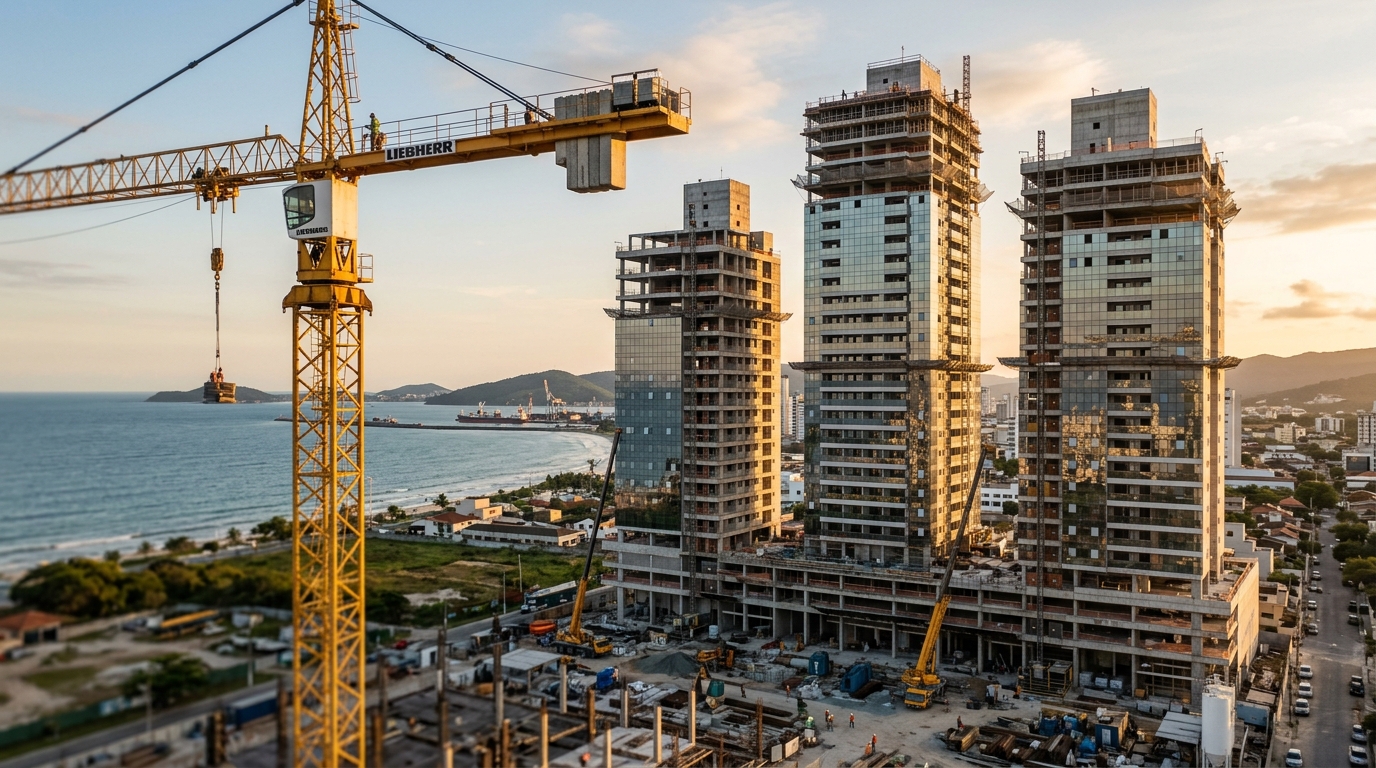
Itajaí and Balneário Camboriú, the twin growth poles of Santa Catarina's northern coast, concentrated more than R$ 28 billion in announced sales value (VGV, or Valor Geral de Vendas, the gross development pipeline reported by industry associations CBIC and Sinduscon-Foz do Itajaí) during 2025, with roughly 380 developments under construction at the same time. In a cycle of that magnitude, a late delivery of keys is no longer the exception. A joint study by Secovi-SP (São Paulo's housing trade union) and ABRAINC (the Brazilian Association of Real Estate Developers) found that about 17% of off-plan units sold between 2022 and 2024 missed their original handover schedule, and a meaningful share crossed the 181st day after the contractual tolerance window. That date is the moment a Brazilian off-plan purchase contract stops being a promise and becomes a bundle of enforceable rights — and it is precisely the moment a high-end buyer, foreign or domestic, needs to know how to act.
This guide consolidates, under Brazilian Law 13,786/2018 (the so-called "Distrato Law" governing termination of off-plan contracts), the Consumer Protection Code (CDC), Article 43-A of Law 4,591/1964 (the condominium and real estate development statute) and Topic 996 of the STJ (Brazil's Superior Court of Justice, the federal court that unifies civil case law), what changes the day after the tolerance window expires, the four routes available to the buyer, how to size compensation using real numbers from the Santa Catarina coast, and which mistakes routinely cost tens of thousands of reais in lost rights. No promises of a courtroom victory — what follows is a technical roadmap that separates the informed buyer from the one held hostage by inertia.
The legal framework: Law 13,786/2018, the CDC, the 180-day tolerance and Topic 996
The Distrato Law (Law 13,786, enacted 27 December 2018) rewrote the relationship between developer and buyer in off-plan purchase contracts governed by Law 4,591/1964. It formalized, in Article 43-A, §2, a tolerance window of 180 consecutive days starting from the contractual delivery date. Inside that window, delay is considered lawful and triggers no compensation — provided that the tolerance clause is written in bold or highlighted form in the contract and expressly initialled by the buyer. Without that formality, the tolerance simply does not apply, and any day of delay puts the developer in default.
From the 181st day onward, the legal picture flips. Article 43-A, §1 allows the buyer to terminate the contract without penalty, with full repayment of everything paid in (corrected by the contractual index) within 60 days of the request. Section §2 of the same article creates the alternative of keeping the contract alive with a monthly indemnity of 1% on the amount effectively paid, calculated pro rata until the keys are delivered. These thresholds are mandatory minimums: the contract cannot reduce them, although it may improve them in the buyer's favour.
Layered on top of the Distrato Law — and prevailing whenever it offers stronger protection — sits the framework of the Consumer Protection Code (CDC, Law 8,078/1990). The CDC classifies the off-plan purchase as a consumer relationship, imposes a duty of objective good faith, authorizes the reversal of the burden of proof in favour of the buyer, and voids clauses that impose unfair obligations on the consumer. In practice this means that the 1% monthly indemnity contained in Law 4,591/1964 does not crowd out other heads of damage: lost rental income, moral damages in qualified cases, and provable material losses can stack on top, in line with consolidated Brazilian case law.
This is where Topic 996 of the STJ enters, decided as a binding repetitive-appeal ruling. The court held that, once the delivery deadline has been missed — tolerance window included — the developer is liable for lost rental income (lucros cessantes), presumed solely by the unjust deprivation of the buyer's use of the property. The presumption operates in the buyer's favour: there is no need to prove that the unit would have been rented out or that a specific deal was missed. If the developer wants to escape the indemnity, it bears the burden of showing that the delay produced no actual loss, which is effectively impossible. For contracts signed before the Distrato Law took effect, the older jurisprudential regime still applies, with lost rentals calculated by reference to the local market rent.
Two further limits deserve attention. First: the statute of limitations to claim restitution and material damages arising from a consumer relationship is, as a rule, five years (Article 27 of the CDC), while the broader claim for contractual breach follows the ten-year period of Article 205 of the Civil Code, as the STJ's dominant view holds. Second: minor punch-list work, snagging inspections or a pending occupancy permit (habite-se) do not entitle the developer to push delivery indefinitely. The legal benchmark is the moment the unit is materially fit for use, with the habite-se issued by the municipality and the individual title document for the apartment formally registered.
The four routes from day 181 onward
Once the tolerance is exhausted, the buyer holds a menu of legally enforceable options. The four routes are not mutually exclusive across the board: the choice between termination and continuation is binary, but lost rentals and moral damages may stack within the chosen route, subject to applicable case law.
1. Termination with full refund. Provided by Article 43-A, §1, this is the route for the buyer who has lost faith in the project or who needs the capital back. Every amount paid — down payment, monthly instalments, periodic balloon payments and contractual inflation adjustment — must be returned within 60 days, with no withholding. No termination fine, no broker commission claw-back, no "administrative retention" is allowed, because the party in default was the developer. Importantly, the refund is full even where the project operates under patrimônio de afetação, the segregated-assets regime that ring-fences each development's cash flow from the developer's other liabilities.
2. Keep the contract alive with a 1% monthly indemnity. For the buyer who still wants the unit — the long-term investor, the future-home buyer, anyone holding a unit in a strongly appreciating sub-market — Article 43-A, §2 grants a monthly penalty of 1% on the amount effectively paid, computed per month of delay starting on day 181 and settled in a single payment at handover. On a cumulative R$ 400,000 paid in, that means R$ 4,000 per month of delay — not a token late fee, but a statutorily tariffed indemnity.
3. Lost rental income. The core thesis of Topic 996. Delay prevents the buyer from putting the unit to economic use — renting it out, moving in or reselling — and the STJ presumes that loss. The usual quantification is the market rent of a comparable unit, supported by an appraiser's report, by FipeZap data (FipeZap is the leading Brazilian residential price and rent index, jointly maintained by Fipe and ZAP Imóveis) or by comparable listings. The majority view allows lost rentals to be combined with the 1% monthly penalty in contracts signed before the Distrato Law; for post-2018 contracts, there is a real split in the lower courts on whether the 1% absorbs the presumed lost rentals or whether both stack — a strategic call that has to be analysed case by case with specialized counsel.
4. Moral damages. They do not arise from delay alone. The STJ and the TJSC (Santa Catarina's State Court of Appeals) hold that a bare contractual breach amounts to a "mere annoyance" and is not compensable. But several scenarios do trigger moral damages: a buyer who sold their current home counting on the handover, a family forced into months of hotel or relatives' housing, an investor with a pre-signed lease to a third party, a buyer with health needs that required a specific custom build-out. TJSC awards in 2024 and 2025 have settled in the R$ 5,000–R$ 15,000 range per buyer in documented cases — modest next to the property-side compensation but symbolically significant.
| Route | Statutory basis | When it makes sense | Main risk |
|---|---|---|---|
| Termination with full refund | Art. 43-A, §1, Law 4,591/64 | Loss of confidence, capital needed, project stalled | Forfeiting future appreciation of the unit |
| Continuation + 1% monthly penalty | Art. 43-A, §2, Law 4,591/64 | Unit in a hot sub-market, long-horizon hold | Delay may drag on; penalty only paid at handover |
| Lost rental income | Topic 996 STJ + CDC | Unit intended for rental yield or resale | Possible stacking dispute with the 1% penalty |
| Moral damages | CDC + case law | Concrete harm to dignity or planning | Requires solid evidence; moderate awards |
What the buyer stops paying — and how to formalize the developer's default
A recurring misconception along the Santa Catarina coast, particularly in luxury launches in Itajaí, Balneário Camboriú and Praia Brava, is that the buyer must continue every contractual payment during the delay as if the schedule were still on track. They do not. Two line items, in particular, become non-enforceable once the developer is formally in default.
Construction-phase interest (taxa de obra or juros de obra). Charged by the financial institutions that fund construction through Brazil's SBPE channel (the residential housing finance system tied to passbook savings) or as part of the developer's bridge financing, this is, in substance, pre-handover interest. Once tolerance expires and default is configured, the buyer can stop paying this charge, because requiring it on top of the 1% monthly penalty would amount to double recovery (bis in idem) for the same delay. TJSC and STJ case law is coherent on this: a debtor in default cannot demand consideration from its creditor for delay the debtor itself caused.
INCC indexation during the delay. The INCC (Índice Nacional de Custo da Construção, Brazil's national construction cost index, calculated by Fundação Getulio Vargas) updates instalments during construction precisely because those payments compensate the cost of building. Once the schedule has expired and default is in place, the applicable index switches to the IPCA (Brazil's official consumer inflation index) or to whatever post-handover index the contract specifies, typically the IGP-M (a broader general price index). Continuing to bill INCC during the delay is an undue charge — exposing the developer to potential double restitution under Article 42, sole paragraph, of the CDC, in line with the STJ's reasoning in Topic 929 where bad faith is shown.
None of this is automatic. The construction of these rights depends on formalizing default. The decisive step is an extrajudicial notice (notificação extrajudicial), an instrument that matters for three reasons: it sets the starting date of the 1% monthly penalty beyond dispute, it acts as a formal interpellation for limitation purposes, and it builds robust evidence for any future lawsuit. The notice can be served by registered mail with return receipt or, preferably, through a Cartório de Títulos e Documentos (a specialized notary office that registers and certifies the service of legal notices in Brazil). The text should clearly identify the contract, the delivery deadline, the date the tolerance ended, the number of months elapsed since, the option the buyer is exercising (termination or continuation) and a deadline for the developer's response. Investors holding more than one unit in the same building should issue one notice per contract — never a blanket notice.
"Delays have become a structural statistic on the northern coast of Santa Catarina because the 2022–2026 cycle absorbed more launches than the regional supply chain can support. The buyer who stays passive is silently financing the developer's problem." — a recurring reading among real estate litigators in the TJSC during 2025.
A worked example: an R$ 800,000 unit in Itajaí, eight months late
The figures below are illustrative and use conservative assumptions for a two-bedroom apartment in central Itajaí, with a sale price of R$ 800,000, paid partly during construction and partly through bank repassing at handover. At today's exchange rate that ballpark translates roughly into the high US$ 150,000s — useful framing for a foreign investor, although every Brazilian-side calculation should stay in reais because that is the contractual currency. The point here is to show the order of magnitude; any real case requires an individualized calculation memo.
Assumptions. R$ 80,000 down payment at signing. Monthly instalments of R$ 4,000 over 36 months (R$ 144,000), with INCC accumulated at approximately 18% over the period, raising the indexed total to roughly R$ 170,000. Two periodic balloon payments of R$ 50,000 each, totaling R$ 100,000. Amount effectively paid by the date tolerance expires: R$ 350,000. Eight months of delay starting from day 181. Market rent for a comparable unit, per 2025 FipeZap surveys for Itajaí: R$ 4,200 per month.
Scenario A — keeping the contract, 1% monthly penalty. Applying 1% on R$ 350,000 per month of delay yields R$ 3,500 per month. Across eight months, that is R$ 28,000 payable in a single instalment at handover, with monetary correction and statutory interest. If the buyer continues to make contractual payments during the delay (the base on which 1% is applied keeps growing), the final figure can comfortably exceed R$ 32,000.
Scenario B — lost rental income. Taking a market rent of R$ 4,200 per month over eight months produces R$ 33,600. For contracts signed before December 2018, the TJSC has precedents allowing this figure to stack on top of the 1% penalty, pushing total compensation toward the R$ 60,000 range. For post-2018 contracts, an important strand of case law treats the 1% monthly penalty as a substitute for presumed lost rentals — meaning the buyer must elect the more advantageous route rather than collecting both.
Scenario C — termination. Full refund of R$ 350,000, updated by the contractual index from each payment date, plus statutory interest of 1% per month from service of process. Combining IPCA inflation and interest, the amount receivable within 60 days can land between R$ 380,000 and R$ 390,000. This route zeroes out the exposure but also eliminates future appreciation — and in a market like Itajaí, where FipeZap reported residential square-metre prices rising on average 14.2% in 2024 and 10.8% in 2025, that is a decision with a meaningful opportunity cost.
For an investor with a rental-yield profile, Scenario B is usually the most attractive in older contracts; for newer ones, Scenario A delivers predictability. The choice between A and C is genuinely strategic and turns on the expected delivery: if the project is in an advanced construction stage and the developer's patrimônio de afetação is healthy, staying in makes sense; if there are signs of prolonged paralysis or balance-sheet stress on the developer side, terminating before a potential judicial reorganization filing (Brazil's equivalent of Chapter 11) protects the capital.
From extrajudicial notice to lawsuit: the sequence that matters
The order of steps matters. Skipping stages weakens evidence, raises legal fees and erodes negotiating leverage. For a sophisticated investor, the playbook has four phases.
Phase 1 — documentary diagnostic. Before any action, gather: the full purchase agreement with every amendment and addendum; payment receipts for the down payment and every instalment, including balloon payments; the memorial descritivo (technical specification of the unit) and the physical-financial schedule; all correspondence with the developer; an up-to-date excerpt from the property registry on the development's incorporation filing (memorial de incorporação); and confirmation of whether the project operates under patrimônio de afetação. This dossier will structure the entire strategy. An extension amendment signed without express reservation, for example, can redefine when the tolerance window starts — which is why every addendum has to be reviewed before action.
Phase 2 — extrajudicial notice. Drafted by a lawyer and served through the Cartório de Títulos e Documentos in both the developer's home district and the district where the development sits. The text should identify the contract and the project, prove that tolerance has lapsed, state the buyer's chosen route, require a response within a reasonable window (15 to 30 days) and expressly reserve every right not yet exercised. From that notice, the 1% monthly penalty starts running with clarity — and while the dominant view allows it to be counted from day 181 regardless of notice, having a formal landmark avoids future disputes.
Phase 3 — extrajudicial mediation and consumer agencies. With the notice served and the developer's response (or silence) in hand, two parallel fronts open before court. The first is Procon, Brazil's consumer-protection authority — at the state level, Procon-SC, which has offices in both Itajaí and Balneário Camboriú and which records grievances in the public Cadastro de Reclamações Fundamentadas (the Substantiated Complaints Registry), creating reputational pressure. The second is ABRAINC's mediation chamber, to which most of the coast's leading developers are affiliated, and which in some cases produces a settlement in 45–60 days with an enforceable extrajudicial title. For high-end buyers, mediation is particularly appealing because it preserves the relationship with the developer and accelerates resolution.
Phase 4 — court action. Once amicable channels are exhausted, the suit is filed, as a rule, in the civil court of the district where the property is located, under Article 53, III, "d" of the Civil Procedure Code (CPC), or alternatively in the consumer's place of residence under Article 101, I of the CDC — a forum choice that can favour foreign or out-of-state buyers. Typical claims: declaration of contractual termination or continuation, payment of the 1% monthly penalty, lost rental income, moral damages where documented, double restitution of undue charges, a preliminary injunction (tutela de urgência) to suspend pending payments during the default, and the reversal of the burden of proof. The average duration of real estate litigation at the TJSC, according to the National Justice Council's 2025 Justiça em Números report, is around 28 months at first instance — a factor that must enter the calculus when comparing a settlement to litigation.
The mistakes that quietly destroy buyer rights
The combination of technical inexperience and anxiety to get the unit produces, in sequence, decisions that weaken or eliminate legally solid claims. Five mistakes show up in almost every case lost at the TJSC over the last two years.
Signing extension amendments without reservation. A developer in default will routinely produce an extension amendment dressed up as a "schedule adjustment." Signing it without an express reservation can be read as a waiver of the right to claim the penalty for the period covered by the amendment. If the amendment is unavoidable — for example, in exchange for a discount or a relevant contractual change — it must contain, in bold or highlighted form, an explicit reservation of all rights tied to the delay already in place and its financial consequences.
Accepting the keys without a reservation of vices and pending rights. Handover is the moment that creates the most traps. The standard form most developers present quits "all obligations in full, unconditionally and irrevocably." Signing it as-is is, in practice, a waiver of the 1% monthly penalty, of lost rental income claims and even of latent construction defects. The recommendation is to commission an independent technical inspection (vistoria) and to sign the handover statement with a written, explicit reservation of: identified defects, all rights linked to the delay, and the statutory construction-warranty periods set out in Article 618 of the Brazilian Civil Code.
Suspending payments without a court order. However intuitive it feels, unilaterally halting instalments can shift the buyer into default and open the door for the developer to seek termination "for buyer fault," with retention of up to 50% of the amount paid for projects under patrimônio de afetação, or 25% in other cases, under the very same Distrato Law. Suspending payments is only safe when backed by a preliminary injunction, or when the extrajudicial notice and the developer's response together establish bilateral default.
Confusing the five-year limitation with the ninety-day forfeiture period. The claim for damages caused by the delay is subject, as a rule, to a five-year limitation (Article 27 of the CDC) or a ten-year limitation (Article 205 of the Civil Code), depending on the head of damage. Complaints about apparent construction defects, by contrast, are subject to a 90-day forfeiture window under Article 26 of the CDC, counted from handover; latent defects run from discovery. Mixing the two periods has caused buyers to lose rights by waiting too long — or by acting on the wrong clock.
Ignoring the developer's financial health. Rights do not compensate for an uncollectible credit. Before opting for termination, especially in projects without patrimônio de afetação, the buyer should check the developer's standing: filings in the Central Bank's SCR credit registry, pending cases in the TJSC's public case-lookup, any judicial reorganization petition. In a stressed scenario, keeping the contract alive — and pursuing the 1% monthly penalty in court, with a future lien over the unit at handover — can be strategically stronger than getting cash back from an insolvent estate.
Conclusion
The 2022–2026 launch cycle on the northern coast of Santa Catarina has turned construction delay into a statistical risk — while, at the same time, leaving the high-end buyer with both more exposure and more tools. Law 13,786/2018, Article 43-A of Law 4,591/1964, the STJ's Topic 996 and the CDC together form a sophisticated protective architecture, running from the 1% monthly penalty to the presumption of lost rental income, with the suspension of construction-phase interest and INCC indexation during default along the way. But rights are not exercised by inertia. They depend on formal notice, technical inspection, written reservations, respected deadlines and a documentary strategy built before any move.
Every case has its own variables — the nature of the contract, the construction stage, the developer's balance sheet, the unit's local market value, the appreciation expectation. Generalizing the answer is the fastest path to a wrong call. The technical recommendation is unambiguous: when delivery is late beyond the tolerance window, retain a real estate lawyer with TJSC experience, assemble the documentary record before any first move, and make a strategic — not emotional — decision. For weekly analysis of the development cycle, relevant case law and market movements in Itajaí, Praia Brava and Balneário Camboriú, the editorial newsletter of the SIDE Empreendimentos portal consolidates, in a concise format, what matters for the high-end investor in the region.