Amenities Driving Praia Brava Property Value in 2026
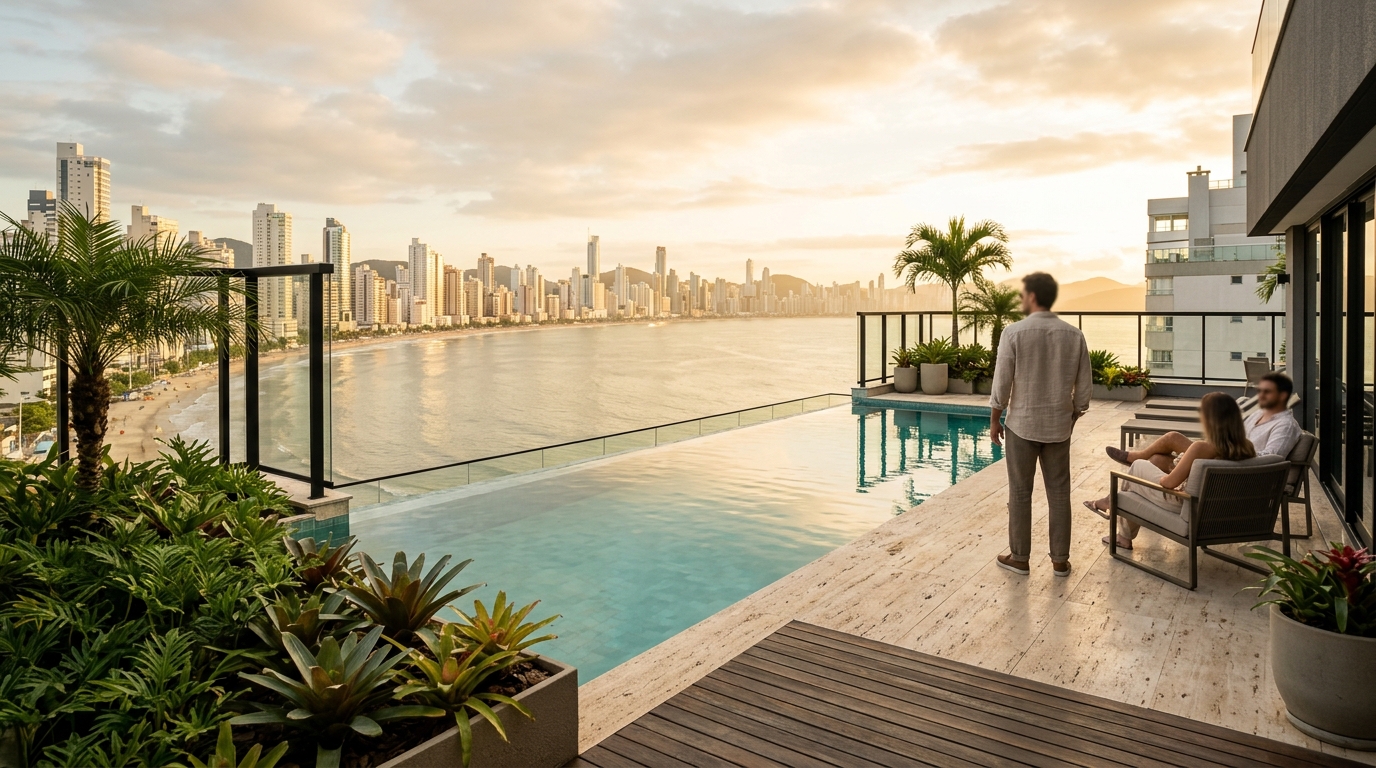
The square-meter price for luxury new-builds on Praia Brava closed 2025 above R$ 22,000 in select launches, according to combined data from Secovi-SC (the local real-estate developers' union) and FipeZap (Brazil's reference price index). Over the same period, the inventory of units under construction along the seafront grew by more than 30%. When supply accelerates faster than demand, the experienced investor knows what follows: price stops being a simple function of location and gets contested, inch by inch, on architecture, finishes and — increasingly — the design of the common areas. In 2026, on Praia Brava, picking the right project means, above all, picking the right amenity package.
This analysis sets out the ranking that matters for buyers treating luxury real estate as an asset: which amenities actually add VGV (gross sales value) per square meter, which are liabilities dressed up as luxury, and how to read all of it against the new seafront master plan, the CUB/SC (a regional construction cost index), the INCC (national construction cost index), and the behaviour of the São Paulo, Paraná and foreign buyers who now dominate the ticket above R$ 3 million in the region.
Why amenities have become the decisive price variable on Praia Brava
Until 2022, the high-end equation on Praia Brava was relatively simple: ocean view, beachfront positioning and generous private floor area were enough to stand out. Three years on, the game has changed. Secovi-SC tracks dozens of simultaneous tower launches between Brava and Praia do Estaleiro, and ABRAINC (the national association of real-estate developers) reports that Santa Catarina was the only state outside Brazil's southeast core to close 2025 with more than R$ 30 billion in launched VGV in mid- and high-end residential. The result is selective saturation: abundant supply in the R$ 2-5 million band, and fierce competition for qualified buyers.
In that environment, amenities have stopped being a marketing line and become a pricing instrument. The City of Itajaí announced in 2025 a package of more than R$ 120 million to upgrade the public seafront — promenade, drainage, smart lighting, street furniture and a continuous bike path running all the way to Praia do Atalaia. That public investment narrows the gap between private and shared experience and pushes the differentiation debate inside the condominium gate: if the street and the beach are being levelled up, what justifies a price premium is what sits behind the door.
The second structural shift is the rise of quiet luxury over conspicuous luxury. The 2026 buyer — typically a São Paulo entrepreneur aged 45-60, a Paraná couple shopping for a second home, or a foreign buyer based in Florianópolis — wants discretion, service and free time. They do not want a flashy façade, a triple-height marble lobby or a 30-seat 4D cinema. That shift in taste rearranges, in practice, what is worth paying for in a condominium.
2026 ranking: the eight amenities that add the most VGV per square meter
Cross-referencing recent resale data from FipeZap, private listings from luxury brokerages and absorption performance audited by Secovi-SC, it is possible to rank, with reasonable confidence, which common areas deliver a genuine price premium and which merely inflate the launch ticket. The ranking below considers two-to-four-bedroom units delivered between 2023 and 2025, compared with peers without the relevant amenity within the same block range.
| Rank | Amenity | Estimated premium on VGV/m² | Recurring condo cost |
|---|---|---|---|
| 1 | Rooftop with heated pool and ocean view | +12% to +18% | Medium |
| 2 | Spa with wet sauna, dry sauna and treatment room | +6% to +10% | Medium-high |
| 3 | Beach service and beach concierge | +5% to +9% | High |
| 4 | Gourmet space with climate-controlled wine cellar | +4% to +7% | Low |
| 5 | Premium gym with resident personal trainer | +3% to +6% | Medium |
| 6 | Coworking with private offices and focus pods | +3% to +5% | Low |
| 7 | Garage with EV charging stations | +2% to +4% | Low |
| 8 | Pet area with grooming and fenced run | +1% to +3% | Low |
The heated rooftop pool with seafront view is, on its own, the highest-leverage amenity of 2026. The reason is not aesthetic — it is operational. The microclimate of the northern Santa Catarina coast offers, on average, only four to five months of tolerably warm water; a heated pool turns the rooftop into a twelve-month asset. Paired with a panoramic deck and ocean view, it competes directly with private square meters in the buying decision — and, unlike floor area, it actually scales in value as the surrounding density grows.
The spa, in second place, owes its position to the same dynamic: the Praia Brava luxury buyer is rarely a full-time resident. They use the property for long weekends and seasonal stays, and they want a hotel-grade experience. Spaces combining a wet sauna, a Finnish dry sauna, treatment rooms and contrast showers have, in practice, become an extension of the master suite. Recently delivered projects from local developers — including SIDE Empreendimentos projects in the region — show that this configuration holds resale value even through high-Selic (Brazil's benchmark interest rate) cycles.
Beach service deserves a separate note. It is a service, not a built area: lounge chairs, umbrellas and food and beverage delivered straight to the sand during high season. It is expensive on the condo bill, but it cuts the friction of the beach experience drastically, and it lifts seasonal rental rates by 15-25% over comparable units without it.
The amenities that do not deliver ROI — and drain the condo fee
The flip side of the ranking matters just as much. Some amenities still feature in launch brochures as differentiators, yet under any honest sale-premium-vs.-running-cost analysis, they are liabilities dressed as luxury. The investor needs to spot them before signing the purchase agreement.
The first one is the private cinema. It is expensive to build, requires acoustic engineering, upholstered seat maintenance, periodic projector and audio replacement and constant climate control — and on Praia Brava it is used, on average, fewer than six times a year per unit. The sale premium attributable to a cinema room is statistically indistinguishable from zero; the recurring cost shows up on the condo bill every single month. Buildings with cinemas typically carry condo fees 8-12% above otherwise equivalent peers, with no positive effect on liquidity.
The traditional indoor playroom is the second. The Praia Brava buyer profile is, by a large margin, couples without small children, or couples whose children are already teenagers. When children are present, the beach, the pool and the games room fill the role. An enclosed indoor playroom requires supervision, insurance and toy upkeep, and sits empty three hundred days a year. It is the classic item designed to win an argument in the sales suite while penalising the owner every month afterwards.
The covered multi-sport court is the third recurring liability. On land as expensive as Praia Brava's seafront blocks, allocating 400-600 m² to a court used occasionally by teenagers on holiday is a waste of buildable area. That same footprint, converted into an additional floor of units or a heated pool with a solarium, would return multiples of the investment in VGV and resale premium.
"An amenity is not a differentiator by itself. It is a differentiator when frequency of use, operating cost and buyer profile line up. When those three vectors fall out of sync, the common area becomes a permanent drag on the condo fee." — recurring assessment in Secovi-SC market studies on premium coastal launches.
How to read the floor plan as an investor — not as a future resident
The emotional buyer looks at the floor plan and imagines living in it. The investor looks at the floor plan and calculates how to sell — or rent — it in five, eight or ten years. The difference in reading starts with the ratio of private to leisure area. In mature luxury markets, the healthy range is 75-82% of private area per average unit out of total built buildable area. Below that, the building is paying — through the condo fee — for common space it will never monetise.
The second filter is timeless finish. Travertine marble, natural wood, black powder-coated aluminium frames, brushed metal — items that age well and survive style cycles. Dated finishes, such as coloured façade mosaics or quartz countertops with aggressive veining, signal a complicated resale in 2030. The CUB/SC index, which tracks the basic unit cost of construction in Santa Catarina, helps calibrate whether the listing price aligns with the spec being delivered: when the ticket per square meter exceeds CUB by more than four times, the premium needs to be justified somewhere visible.
The third filter is sustainability certification. AQUA-HQE (a French-Brazilian green building standard) and LEED, once dismissed as marketing flourishes, have become concrete pricing instruments for the foreign buyer and the institutional investor. Buildings holding active certification record, according to data consolidated by CBIC (the national chamber of construction), an average sale premium of 5-8%, and — more importantly — significantly lower long-term rental vacancy. In a market that is starting to take energy efficiency seriously, these labels are asset protection.
The fourth filter, frequently overlooked by foreign buyers, is the INCC applied to premium amenities during construction. In Brazilian off-plan contracts, instalments paid during the build are corrected by the INCC each month. Every additional luxury item raises the project's effective INCC exposure, because the index tracks specialised labour and high-end materials. The INCC closed 2025 above 6% on a 12-month basis, and projects with heavy amenity packages delivered even larger real corrections on instalments during the build. The investor must model that effect before signing.
The new seafront master plan and the repositioning of private amenities
The R$ 120 million package announced for the Itajaí seafront, extending across Praia Brava and Praia do Atalaia, resets the balance between public and private space. An upgraded promenade, continuous lighting, uniform street furniture and an unbroken bike lane lift the sand strip into a natural extension of each building's common areas. The practical effect is twofold.
On one side, it adds value to every beachfront property, without exception. On the other, it forces buildings on the second and third row to sharpen their internal amenities, because the comparative advantage of being right on the sand fades when the entire beach delivers a premium experience. In that rearrangement, the rooftop with a view, the spa and the beach service gain even more relevance: they become the way to capture upside from the public investment without literally sitting on the front row.
The public-private integration also opens a window for buildings that negotiate, with City Hall, shared-use zones — kiosks, decks and qualified beach access points. Qualified buyers are starting to ask, at the sales pitch, what the building's relationship with the seafront master plan looks like. Whoever cannot answer is losing the sale.
On a regional comparison, Praia Brava sits in 2026 above Balneário Camboriú on per-square-meter ticket in several boutique launches and below Jurerê Internacional on the overall average — but with a higher absorption rate than either, by combined Secovi-SC and ABRAINC data. That pricing blind spot is precisely what makes Brava interesting for the disciplined investor: there is still a premium to capture while the market evens out perception.
The investor's checklist before signing
Reducing the amenity ranking to a wish-list is not enough. The investor needs to look at the operation behind each common area. A spa without a professional management contract turns into mildew within two years. A beach service with no continuity clause in the condo bylaws disappears at the first heated assembly. A rooftop heated pool with no clear clause about who pays for the gas becomes a permanent source of litigation between owners.
Four questions need a written answer before the contract: who operates each amenity during the first five years, what use restrictions apply in high season when the unit is rented out, what contractual guarantees the developer offers on the delivery of each item — particularly signature ones such as spa and concierge — and what the projected condo budget looks like, line by line, for the first three years after the habite-se (the building occupancy permit) is issued.
Equally important is understanding the rental regime allowed by the convention. Premium Praia Brava buildings operate, in practice, under one of three regimes: free seasonal rental, long-stay only (30-day minimum), or an outright ban on short-term rental. Each regime radically changes the yield profile of the asset. A restrictive convention kills the rental thesis; a permissive one preserves liquidity but can put pressure on amenity use during peak weeks.
The final checklist item is fiscal and legal. INCC-linked adjustment clauses during construction, delivery schedules tied to the occupancy permit, bank or balance-sheet guarantees covering the delivery of common areas — every one of these needs to be read through an investor lens, not a resident lens. The difference between an excellent deal on Praia Brava in 2026 and a five-year headache rarely lives in the rooftop. It lives in the twenty pages of the contract that nobody read before signing.
Conclusion: what the ranking really means for the 2025-2027 cycle
Praia Brava enters 2026 as the densest high-end launch market on the Santa Catarina coast — and, for that reason, the most demanding on differentiation. In an environment of still-restrictive Selic, pressured INCC and rising supply, the investor who buys off the brochure pays a high price for optimism. What will sustain a sale premium over the next five years is the precise combination of amenities that scale in real use, finishes that survive style cycles, and contracts that protect the asset.
Anyone watching the market with discipline has already understood it: heated rooftop, spa, beach service, gourmet space with wine cellar, premium gym, coworking, EV charging and pet area are, today, the baseline competitive package above the R$ 3 million ticket in Brava. Cinema, indoor playroom and multi-sport court are, at best, neutral. For continued analysis of this and upcoming cycles on the Santa Catarina coast — with FipeZap, Secovi-SC, CUB/SC and ABRAINC readings translated into investment decisions — it is worth following the weekly column on the SIDE Empreendimentos portal, where each launch is read through the lens of a buyer who is already thinking about the exit, not just the move-in.