Airbnb in Praia Brava Condos: What Changes in 2026
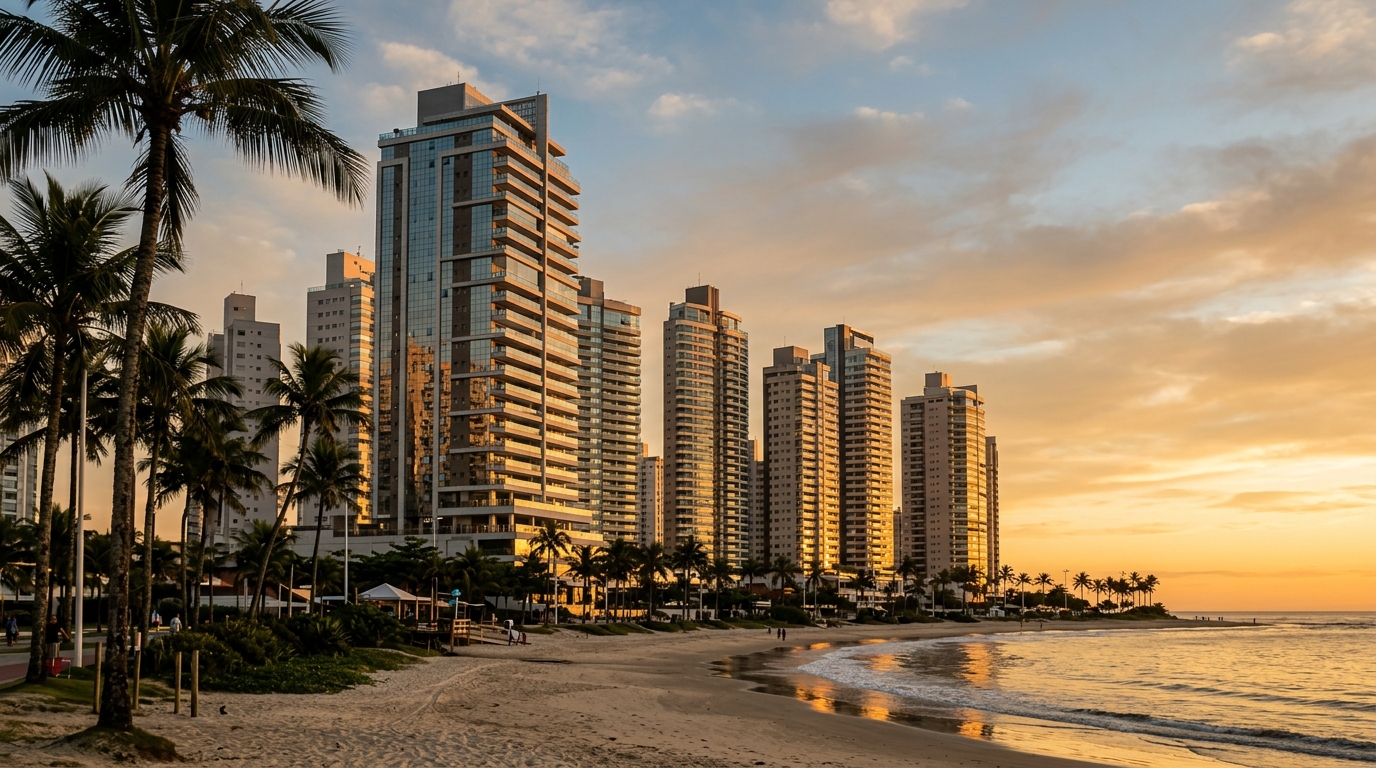
When Brazil's Superior Court of Justice (STJ) consolidated, in 2021, the position that a condominium assembly may ban short-term rentals by qualified quorum, the foreign investor buying off-plan in Praia Brava still treated Airbnb as a guaranteed double-digit cap rate. Five years later, the picture has flipped: of the twelve new-development bylaws filed in Itajaí between 2024 and the first half of 2026 and mapped by Secovi-SC (the state real-estate developers' union), eight contain clauses restricting short stays — three with outright prohibitions, conditioned on a 30-day minimum stay. For someone who put roughly BRL 2.8 million (about USD 560,000) into a 180 m² penthouse on the northern shore counting on nightly rates near BRL 1,800, the gap between projected and realised cap rate has slid from 9% to 4.2% on certain assets. This piece translates, in numbers and in law, what has changed — and what is still about to change before the end of 2026.
The STJ doctrine: how a two-thirds vote can rewrite your investment
The legal starting point is Special Appeal 1,819,075/RS, decided by the STJ's Fourth Chamber in 2021 and since adopted as reference by state appellate courts. The Court fixed three premises that remain in force: short-term rental via digital platforms is a hybrid activity, closer to atypical lodging than to the pure residential lease governed by Brazil's Tenancy Law (Law 8,245/91); a residential condominium has standing to regulate unit use whenever there is impact on coexistence, security and the enjoyment of common areas; and any resolution that prohibits or restricts such use requires the same qualified quorum used to amend the bylaws — namely two-thirds of the ideal fractions (the ownership shares attached to each unit).
The practical consequence is direct, and has been reinforced by parallel state-court rulings between 2023 and 2025: a well-conducted extraordinary general assembly, attended by owners representing two-thirds of the condominium, can approve an Airbnb ban in a building whose original bylaws were silent on the matter. No collective lawsuit is required, no new developer filing is required. All it takes is proper notice, an agenda that expressly lists the topic, minutes registered at the notary office and the amendment annotated on the property record. In premium Praia Brava buildings — where the typical non-resident investor holds a small ideal fraction — full-time residents wield disproportionate voting weight relative to their unit count.
The second point the investor must internalise is the distinction between banning the practice and regulating it. Brazilian case law accepts the middle path: bylaws that set a minimum number of nights (generally between 5 and 30), require prior guest registration at the front desk, forbid late-night check-ins, demand a security deposit, charge an additional condominium fee for units exploited commercially, or condition the activity on full compliance with municipal tax obligations. These partial restrictions have been upheld by courts and reshape the revenue curve without killing it. Confusing prohibition with regulation overstates the risk and, paradoxically, causes buyers to miss opportunities in lightly restricted assets that the market has aggressively discounted.
The third point, often missed, is the transition regime. Recent rulings have recognised that a subsequent prohibition cannot reach short-term rental contracts already underway, but does apply to future bookings from the date the amendment is registered. In other words, an investor caught by a bylaw change does not lose the next sixty to ninety days of confirmed reservations, but must stop accepting new ones immediately. The hit to annual cash flow is usually brutal, precisely because it concentrates the loss in the following high season.
The local regulatory map: what Itajaí and Praia Brava did in 2024–2026
The City of Itajaí does not ban Airbnb — and is unlikely to, given how much of the northern Santa Catarina coast's service-sector GDP depends on alternative lodging. What does exist is a regulatory ecosystem that makes the operation more formal, more expensive and far less invisible to the tax authority. The municipal land-use and zoning law, in the Master Plan revision concluded in 2024, classifies Praia Brava as predominantly medium- and high-density residential zones, with mixed-use tolerance only along specific corridors near Avenida José Medeiros Vieira and the SC-410 highway access. Developments launched within those corridors have more room for regularised mixed use with segregated lodging floors, while buildings on strictly residential blocks remain exposed to pushback from their own co-owners.
On the tax side, Itajaí's Treasury maintains the municipal services tax (ISS — a city-level levy on services) at 5% over hospitality revenue, regardless of which platform brokers the booking, and since 2024 has been cross-referencing platform data with the municipal taxpayer registry. There is no mass enforcement yet — only signalling. The individual owner operating without a tax registration is, today, a prime target for the next audit cycle. At the federal level, Brazil's IRS already treats Airbnb income as taxable under the monthly self-assessment regime (carnê-leão) whenever the activity is habitual, with progressive rates that can reach 27.5%, and without the right to deduct condominium fees or property tax as operating expenses — a fact that destroys naïve comparisons against traditional residential leasing.
The most relevant move, however, is coming from the developers themselves. Two single-tower launches in Praia Brava in 2025 already filed bylaw drafts, before opening sales, with an explicit clause restricting stays shorter than fifteen days. Two other high-end launches chose the "condominium with hospitality regulations" route: short stays are allowed, but only through a registered operating company, with mandatory 24-hour concierge service billed separately, and adherence to a minimum service standard with a guest manual. This second path is consolidating as the dominant 2026 trend — and it favours the professional investor at the expense of the amateur running everything alone from the app.
The math: short stay vs annual lease vs resale
In a 140 m² penthouse in Praia Brava with an estimated asking value (VGV — the developer's gross sales value) of BRL 2.4 million, comparing the three monetisation routes must be done on net revenue, not on headline nightly rates — and this is where marketing narratives most distort reality. Assuming a weighted average nightly rate of BRL 1,250 (high season December–February at BRL 2,000 to BRL 3,000, shoulder months June–October between BRL 700 and BRL 1,100, and low season between BRL 500 and BRL 800), and a realistic 55% occupancy — the level regional surveys by Inventur SC have been recording between 2024 and 2025 — gross annual revenue lands around BRL 251,000. From that you must subtract platform commission (15% on a weighted basis), professional local operations (20% to 25%), the municipal ISS (5%) and personal income tax (up to 27.5% on the taxable balance).
| Metric (140 m² unit, asking BRL 2.4M) | Professional short stay | Annual lease | 30+ day mid-term lease |
|---|---|---|---|
| Estimated gross annual revenue | BRL 251,000 | BRL 132,000 | BRL 168,000 |
| Platform + operating fees | BRL 87,850 | BRL 13,200 | BRL 25,200 |
| ISS + estimated federal taxes | BRL 42,000 | BRL 13,000 | BRL 22,000 |
| Condo fees + property tax + linens | BRL 54,000 | BRL 39,000 | BRL 44,000 |
| Net annual result | BRL 67,150 | BRL 66,800 | BRL 76,800 |
| Net cap rate over asking value | 2.8% | 2.78% | 3.2% |
The table reveals what tends to surprise the first-time buyer: once every invisible cost is netted, a professionally run Airbnb produces virtually the same cap rate as a well-structured annual lease — and lags the mid-term lease (30+ days), which sidesteps the peak operating cost and falls under a friendlier tax framework when structured as non-residential seasonal leasing. The real return thesis for a Praia Brava property, therefore, is not yield — it is compounded capital appreciation. Over five-year cycles, FipeZap and ABRAINC data (the main Brazilian residential property index and the developers' association statistics) point to real appreciation of 6% to 9% per year above INCC (Brazil's construction cost index, the equivalent of a build-cost inflation gauge) for the northern Santa Catarina coast. The cap rate covers the carrying cost; the sale prints the profit.
That completely shifts the decision ruler. Buying in Praia Brava for income means accepting a cap rate around 3% as a good outcome, with upside to perhaps 5% in exceptional assets under flawless operation. Buying for appreciation means selecting on scarcity — permanent ocean view, high floor, functional layout, generous ideal fraction — and treating rental income as a subsidy to the carry. Both strategies are legitimate; mixing them is what usually destroys the final return.
Bylaw due diligence in seven points before you sign the deed
Buying a unit in Praia Brava without reading the condominium bylaws is now the equivalent of buying a stock without reading the earnings release. The first checkpoint is the rental regime in the document: the bylaws must be read word by word to detect any short-term restriction, minimum stay, operator-company requirement or mere use regulation. Silent bylaws are the most dangerous, because they leave the buyer exposed to the next assembly.
The second checkpoint is the recent assembly history. Minutes from the last twenty-four months reveal the building's mood: Airbnb debates, noise complaints, proposals to surcharge short-stay units — all of these signal that a full ban may only be a matter of time. The third checkpoint is the ownership mix: the higher the share of full-time residents over investors, the higher the internal regulatory risk. In some delivered buildings in Praia Brava, the ratio already exceeds 70/30 in favour of full-time residents, especially in towers completed between 2018 and 2021.
The fourth checkpoint is the internal regulations and the owner's manual. The harshest restrictions often live not in the registered bylaws but in regulations passed at ordinary assemblies by simple majority. These documents are easier to change — and the change rarely favours the investor. The fifth checkpoint is the condominium budget: buildings with a thin reserve fund, high arrears or structural works planned for the next three years are flagged for special assessments and cap-rate erosion.
The sixth checkpoint, frequently overlooked, is the property manager's stance. Management firms that professionalise the hospitality service inside the building tend to defuse conflict; those that merely execute assembly decisions without mediating tend to polarise it. The seventh checkpoint is the surrounding cluster: developments on the same block that have recently approved bans contaminate, legally and politically, their neighbours.
"An investor paying BRL 18,000 per square metre in Praia Brava without reading three sets of assembly minutes and the bylaws is, in practice, buying a derivative whose underlying he doesn't know" — observes a regional market analyst who has tracked developments in Itajaí and Balneário Camboriú for more than a decade.
How to price the regulatory risk — and what alternatives still perform
Regulatory risk is not binary; it is a price discount. Assets in lightly restricted condominiums — operator-company requirement, 5-day minimum, surcharge — have been trading in 2025–2026 with an average 6% to 10% discount versus unrestricted comparables. Assets in fully prohibited condominiums lose between 12% and 18% on short-term resale, partially recovering in the medium term as unrestricted inventory becomes scarce. That is the core trade-off: the investor can buy cheap in a restricted building and operate within the rules (30+ day leases, qualified annual contracts), accepting a lower cap rate against appreciation upside; or pay a premium in an unrestricted building, knowing the bylaws can flip at any assembly that musters two-thirds of the ideal fractions.
The first meaningful alternative is the condo-hotel, or pool-managed flat. Developments with individual deeds but unified hotel operation — a model that has regained popularity in Itajaí between 2024 and 2026 — sidestep the bylaw conflict because the use regime is commercial from inception. The typical net cap rate sits between 4% and 6%, with professional management embedded and the owner shielded from operational friction. The trade-off is restricted personal use and dependency on the hotel-operation contract, which deserves the same forensic reading as the condominium bylaws.
The second alternative is the mid-term lease (30 to 180 days), a format gaining traction on the northern coast as it captures digital nomads, executives in transition and families in between properties. The numbers tend to beat net Airbnb income, with lower operating cost and more predictable taxation, especially when the investor structures the operation through a legal entity under the lucro presumido regime (Brazil's deemed-profit tax framework for small and mid-sized companies, where the IRS presumes a percentage of revenue as taxable profit). The third alternative, still emerging in Praia Brava, is the development designed for mixed use from incorporation — residential floors and hospitality floors under the same developer entity, with a dual-bylaw structure. These assets are rare, expensive and tend to be absorbed by institutional investors, but their launch signals the maturing of the regional market.
Among the developers applying this product logic from the drawing board, the reading by SIDE Empreendimentos of the coastal corridor between Itajaí and Bombinhas is worth noting: prioritise floor plans with strong end-use appeal and simultaneous flexibility for qualified leasing, rather than promising an Airbnb cap rate the next assembly could dissolve. The idea, simple in essence, is to align developer, condominium and investor from the blueprint — not to wait for the conflict to surface in the second year of operation.
The seven costliest mistakes for the first-time Praia Brava investor
The first mistake is buying off the high-season nightly rate. Multiplying a December night by three hundred and sixty-five is the most common way to inflate projections: Praia Brava's actual curve has roughly ninety high-season days, one hundred and twenty mid-season days and one hundred and fifty-five low-season days. Any simulation that ignores this distribution is fiction.
The second mistake is ignoring invisible costs. Monthly condominium fees in a premium tower in Praia Brava ran between BRL 1,800 and BRL 4,200 in 2025–2026; annual property tax (IPTU — the Brazilian municipal property tax, levied on the unit's appraised value) on a BRL 2 million penthouse runs between BRL 12,000 and BRL 22,000; linen replacement, preventive maintenance, pest control, internet and insurance consume another BRL 8,000 to BRL 14,000 per year. An investor whose spreadsheet omits these lines discovers the error in year two, when cash begins to bleed.
The third mistake is neglecting the tax structure. Operating as an individual with evident habituality is the most expensive route: progressive income tax with no meaningful deduction of operating costs. Setting up a company specifically for the activity, under the lucro presumido regime with a 32% presumption base for hospitality services, lowers the effective burden and still permits tax-free profit distribution to the owner. Above roughly BRL 200,000 in annual revenue, the tax savings cover the accountant and leave change.
The fourth mistake is trusting the broker who sells the unit as a guaranteed cap rate. There is no guaranteed cap rate in short stay: occupancy swings with currency (the BRL–USD pair alone can move foreign-tourist demand by double-digit percentages within a season), weather, regional events (the Itajaí Film Festival, nautical events, the cruise calendar at the Port of Itajaí), and with the saturation of available inventory itself. The fifth mistake is failing to monitor competing inventory. Praia Brava grew from about 1,100 units listed on platforms in 2022 to more than 2,400 in 2026, according to dynamic-pricing firms sampling the area — a growth rate that compresses nightly rates and occupancy at the same time.
The sixth mistake is funding a short play with long debt. Taking out a 15- to 20-year SBPE mortgage (Brazil's main subsidised housing-finance line, drawn from savings deposits) for an investment whose thesis is a three- to five-year sale compromises liquidity and exposes the buyer to Selic moves (Selic is Brazil's base interest rate, the equivalent of the Fed funds rate). In high-Selic cycles, the carry can eat the entire annual appreciation. The seventh mistake is the subtlest: buying emotionally — enchanted by the view, the balcony sunset, the "personal use during holidays" argument — and recalibrating the spreadsheet after the deed is signed, under confirmation bias. The disciplined investor does the opposite: spreadsheet, due diligence and legal reading first, then the decorated-unit visit.
Conclusion
The STJ ruling did not decree the end of Airbnb in condominiums, but it reshuffled the game: it swapped the blind short-term bet for the demand of legal reading, bylaw due diligence and realistic tax modelling. In Praia Brava, where the price per square metre keeps climbing and premium-asset inventory is finite, the investor who turns professional — picks the right development, reads the bylaws like a prospectus, structures the operation through a legal entity, and accepts that the real profit lies in capital appreciation — continues to hold one of the best assets on the Brazilian coast. Whoever ignores the new playbook discovers, at the end of the first cycle, that they paid a premium for an equation whose rules changed mid-game. To follow the next market readings, the regulatory cycle and the opportunities of Itajaí and the northern Santa Catarina coast, subscribe to SIDE's weekly analysis.