Furnishing a Studio in Itajaí: 2026 Cost Breakdown
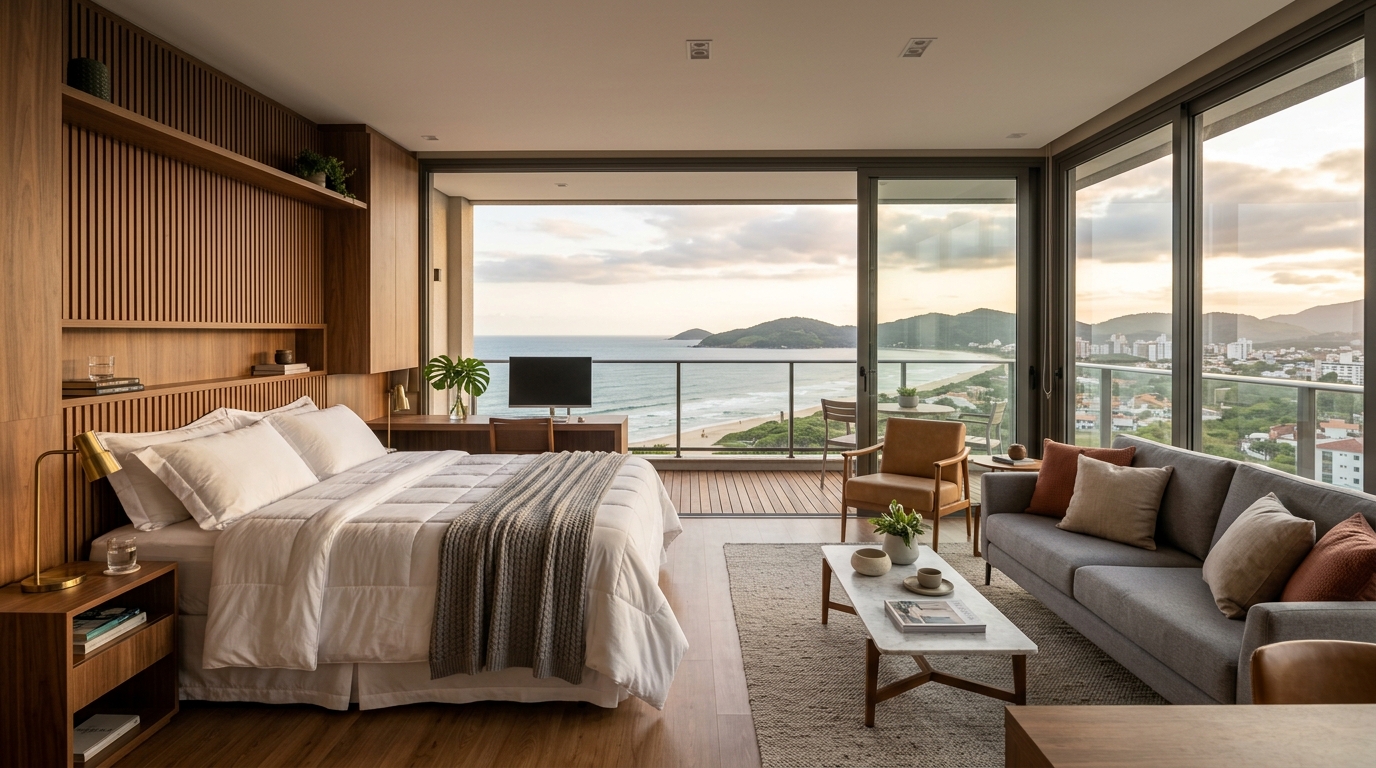
The investor signs the R$650,000 contract for a 35 m² studio on the Itajaí seafront, wires the 30% down payment, and breathes a sigh of relief. He rarely looks at the next line: the R$28,000 in furniture, the R$5,000 in linens, and the contingency reserve that the first booking season will demand. In compact units aimed at short-term rental, this "invisible" capital represents between 15% and 25% of the property's total cash outlay — and it is precisely the slice of the spreadsheet that most erodes the cap rate when underestimated.
The confusion has a clear origin. The VGV (Valor Geral de Vendas, the developer's gross sales value) published by builders and the reports from Secovi-SC, FipeZap, and ABRAINC — the three benchmark sources for Brazilian real-estate pricing — track the value of the unit, not the operational asset ready to generate a nightly rate. Between one and the other sits an additional CAPEX that has grown above inflation: the INCC, Brazil's construction cost index, reported a 7.1% twelve-month increase as of January 2026, and the retail indexes for appliances and bespoke joinery monitored by Brazilian industry associations posted between 6% and 11% over the same window. A foreign buyer who locked in a 2023 off-plan unit based on that year's furniture budget will be handed the keys in 2026 facing a 20% higher cost to make the unit rentable.
The Invisible CAPEX That Eats the Cap Rate of Short-Term Rental Investors
The first question a short-term rental investor should ask is not "what will it yield?" but "what does it cost to be ready to yield?". In studios between 30 and 45 m² destined for vacation rental — the dominant profile in Praia Brava, Atalaia, Cabeçudas, and the compact launches in Balneário Camboriú — furniture and linens account for a slice of total investment that typically ranges between 4% and 7% of the unit's sale price. It sounds small. It is not.
To grasp the real impact, this percentage must be translated into cap rate. Picture a R$650,000 studio generating R$45,000 in net annual income. Without considering furniture, the headline cap rate is 6.92%. Add the R$33,000 initial CAPEX in furniture and linens plus an R$8,000 reserve for first-year replacements, and the denominator climbs to R$691,000. The effective cap rate drops to 6.51%. The 41 basis-point gap looks marginal on a spreadsheet, but over a decade of operation it is equivalent to nearly a full year of positive cash flow.
There is also a rarely addressed point: furniture and linens depreciate faster than the building itself. The accounting useful life of custom joinery on the Brazilian coast is six to ten years because of salt air, and textiles require partial replacement every year. Ignoring this provision is what makes many investors puzzle, in the third year of operation, over the sudden drop in returns — they were not earning more before; they were consuming the asset.
What It Costs to Furnish a 30 to 45 m² Studio in 2026
The Santa Catarina bespoke furniture market currently operates within three reasonably well-defined tiers. Each serves a distinct ADR (average daily rate) positioning and a different guest-acquisition strategy. Moving up a tier does not automatically guarantee a higher nightly rate, but moving down a tier guarantees a low ceiling. The references below already include installation, freight within the Itajaí–Camboriú corridor, and Brazilian taxes.
For international readers, the figures sit in Brazilian reais (BRL). At the spot exchange rate at the time of writing, R$5 trades for roughly USD 1 and EUR 0.95, but the operationally relevant number is not the BRL/USD figure of the day — it is whether the BRL-denominated furniture cost grows faster than the BRL-denominated nightly rate. As we will show, it usually does, and that is where the cap rate erosion comes from.
| Tier | Total investment (BRL) | Target guest profile | Expected high-season ADR | Estimated useful life |
|---|---|---|---|---|
| Economy | R$ 12,000 to R$ 18,000 | Young families, groups, short stays | R$ 280 to R$ 420 | 4 to 6 years |
| Mid-tier | R$ 20,000 to R$ 35,000 | Couples 30–45, digital nomads | R$ 420 to R$ 680 | 6 to 8 years |
| Premium (Itajaí / BC) | R$ 45,000 to R$ 80,000 | High-income couples, executives, long stays | R$ 680 to R$ 1,200 | 8 to 10 years |
The percentage composition of this budget repeats with little variation across the three tiers, which helps calibrate priorities. Bespoke joinery — wardrobe, TV panel, storage bed, integrated kitchen counter — concentrates between 35% and 45% of the total. White goods and cooking appliances account for another 15% to 20%. Sofa, bed, and mattress add up to about 15%. Decoration, accent lighting, and wall art come in at 10% to 15%, and kitchenware and table settings consume the final 8% to 10%.
These weights matter because they guide where to economize without compromising the operation. Cutting bespoke joinery in favor of off-the-shelf retail furniture appears to save 25% in the first year, but it usually requires full replacement within 36 months because of the Santa Catarina coast's humidity — which wipes out the saving and adds the logistical headache of refurbishing a unit already in service. By contrast, decoration and wall art tolerate a mid-tier solution well, provided the listing photography is professional.
Professional Linens: The Line Item Nobody Costs Correctly
While furniture is treated with at least some care by the investor, linens usually slip into the spreadsheet as a residual figure. It is an expensive mistake. Professional vacation operators, platforms such as Airbnb, Booking, and Vrbo, and the established property managers in Itajaí all work with minimum standards that — when missed — drag down search ranking and average ticket.
The practical rule consolidated by the region's property managers is simple. For each bed, three full sets of sheets — one in use, one in the wash, one in reserve. For each guest, four bath towels plus four hand towels. To this add waterproof mattress and pillow protectors (two units each), a duvet with reversible cover, kitchen sets (cloths, oven mitts, aprons), and table linen for the unit's maximum capacity. For a 35 m² studio with a double bed and a sofa bed, the upfront outlay runs between R$3,000 and R$9,000, depending on the chosen furniture tier.
"The investor who tosses R$1,500 of cheap linens into a premium studio is not economizing — he is sabotaging the very perception of value he paid the joinery bill to create. Bed linen is the item the guest literally touches."
The second recurring mistake is material choice. One-hundred percent cotton is the preferred fabric in São Paulo and Brasília, but on the humid Itajaí coast — where annual relative humidity averages 80% — it grows mildew between rentals and yellows after the first aggressive industrial wash. The region's professionals have migrated to 50/50 cotton-polyester blends or high-gsm microfiber, which dry in half the time, withstand commercial laundry cycles, and hold white through more seasons.
The third factor is replacement. Operators running year-round with 55% to 70% occupancy must budget annual replacement of 25% to 40% of the linen inventory — towels lose their pile, sheets fade or tear, pillowcases pick up makeup stains that will not come out. This means that, against the R$5,000 initial outlay of a mid-tier linen package, it is prudent to provision R$1,250 to R$2,000 per year purely to maintain the standard photographed in the listing.
The Full Sum: A 35 m² Studio on the Itajaí Seafront
Bringing it all into a working example, consider the most common scenario in today's Itajaí seafront launches: a 35 m² studio bought for R$650,000 in a development scheduled for handover in the second half of 2026. On top of the VGV, the investor adds R$28,000 in mid-tier furniture, R$5,000 in professional linens, and an initial R$8,000 reserve for unforeseen replacement and post-handover adjustments (final measurements that do not fit, drawers that need to be remade, appliances that arrive non-compliant).
Total operational investment therefore rises to R$691,000. Assuming realistic occupancy between 55% and 70% — the level reported in quarterly figures from Praia Brava and Atalaia property managers for the 2024–2025 season — and median ADR of R$480 outside the December–March peak with peaks of R$850 in high season, gross annual revenue lands between R$78,000 and R$102,000. After deducting management fees (15% to 22%), platform commissions (3% to 5%), cleaning, condo fees, IPTU (Brazil's annual municipal property tax), and electricity, net revenue falls to the R$42,000 to R$58,000 range per year.
The cap rate impact is direct and measurable. Without the additional R$41,000 CAPEX, the R$650,000 asset delivers a cap rate between 6.5% and 8.9%. Once the CAPEX is included, the effective cap rate adjusts to between 6.1% and 8.4%. The drop is roughly 50 basis points — equivalent, in financial-market terms, to nearly half the spread between Brazil's CDI interbank rate and current IPCA inflation. It is not a residual line item.
The specific payback period for furniture and linens — the time until the additional R$33,000 outlay pays for itself purely through the nightly-rate premium of a furnished unit over an unfurnished one — runs between 14 and 22 months at the mid-tier level. The reference point is straightforward: an unfurnished studio in the same area cannot operate in the short-term market and would have to migrate to conventional long-term lease, where annual net revenue would fall to the R$22,000 to R$28,000 range. It is precisely this revenue delta that finances the furniture — and it is why cutting costs here is usually false economy.
The Five Mistakes That Destroy Furnished-Studio ROI
The first mistake, and the most common among first-time investors, is fitting out the unit at mass retail. Department stores offer attractive pricing for the urban end consumer, but they work with standardized pieces in dimensions that rarely optimize a 35 m² compact. The result is 8% to 12% of usable floor area wasted and an aesthetic that fails to differentiate the listing in the platforms' ranking algorithms — exactly the opposite of what is sought when paying a premium for the seafront.
The second mistake is failing to provision replacement. Investors who treat furniture and linens as a one-time capital expense watch the third-year cash flow collapse when they need to swap mattress, sofa, or half the linen inventory simultaneously. The provisioning rule recommended by accountants specializing in short-term rental sits around 4% to 6% of gross annual revenue earmarked for a replacement fund.
The third mistake is neglecting listing photography curation. Studios in the same price range, on the same Itajaí street, with identical furniture, can vary by 25% in annual revenue purely as a function of the photos. Spending R$40,000 on sophisticated furniture and R$600 on amateur photography is, in practice, throwing away 15% of the possible nightly rate. Regional property managers charge between R$1,500 and R$3,500 for a professional shoot with daytime and evening lighting — a single payment that recovers itself in a single high season.
The fourth mistake is operating without a formal inventory with the property manager. When the investor hands over the studio without a signed checklist including photos, appliance serial numbers, and condition described item by item, any loss during the season turns into a subjective dispute. Formal inventory is not bureaucracy: it is the instrument that ensures the contingency reserve does not become a write-off for damage that cannot be pinned on a specific guest.
The fifth mistake is confusing professional bespoke joinery with neighborhood-carpenter work. Professional short-term-rental joinery uses marine-grade MDF, anti-corrosion hardware, sealed backs against humidity, and supervised installation by an architect who understands intensive-use regimes. The same kitchen cabinet that lasts 12 years in a residential apartment lasts 4 years when opened and closed by 280 guests a year — and the difference is absorbed by the unaware investor.
What Separates the Professional from the Amateur in Brazil's Short-Term Rental Market
Santa Catarina's northern coast short-term rental market matured enough during 2025 and the start of 2026 to leave amateur territory behind. Data consolidated by property managers in Praia Brava, Atalaia, and Balneário Camboriú show growing revenue concentration in units operating at hotel-grade standards — professional cleaning, restocked linens, seasonal photography, 24-hour service. Anyone entering with a furnished-residential-lease mindset simply does not compete in the same nightly-rate bracket.
The reflex of this maturity shows up in the launches from the region's most serious developers. Projects such as those delivered by SIDE Empreendimentos in Itajaí already reach the market with floor plans engineered for short-term rental operation — plumbing for industrial laundry equipment in the building's common areas, dedicated support zones for housekeeping, lobbies that accommodate check-in, shared laundry rooms that reduce individual washing-machine outlay. Buying well at the development stage is the first filter; furnishing well is the second. Skipping either tends to cost more than it appears to save.
Why This Matters for the International Buyer
For the foreign investor evaluating a Brazilian coastal entry, the furniture-and-linen line is not a minor footnote — it is the bridge between a contractual asset and an income-producing one. The Brazilian real estate market reports nominal returns that, on paper, look attractive against developed-market yields. The catch is that those returns are typically published gross of operational CAPEX. The same gap that local investors learn about the hard way translates, for a foreign buyer, into the difference between a thesis that survives the second year and one that does not.
Two practical implications follow. First, the BRL-denominated revenue is what services the BRL-denominated operational costs, so the foreign buyer should not over-index on a single exchange-rate snapshot when modeling returns — the relevant comparison is between local inflation indexes (INCC for construction-linked costs, IPCA for general inflation) and the trajectory of nightly rates in the specific micro-market. Second, the choice to work with a developer that delivers projects engineered for the short-term rental operation — rather than retrofitting a standard residential floor plan — meaningfully lowers the operational CAPEX and shortens the payback window. That, more than the headline yield, is what separates an institutional-quality entry from a vanity purchase.
Conclusion
Investing in a short-term rental studio in Itajaí, Praia Brava, or Balneário Camboriú in 2026 has stopped being purely a real estate decision — it has become an asset-operations decision. The spreadsheet that only considers the sale price and the expected nightly rate is incomplete before it is even filled in. Furniture, linens, and contingency reserve are not loose ends at the end of the process; they are the 4% to 7% of investment that decides whether the published cap rate becomes the realized cap rate.
The investor who understands this math plans the full CAPEX from contract signature, chooses a furniture tier coherent with the property's positioning, and provisions replacement as a recurring line item. To follow weekly analysis of cap rate, occupancy, and short-term rental trends on the northern Santa Catarina coast, subscribe to the SIDE real estate intelligence bulletin — the Thursday edition consolidates data from Secovi-SC, ABRAINC, and the region's leading property managers in a direct format, written for those who operate the asset rather than merely buy it.